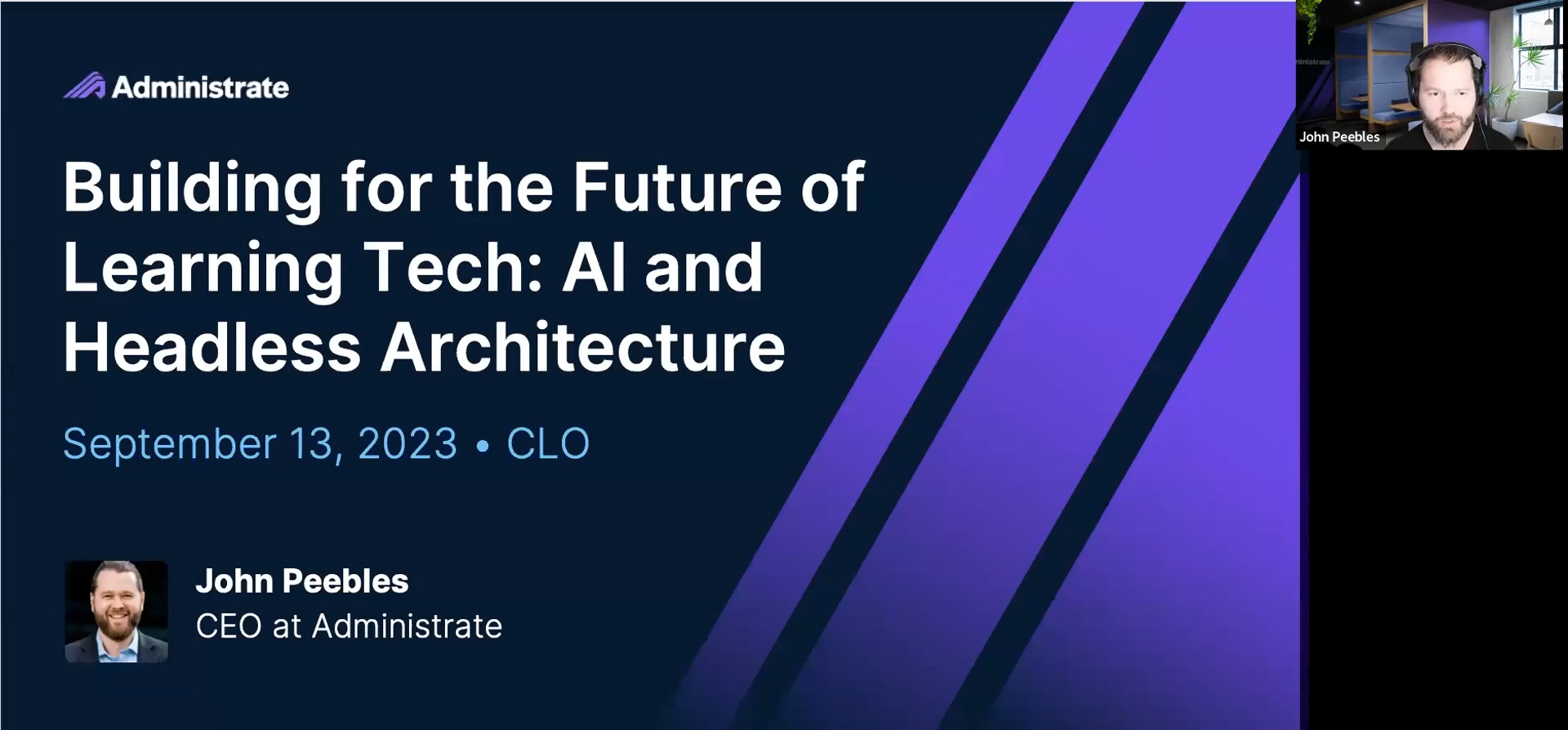
This is a webinar we did with Chief Learning Officer that explains why building the foundation, or infrastructure, for AI is a cornerstone of Administrate’s AI strategy. What better way to explain this than with elevator shafts. John Peebles, Administrate CEO, uses the story of 19th century industrialist Peter Cooper (who famously built elevator shafts before there were elevators) to underscore the importance of infrastructure.
This relates to Administrate's AI strategy, because building the foundation for AI, which is rapidly changing (and changed dramatically since this webinar was recorded) allows future AI tools we aren’t even imagining today to be rapidly deployed.
The webinar reveals Ping Identity’s (formerly ForgeRock) Project Ferrari: which used Administrate’s best-in-class API as infrastructure to build custom apps, business processes, and solutions.
49:39 watch · 9,135-word transcript
Auto-generated transcript — may contain errors. Tap a timestamp to
jump the video.
Good morning. Good afternoon and welcome to today's Chief Learning Officer Webinar sponsored by Administrate Hope. Everyone's having a great start to their week so far and excited as I am for today's webcast building for the future of learning Tech, A.I. and Headless Architecture. My name is Steve and as always, I'll be working in the background here to help answer any general or technical questions you may have. Before we get started, though, I want to go over a few housekeeping items first, all audio will be streamed through speakers or headphones, so please adjust your volume there accordingly. Be any questions today or experiencing technical issues throughout this webcast. Go ahead and click on the Q&A button at the bottom of your screen. If you have a technical question, the answer will appear here. Any content related questions for our speaker today will be read at the end of time allows.
Don't forget, you can chat with your fellow attendees by joining the live attendee chat and finally you will receive a link to the recording of this webinar along with the certification course for this webcast in a follow up email. So please allow at least 24 hours after the conclusion of the event before this information is sent. We also have a couple of resources provided to you by administrators. We will also be adding that into the follow up email and you should be able to download some of those throughout today's presentation. Now, at this time, I'd like to go ahead and introduce our speaker for today's webinar. We have John Peebles, CEO of Administrate, and I'm going to pass things over to John to get us started. So John, take it away. When ready. All right. Thank you very much. Just going to start sharing my screen here, and I'm really excited to be speaking to everybody today.
I am actually broadcasting from our headquarters here in Scotland, in Edinburgh. So it is late in the day for me. But, you know, really kind of fun set of topics here that are intertwined that I want to cover today and hopefully will be able to learn together. And we can keep it informal as well. So if you got questions or comments or thoughts, feel free to post them in the chat. I'll try to respond as we go and then we'll have some time for questions at the end as well. And when you think about what are our goals today for this session, really want to understand what we believe is the biggest obstacle between training teams and effective AI tool implementation. Discuss how we can solve that problem using something called headless architecture and also illustrate why investing in infrastructure now will pay off not only for this AI boom that we're in the middle of, but over the next coming years and decades.
So those are our three goals today and takeaways. And like I said, if you have any questions, feel free to to reach out. And don't worry, Vivek, we can't hear you. So we know that families can get a little noisy and, you know, don't don't worry at all. You're muted. So before we start talking about the nitty gritty of AI in this headless architecture thing, I wanted to talk about this guy. This is Peter Cooper, who has one of the most fantastic beards I've ever seen and is a really, really fascinating guy. In fact, the team that helped research this and put this together, they do a great job for us here at Administrate. But they said, you know, don't nerd out too much on Peter Cooper because we know you think it's fascinating, but we've got limited time. We want to really focus things on on this topic.
And they're right. But also, we're going to learn a little bit about this guy who I'd never heard of until recently, but he was an industrialist, an investor, a philanthropist. He was basically live from the late 1700s to the late 1800s. And he did a lot of things throughout his career. He's described as a tinkerer, which is probably one of the best ways to describe all the varied things that he did. He was, for example, he was a coach makers apprentice, a cabinet maker, a hat maker, a brewer, a grocer. He had this scheme to string an endless chain across the Erie Canal to tow boats with it and make that more efficient than using horses that never got off the ground. He built up a glue factory and then was helped get the first transatlantic transatlantic telegraph cable built between the U.S.
and the UK. He was a property developer and he's also a prominent anti-slavery activist and was an advocate for Native Americans and getting them the respect and the the equal opportunity that they deserved. And so this guy was fascinating. He ran for president at one point. But one of the things that he invented that you may have heard of is this right here, which is Tom Thumb. Now, this is actually technically a replica of it, but this is the first steam locomotive in the United States invented by Peter Cooper while he was tinkering around. Very interesting guy. And then maybe something that's more close to home for all of us, which is this, which is Jell-O. He invented Jell-O. And his wife came up with the name Jell-O. And it's just amazing what people get up to when they've got spare time.
But he also did something that he was really proud of that lasts until this day, which is this building over here on the right. This is a building, New York City. It's actually a very famous building in and of itself. What Peter Cooper did is he wanted to establish a university that would take in folks that couldn't afford it. Maybe they had racial or ethnic backgrounds that were not accepted in universities of the day. And he wanted to provide these people an opportunity. And up until very recently, you could attend this university, which is very well respected, and you would do so tuition free because he endowed it with an endowment that lasted for hundreds of years. And really this building is unique architecturally. It's had something like almost every American president has delivered some sort of address at this building.
So a storied past in and of itself. But it's unusual in that this building had the world's first elevator shaft incorporated into its design, and the building was finished in 1853. But the interesting thing was the first elevator was not installed until 1857 anywhere in the world. And that is mind blowing on one level. But it's also kind of a clue as to how Peter Cooper ran his businesses and thought about the future. And that is he knew that the elevator was coming. He had seen kind of these ideas. He was confident that would be invented. He just didn't know quite when. And so what he wanted to do was in this building that he spent a decent sum of money on back in the day. He wanted to make sure that it was future proofed and that he had the architecture and infrastructure ready to go so that when the elevator finally did come on the market, this this building wouldn't need rework or expensive modifications and one could be installed and they'd be off to the races.
And what's interesting, the only thing he got wrong was he was convinced the elevator shafts would be round and not square like they normally are today. But he had plenty of space and the elevator got installed. And we love this idea because what is it that we can learn? Right? It's that Cooper didn't have to tear down anything or renovate or close the building or pause the university or anything like that. When the elevator was finally invented. And we want to discuss today how A.I. is like the elevator in our industry and in terms of tech and that headless architecture is that elevator shaft that we think you should be installing within your operations in your infrastructure today so that you can be prepared for worry free adoption with a flexible tech stack that's designed to last into the future.
All right. So but first, let's talk about some questions that we're hearing more and more of and we believe will keep hearing more and more of. And that is this, you know, why are we using AI to do this? This is probably a question that you have heard around a table, maybe even your dinner table with your family. I think we just had an all hands meeting here to administrate and somebody asked if they could training AI to replace me because I do all the public speaking within the company and for our own hands. And that got quite a number of laughs. But then I actually thought, well, you know, if we can replace myself with an AI and I don't have to do work and I can still get paid, that sounds pretty good. But this is a question, right? Why aren't we using AI to do this? We've heard this from lots of our customers. So what is our strategy around AI and so forth?
And actually we are probably an interesting company because our AI strategy is to completely ignore the application of AI and instead be that infrastructure that AI solutions and providers will plug into in order to consume and produce data and work. Right? In other words, administrate is very, very squarely focused on building the infrastructure that will that will allow and permit AI to be effective. And that's and that's why we're here today. And so, you know, more often than not, though, we get enamored with this idea of can we use A.I. to do this and how are we going to do that and so forth. But we got to remember that fundamentally, we are still operating within a paradigm of computer science that has been foundational ever since computer computers and computer science began.
And that is garbage in, garbage out. And so we'll talk about what this means, but effectively, it means if we don't have the data ready for AI to leverage, then we're not going to get a good result. If we have bad data that goes in or confusing data or unclear data or incomplete data, we're going to get bad, confusing or incomplete answers out from the AI, and that is going to be quite painful. And actually, one of the things that we have been basically counseling customers and partners to really pay attention to is make sure that whenever you're applying AI to your environment, make sure that it is high trust, you don't want weird answers coming out or hallucinations, as they're called, because nothing, just trust.
Destruction will happen. And then and then your users will will immediately be suspect. And that's a good way to go off the rails. And so the other lesson is AI doesn't operate in a vacuum. It's still within that paradigm of it needs data to operate on and to produce results. And really, if we don't have our tech stack and our data architecture and infrastructure set up in a way that will be ready for this, this is a pretty good example of what will happen when we try to plug in these various AI tools that are going to be coming down and maybe you're using today into existing infrastructures, and that is it's not going to work, it's not going to line up. In fact, there might be some breakage that happens and it's not going to be very pleasant.
And so really what we want to kind of challenge you and encourage you to think about is, is your tech stack, is your system, is your infrastructure, your for your own operation, for your training teams and so forth, ready to go to be to be leverage able by these AI tools. So pause real quick here for a quick poll. Has your organization started a conversation about how your tech stack will support AI tools? And we got four answers for you here, kind of on opposite ends of the spectrum. A We haven't really considered what I will mean for our tech stack. B We've started some early discussions on how to support AI tools. C We've been seriously discussing a strategy for I support or D we have a comprehensive plan in place for supporting eight tools.
So give me a minute to think about that. Has your organization started a conversation about how your tech stack will support AI tools? A We haven't really considered it. B We've started some early discussions. C We've been seriously discussing a strategy and D we have a comprehensive plan in place for supporting AI tools. So take a minute to think through that and then we'll see the results. Hopefully another 20 or 30 seconds here. All right. Last chance to put your answer in. Let's see the results. Okay. They're up on my screen right now, so it looks like about 30%.
We haven't really considered what I will mean for our tech stack. Half or nearly half have started some early discussions, about 20%. We've been seriously discussing the strategy and then less than 10%. We have a comprehensive plan in place. Okay. I would say that that is a mirror of what we have seen as we've gone out and discussed this with customers and prospects and partners and so forth. And so it's a pretty good representative of what we've seen out there in the market. And Robert's got a great question, which is when you say tech stack, is that our ELA mass or where is this polling from? Great, great question. So when we think about L.A. teams and L.A. operations and training and so forth, L.A. will certainly be a component of the tech stack, but it's all of the collection of different tech tools that you're using day to day to deliver training to your broader organization and stakeholders.
So it could be everything from Zoom or teams to in L.A. Mass to in L.A. to a content management system to maybe, you know, other pieces of tech, like even just single sign on that are in play. You want to make sure that that text act, that collection of products and tools is ready to go because we'll need data out of all of them to feed in to AI. And so what we'll do is it just full disclosure, I've got a computer science degree. It was a long time ago. In fact, my comp, my concentration was in I back when we referred to AI in terms of like expert systems and neural networks and so forth. Right. And we moved on a little bit. But the concepts remain the same even 20 years later. And so I just wanted to walk through an example of what might be required to get the data marshaled and in place to feed in data about your organization to a simple A.I.
chat bot that can answer the questions in your content for for L.A. So, well, let's let's make believe that we're building a chat bot that will operate on our own data because this is a question we get a lot from customers and think through what might be required. So we've probably all heard of Chat GPT, or at least in passing in chat, GPT just happens to be a subset of what is known as an alum or a large language model, right? These models have been trained on tens of millions and billions of pieces of written content all around the world, and they're really great in answering questions that they have access to the data for. However, one of the things that most customers of ours and most learning organizations are interested in is how can I get these chat bots, these alums, to answer questions based on my content or my data?
Right? So let's say you're some sort of training company that maybe trains flight attendants. You've got all this these materials and all this content and so forth, and you might want students to be able to use the chat bot to ask a question and get an answer or review something and so forth. And so the way that this works is you basically have to get all that content, whether it's storm or whether it's training content, like PDFs and so forth. Maybe it's videos, other materials that you might be handing out and so forth. And we need to go through and parse the data. So if it's a video, we want a transcript. Same thing with Storm. If you've got written content, we want to basically feed that into a parser and what we're going to do is we're going to break this stuff up into chunks.
Okay? So literally imagine a word document. It might be 20 pages long, some sort of technical flight manual or something. And we want to choose a chunk size that is large enough that we think will allow the large language model to provide an answer based off of but small enough so that we don't get too distracted or too vague in the answers. And really, one thing that we want to do, which isn't like super clear on this diagram, is we want these chunks to slightly overlap as well. So we want chunk one to kind of overlap with chunk two. In other words, it might take the first five sentences for chunk one and then I might take sentences 3 to 7 or 328 for chunk two. Right? So there's a little bit of overlap as we're going through and we're building out our chunks.
And then once we have a bunch of chunks and it will be lots and lots of chunks from lots of lots of different pieces of data and content and so forth, we then feed it in to a vector database and generate what's known as an embedding. And basically an embedding is kind of a vector in in space that says this piece of text is kind of this vector over here. And then when we go to search, what happens is we'll say, Hey, chat bot, I want you to provide an answer to this question, but I want you to first look at this chunk that we have found that matches the question to to provide the result. Right? And so then that's what happens. The alarm will read in that chunk and learn about the bit of you know, it will not learn but it'll it'll pass the bit of content that it sees and provide an answer that makes sense.
And so this is actually fairly straightforward. There's lots of blog posts out there. You can read about it, but getting this data chunked up and spliced up into the way that it's going to best serve the the chat bot is really, really important. And the bottom line is your data really, really matters in this operation. So having done some proof of concepts and some tests and so forth and played around this on personal, you know, who wouldn't want a little chat bot to answer, you know, based on emails and, you know, data that I've got on my hard drive and so forth, what I would have learned is what we already knew long, long time ago in computer science, which is the your data just really, really matters. And it not only matters that you have it, that you have access to it, but it matters that you can get and maintain access to it and transform it and clean it and massage it into a format that will provide good answers When fed through a large language model.
Okay, So if that's the bottom line and in fact, I would say this this marshaling of the data, this chunking of the data to then feed into a large language model is the most important thing. And there is no number two, really when it comes to leveraging a large language model AI on data that is yours. Okay? It really, really matters. And if you follow any of the literature, you'll you'll learn that, hey, it not only matters when it's kind of scanning over your data, but that's how they train these large language models and they need to make sure that the data that they're feeding in on the training is really well curated as well. So if that's what really, really matters, how do we get these tools, the data that they need? And we're talking about a chat bot today, but it could be anything, right?
It could be any sort of AI tool or process that needs access to data in order to answer questions, make decisions and so forth. And really what we're here to talk about today is this concept of headless architecture. And this is kind of a fancy sounding name. This is actually a paradigm that's been around for quite a while. It you know, it's been used for the last decade or two, and actually it got a lot of steam. The e-commerce and CMS content management markets, because, you know what? What they found is that actually in terms of e-commerce for your shop front and so forth, people and stores are really opinionated about what they want their shopping experience to be like, but all the back end operations are the same.
And and that's kind of what's interesting about this challenge is most of us don't. I mean, we care we care a lot about the operational and the back office stuff that has to happen in order to get learners moving through various classes and so forth. But all of that stuff pretty much operates the same. You know, the, the, the method of delivering classroom instruction from one company tends to not differ too much. But what we really care about is we really care about that end user learner experience, and we want that to be very, very tailored to us and to our brand and to how we think about learning within the context of our organization and so forth. And so really headless architecture is kind of the perfect marriage for that idea of we want a very, very flexible learning service area and learner experience.
But we also want to not have to build a bunch of stuff. We want to ride on top of a standardized back end process. And so that's what Headless Architecture is designed to do, is effectively or essentially we split things into a front end user experience that basically communicates with the headless back end, right? The head being the front end, the user interface that we all interact with. And when we're using a computer and the way that that is accessed through backend system is through an API, which is an application programing interface. Okay. And so what we mean is in training terms, what the learner sees and how they experience learning is really the front end and how the administrative back end, you know, maybe you're billing for your training, maybe you're, you know, doing all kinds of different administrative activities in the backend that is done within the backend and within a system like a ministry.
Okay. And so here's another Vivek saying that headless architecture has been on my head for the past seven years. So yeah, there's, there's so many puns and I've been forbidden to make jokes about this because it just evolves so quickly. So feel free to make your own jokes in the chat, but we've got limited time and we'll keep going. But what isn't Headless architecture That's something that's probably worth talking about as well. So this isn't a tool or a feature, right? It's not something where you have a product already and all of a sudden they just say, Hey, by the way, we've just added the feature Headless Architecture. That's not really what we're talking about and it's not a plug and play process. Instead, what it is, is it's a platform approach where you have an API.
First way of exposing the functions and the features of the platform and the data. And then what can happen is a user or a customer can come come through and they can concentrate on the pieces that they really care about, which is that front end learner user experience. But they don't have to build all the nonsense that goes on behind the scenes that would be better, better served by a platform. And so one of the things that has happened a lot over the last ten years that we've seen is many, many organizations have kind of built up this tech stack. And that's been, you know, to a large degree, maybe not integrated as well as they would like. But one thing that's really nice about headless architecture is you can swap out systems and you can have systems come in that fit the stage of organization that you're at.
And we'll kind of give some examples of that in just a few minutes. So you might be sitting here, you're like, Great, this sounds super technical and we're talking about I know we're talking about headless architecture. And you know, what is the point here? Well, we really believe that not only I, but we believe that decision support this broader context around AI is the future of business operations. And what I mean by that, the way that I tend to describe this is if you've ever seen Star Wars episode four, the first old one, as I've heard it described, right, you've got the bit where Luke is coming down and they're trying to blow up the Death Star and they're coming in with the X-Wing and basically the pilots have to hit this very small exhaust portal with the torpedo, and it's a very difficult thing at high speed.
And they got guns firing at them and all sorts of stuff. And so what happens is they they basically engage a computer right in the computer, comes down over their eye and it tells them how far they have to go before they hit the button to fire the torpedo. Okay. And this is what we kind of think about in terms of decision support. Basically, as more and more data is generated and we have access to it and so forth, we want basically to think about how can our computers and our software and our data help us make better decisions? Is there a way that we can get prompted and really have the computer riding along side with us in our mission to help us answer questions and get data and maybe even proactively say, Hey, by the way, it seems like this set of classes is always completely booked out for the first couple of months of the year.
Maybe we should think about running more of those classes, or maybe we should acquire more resources or things like that. And so if we think that that kind of decision support framework is the real big thrust here and that AI is an important part of that, we're going to need a technical architecture that can support this, this goal and these tools with data. And ultimately we want to look to optimize major business decisions and the day to day management. Okay. And so really what we mean here is we also want an opportunity to increase what we call the learning surface area. And this is basically something that that, you know, we talk about and we think about a lot, which is a lot of us are used to having our students basically log in to a computer somewhere.
They're sitting at a desk, and maybe if they're really advanced, they'll have something on the phone or tablet or whatnot. And that's all great and it works. And we've been using that. And maybe they'll go to class and we will log on to a computer there and a lab or whatnot. But actually we're kind of we want to think about how do we get learning to happen alongside work or maybe learning gets integrated, incorporated in the product of our customers and so forth. And so a couple of examples of this would be, you know, we've got a large nuclear research facility as a customer and security of that of that research facility is really important and it's important for a whole bunch of reasons, right? It's not only a national security thing, but it's also important to make sure for safety reasons that the people aren't entering the wrong areas of the building.
And so one of the projects that they are going to that they they're looking at in leveraging this headless architecture for is to integrate the door locks of their facility with the learning records that they hold. Therefore, if I, John Peebles, try to go in and badge into an area where my training has either expired or I haven't progressed enough on it will just say, sorry, you can't, you can't do that and you have no access and you need to go complete your training. And it's things like that where, okay, now all of a sudden the the power and importance of learning is put in front of the user that we get really excited about, and that's expanding this learning service area. And so really when we talk about what are the benefits of headless architecture, well, you get improved data access and management, right?
The data is not locked behind screens or export, so you have to manually do and so forth. You can basically get decision support that can help you and your organization along the journey. And you can also have a much more flexible tech stack that can incorporate multiple different products that require multiple different things and are suited for multiple different tasks. And ultimately this means that we can compose or customize this learner experience to be on the phone, on the computer, maybe on the door lock, right, or various different product kind of exposure areas that that might be very valuable. And so really it's just about providing flexibility and future proofing to folks that that are thinking about what, you know, what is the future hold what we don't know.
But we need to make sure that our building has an elevator shaft because we know that the elevator is coming at some point. And so I want to talk a little bit about an example of this to really kind of conquer this and more kind of, you know, tangible terms, because we've been talking a lot about tech and about APIs and so forth. What does this actually mean in practice? So this is a company called Forge Rock, who's been our customer for a long time, about seven or eight years. And they came to us when they had just raised their series A round. I think the company had maybe 30, 40 people, so not very large organization. Over the next seven or eight years. They were like a rocket ship and they grew really, really fast. They raised several hundred million dollars in funding. They went public.
They've become one of the leaders in the identity management space. So one of the big products that they that they provide is single sign on platform that is used by large enterprises. If you've ever processed a banking transaction in the UK, for example, all the authentication of that transaction went through forged products. They have a huge presence here in in the U.S. and they're just a great company and a great crew. And it's been a wonderful story and actually we have loads and loads of different examples of how they have leveraged a headless architecture to achieve a product or give a problem or solve a problem and in chief an outcome that would otherwise not be possible. But I'm going to talk about one of them. Their team over there is super, super aggressive in terms of integrating new tech and researching what can help the business.
And they've become one of the big growth engines for that company has been really, really fun to see. They've won a lot of awards and and this is one of them and, and that is they came to us about a year and a half ago and they said, look, we've got this problem right. They wanted to continue to grow. They wanted to continue to generate new leads for their sales team to retain customers that they already had. And they felt like one of the best ways and one of the best assets they had to do that was called Forge Rock University and specifically their backstage component, which includes classroom training that you can pay for, but it also includes a lot of free stuff that customers could go in and check out. And one of the challenges was that, like most learning management systems at Administrate, our student portal in our front end requires you to log in in order to see the full catalog.
You can, of course see the catalog, but if you want to start learning or something, you need to log in right with the username and password. And the team of four drunk said, Look like we don't we don't really want this. What we're going to do is we're going to chop up all of our content into bite sized pieces and these might be videos that are a minute long, 5 minutes long. They might be a chain of videos or learning path that's like 25 videos, all 3 to 5 minutes long. And they wanted basically folks to be able to search on Google, right? Not even on the Forge Rock website. Find content that meet that match their very specific search terms, go to the Forge Rock website, see the catalog and see the video. That might be 3 to 5 minutes and start playing it and start learning all while not authenticating at all.
And then they wanted it so that when a student would come back after doing this for three or four weeks, or maybe they got prompted halfway through, you know, video number 22 to log in that if they logged in, basically the learning that they had done while they were not logged in would be mnet up to their profile and it would be there and they would have a history of it. And so we sat down and talked to them. This is called project Ferrari and we sat down and talked to them and we said that is an incredible idea. In fact, I was annoyed that I hadn't thought about it myself. Right? It's just really, really good. Good for lead gen, good for discoverability helps customers and prospects alike. You know, just really, really sharp idea. And we said the reality is we're never going to do this right. We're never going to get there. Right. It's not our roadmap 18 months ago.
It's not our roadmap today. And sorry, but our products are not going to do this. We're not going to build this in. And before directing said, okay, that's fine. That's all we need to know. What we're going to do is we're going to leverage the headless architecture that administrate provides, and we've got a few engineers and we're going to build this ourselves. And so over the next two months, they did exactly that, and they built a presentation of the courses and the content that they had within administrate entirely access be our API as an administrate customer. By the way, you get access to the exact same API that our own engineers use to build our product. And so there's no differentiation there. So you can build incredible stuff. People have built, you know, iPhone and Android apps. They've built robust integrations with all kinds of e-commerce platforms and so forth.
And they've built, for example, in this case, a different front end to browse content and and then at the point of when the learner would go and sign up for an account or log in, we would knit the records together and they shipped this within two months. And it really was an incredible thing to see. They won awards for it. It became this huge piece of their strategy for growth, and it was something that we still don't have as part of our feature set in our platform. But it's because we have this this headless architecture exposed to customers. They can solve problems that aren't necessarily our top priority and do so in a very fast way. So now Kevin and the team at Forge Rock have a great UI that matches their branding.
They have this user journey that specifically matches how they wanted the user journey and experience to be, and they don't have to maintain or build all the stuff behind that. They just had to work on the user interface, hook it up, and in a couple of months later they were ready to go. And it's just a fantastic success and it's one of those things that we're really proud of, even though we didn't have a whole lot to do with it, we were proud of just a good example of when choosing the right infrastructure can really, really get you outsized outcomes. And it was great. So a couple of takeaways here and we'll kind of pause for some questions. But, you know, basically there's already an explosion of tools out there that are powered by AI in the R&D space, and this is just going to continue and continue and continue.
So, you know, we're going to continue to see more and more of these tools crop up all over the place. Some of them are really, really innovative. Some of them are going to be doing amazing things, but they all need one thing that is difficult for most training organizations and learning organizations to get, and that is access to data, access to data that not only is held by your alums, but might be held by your corporate CRM and so forth. And it's it's important to make sure that we're well, well positioned for this over the next 5 to 10 years. And then the second takeaway would be dreaming about our use cases in enterprise is fun, but we need to plan for how we're going to gather and process the data these tools require.
So, you know, we have spoken to a lot of folks that really have a clear vision of the end game that they want to achieve, but they're missing the middle part and the beginning part, which is how do we get everything into infrastructure that can support these tools and get those outcomes? And then third, headless architecture and flexible APIs. API based integrations are the solution to the problem of feeding AI powered tools, the data that they need. So hopefully you enjoyed the stories and learning a little bit about Peter Cooper and his beard. I know I did, but we if you want to keep learning, here's some resources that you can access and we'll be sending some out to you as an attendee. This is my email address is my real email address.
Feel free to email me and say hi. Connect with me on LinkedIn. And then there's a resource there where we talk about how to design for learning analytics. And a lot of the the, the thinking around that is exactly the same thing for AI and preparing for that. And, and so, yeah, I really appreciate the time today in talking through this and getting to geek out for a bit. And now we'll kind of pause for some questions and see see how, how you guys got on. So. Oh, I'm sorry. Yeah, we do have some questions coming in here. This first one reads, How long does it usually take to set all this? It's a great question and it's one that I'd be asking myself, and I think the answer is, look, it it'll always depend right at administrate.
What we try to to to see. What we want to see is we want to see customers getting serious value out of our platform within the first three months. You know, some larger customers are more complex that want to take a little bit longer than that. But, you know, within three months you should be able to get a platform in place and then really have a well sequenced series of projects you might want to tackle. And it's kind of like what we tend to say is the rule of thumb is the first year is getting up and running. You're getting massive value out of this infrastructure, but you're still hooking things up because those things need to be done in sequence. You know, sometimes you can do them in parallel as well, but it's just going after the various pieces of your tech stack that need to be integrated to get it all in one spot so you can analyze things and feed data to other programs and platforms that need them.
So I'd say a good rule of thumb is plan for at least a, you know, three to 3 to 4 months of getting up and running, then another kind of 8 to 12 to really get most of your tech stack integrated. And at that point, you're really, really well positioned. And one of the things that, you know, I didn't mention in the forums story is they they started out as a small company with us. And so, you know, they move from tools like SurveyMonkey, which you've probably all used and maybe even used in our personal lives, to then survey Gizmo, which was a much more enterprise focused tool to eventually Qualtrics Right. And that kind of transitioned through three different platforms, each one more and more enterprise as they became bigger and their needs changed was really straightforward. When you've got the infrastructure in place, it didn't require, you know, ripping out that elevator shaft or, you know, shutting the building down and knocking holes through floors because they'd invested in the right stuff early on.
Awesome. Thanks to John. This next question reads, What are some signs that our team is ready to consider a headless architecture? Yeah, I would say one of the things that you definitely will want is you'll need to have access to some sort of engineering resource. Now, that doesn't have to necessarily mean you have to have a couple of engineers on the team. But we have seen more and more that as over the last ten training teams, particularly those for larger multinational enterprises, are starting to have folks like data analysts and have engineers on the team and so forth. And so I think that access to the engineering resource is really, really important. And one of the most important things to do because somebody has got to hook this stuff up, it's not it's not necessarily dragging, drop or plug and play.
There are definitely things that business analysts and folks who aren't engineers can accomplish, but you need that access to the engineering resource. And then a second thing is you just need that vision of here's how we're going to get this infrastructure in place, hook up all the various tools that we that we use and and and manage and articulate what is the return on investment that you're expecting to see from that from that that that that change. So make sure I was all right. Here we have another one coming in. This one says, excuse me, are there any A.I. tools that you've seen for training that look like they're going to dominate? Yeah, that's a great question. In fact, I was talking about this with somebody just the other day, and and they were kind of like, what are your top ten AI tools?
And I was like, the problem with this answer is that my top ten or top five has changed based on kind of what seat I'm sitting in, whether it's me as a hobbyist doing something, me as the CEO of the company or whatnot. And even each month it seems to change, right? So the the innovation and the pace of change in this is really, really high. And stuff that I was using to, you know, generate cool phone screensavers and things like that, cool phone wallpapers. I've gone through about three or four different tools in the last three months. And so I guess my point would be if you got five people that really knew all these different tools, and I have to tell you, I thought it was difficult keeping up with 1200 different elements systems, trying to keep up with all these different A.I.
tools is going to be even more interesting and chaotic. And if we were to find five experts and put them in a room, they'd all come up with probably a different top five list. So I personally have spent less time evaluating that because one thing I can always count on our customers to do is bring great new tools and solutions to the forefront and tell us about them and and I pay less attention to that and we're more very focused on making sure we've got the infrastructure to support whatever the cool new new tool is. Ask John this next question says, Do you have any inputs or any inputs integrating with the the SAP platform we have? It's definitely going to rip the building down to implement something for us, I feel.
Yeah. So look, SAP, it's it's one of those platforms that everybody's got an opinion on it. We've got customers that get a ton of value out of it and have really implemented SAP well. But yeah, it sometimes can be a little bit intimidating thinking about an integration. They're one of the things that we often kind of really encourage customers to think about is try to integrate with the SAP or the CRM or the big business system that your organization is using to get those metrics out that are very, very important to the organization. So that you can you can marry them up with training records. Right. And one of the best examples of this was a customer of ours, Boston Whaler. They had their MRP system basically feeding into administrate and saying, here's where the design here's where the manufacturing defects were last week and the training team could actually marry those records up and say, hey, it was John out on the assembly line.
And, you know, he made a mistake and put the propeller on the wrong way. And the reason he did that is because he's two years out of certification for propeller installation. Right. And so then they would go and enroll me in training and away we would go. And that changed everything because then the learning team wasn't just this checkbox exercise. They became one of the most important tools and resources for the business, and it helped them expand and double that the size of that plant. And so for SAP, what I would really recommend is, you know, you don't have to start with full blown automation. A lot of times you can get some sort of daily or weekly file feed of data out of those systems and then ingest that into administrate. And it can be a nice way to start proving ROI.
And then once that happens, think about automating. And so we always talk about there's kind of this crawl, walk, run methodology around trying to get these these platforms integrated. And SAP can be can be difficult, but it's also been done numerous times by our customers. So there is hope. So it's a great questions. Come in. We have another one here that just popped in, so I'm trying to get some taste of AI as we move toward a future where it's everywhere. I was reluctant to get involved with Chat GPT when I came out, but I'm now just dipping my toes in the water. What can I do to try and catch up to the AI boom? I can help my company implement it when they catch up, end quote. Yeah, I mean, look, William, it's a it's a it's one of those feelings that unfortunately a lot of people are having right now, which is, you know, feel like I'm behind, but I don't really know what to do and I don't want my company to suffer and so forth.
So I think it's a totally valid feeling that a lot of people are sharing. But I would say that the single biggest piece of advice I could give to anyone and we're taking this as a as our own company, is build that technical infrastructure so that whatever it is that that your company and your organization decides needs to happen. With regards to AI, you can say, okay, that's fine. You can plug in to this tech stack that's ready to go. I'm I think going back to that garbage in, garbage out, that is the most important thing. If you can't get access to the data that is held within your training records about your learners, where they are in their journey, how they're performing in their job, and you can't get that easily.
It's going to mean that a lot of these air use cases will just be a nonstarter. And so really it's invest in that infrastructure early. Now, we know the elevator is coming. We just don't know exactly what size or style it will be. And we know we need that elevator shaft going back to that story. So build that now. And that's the most important thing. And by the way, you'll get of advantages along the way for for getting stuff automated. And in one platform it'll help you with analytics will help you with decision making and will help you with AI. So don't despair. Get another one here says, How do how do we keep the prior battery information of the company contained from getting out of the web via air?
Yeah, great, great question. And so basically the the answer to that is things that we have used as consumers like chat, GPD and so forth. Those are not going to be palatable to most enterprise security teams, right? Instead, what's going to happen is we'll need to leverage private models that have been trained on data that we understand and that are running on within within a company's infrastructure. And so I expect a couple of things to happen. I expect some organizations like Chat, GPT and Openai to consider just continue down this kind of B2C business to consumer route. They will they will sell to us, they will sell to my mom, they will sell to me, you know, as private citizens and we will use them and that'll be great.
But for organizations that want to keep a hold of their data and don't want it to be going out of their walls, there's going to need to be products that are specifically designed with the idea that, you know, this is for companies to run themselves. It's within their own security model and the data is not going anywhere already. There's plenty of opportunities to do this using open source models. I expect there to be numerous companies that will come out very shortly that will provide an enterprise grade secure air platform to build on top of. But again, you're still going to need your data in order to feed into it because those won't have access to the that you hold within your four walls. You'll have to provide it. Awesome.
Well, right now, looking like we don't have any of the questions left, John, is there maybe one final message or keynote you want to get out to the audience before we close out? Just that, you know, there's a lot to learn. I would check out these resources, ask questions, send us emails if you want. If things were unclear and you want clarification, let us know. We realize it's a lot to digest. We're talking about headless and architecture and technical concepts, and we're also talking about AI, which is still very new. So, you know, anything we can do to provide clarity, we're here to help. And if you want to talk about, you know, how to get that infrastructure in place and how to really future proof you, your organization from a learning and development perspective on what's to come, let us know. We'd love to talk to you about that.
Awesome part of me as my cats walking through the shop there. All right. Well, thank you, John. Unfortunately, that is going to be all the time that we have for today. Thank you for taking this time out of busy day to present this great and valuable information with us. The audience really enjoyed it, as did I. To the audience, thank you for joining in and thank you for continuing to support our chief loan officer webinars. And of course, last but not least, thank you to our good friends over at Administrative for sponsoring today's event. Be sure to register for our next webcast. This one taking place in about an hour from now titled Five Things You Need to Know before Purchasing a Coaching Platform. Once again happening at 2 p.m. Eastern 11 a.m. Pacific. This concludes sales webcast. Stay Safe. Everyone, have a great day.
AI is transforming training, but it is not the most important technology emerging in L&D. Explore how headless architectures are the engines that feed AI.
Artificial intelligence is a rapidly-emerging field, and it’s difficult to predict what the next few years might look like.
But to find success in the future, we need to start laying the groundwork today. Join Administrate in developing high-capacity software infrastructure for enterprise L&D.