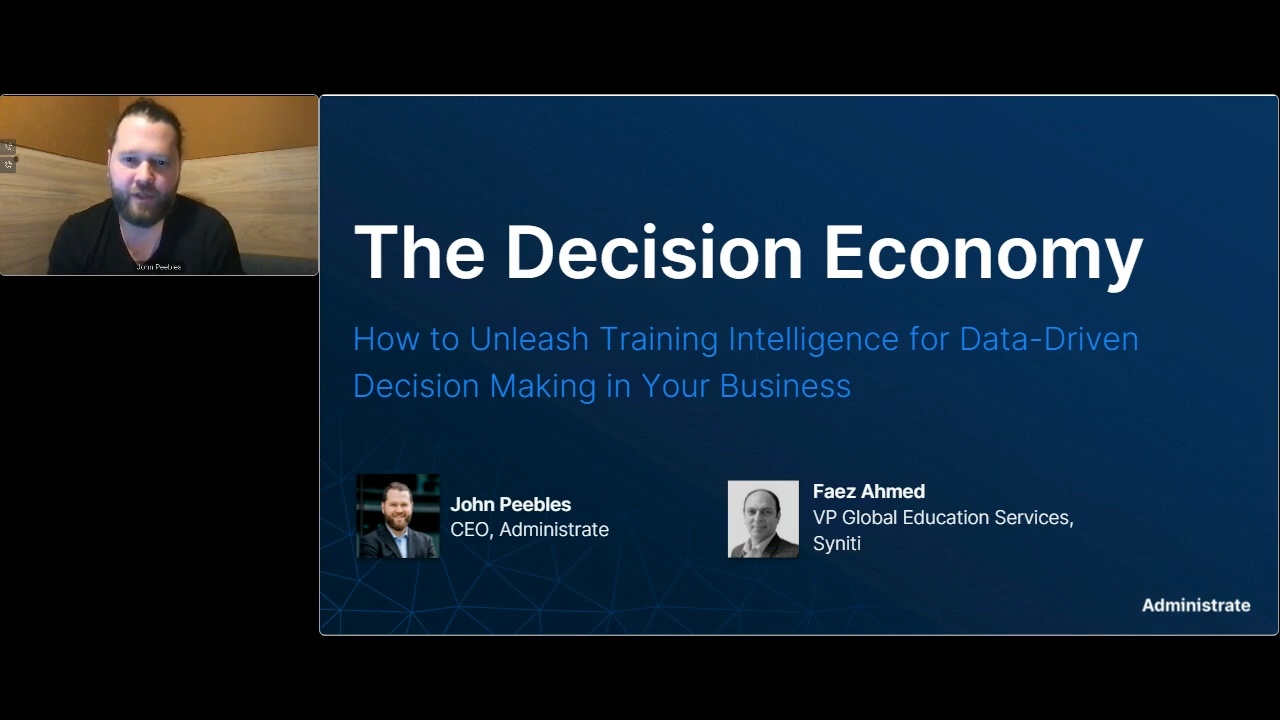
This is a webinar we did with Chief Learning Officer, in which John Peebles interviews Faez, VP of Education at Syniti and previously the first education hire at ServiceNow, about what has to be in place before a training team can make data-driven decisions.
They start with the foundations, which run in a specific order: the right people, then the infrastructure, then data literacy. Faez also describes how program design has shifted since the pandemic, with fundamentals self-paced online, advanced topics offered as virtual instructor-led, e-learning or guided learning with instructor checkpoints, and practical certification done in cheap on-demand lab environments so learners can apply what they learned months later at the speed of need.
The story worth waiting for comes from ServiceNow. Adding a single lack-of-training reason code to support ticket closures let the team show customers exactly what untrained staff were costing them, pushed targeted recommendations to people who had no idea the training existed, and brought ticket volumes down. Administrate has its own version: our university program halved customer support tickets and moved NPS by 30 points, which doubled the team's budget overnight. Faez is also pointed about companies leaning on AI to fill data-skills gaps while spending under $500 upskilling their own people.
56:08 watch · 8,447-word transcript
Auto-generated transcript — may contain errors. Tap a timestamp to
jump the video.
Good morning. Good afternoon and welcome to today's Chief Learning Officer Webinar sponsored by Administrate. I hope everyone's having a great start to their week and excited as I am for today's webcast: The Decision Economy, How to Unleash Training Intelligence for Data-Driven Decision Making in Your Business. My name is Steve and as always, I'll be working in the background here to help answer any general or technical questions you may have. Before we begin, though, I want to go over a few housekeeping items. First, there is no dial in number for attendees. All audio will be streamed through speakers or headphones. So please adjust your volume there accordingly. Now, at the bottom of your screen, you should see a variety of icons. You will have access to all these tools throughout today's session. So please feel free to customize your console however you would like.
Among these tools we have the attendee chat. Ask a question. Resources and certifications. If you have any questions or experience any technical issues throughout this webcast today, go ahead and click on that purple icon marked Q&A. Type that question the box provided and click submit. If you have a technical question, the answer will appear here. Any content related questions for our speakers today will be read at the end if time allows. The certification code for this webinar will appear in the certification box located to the right of your slides. Once you have met the required watch time, you can download today's webcast slides along with some additional resources provided to you by administration by clicking on the green icon labeled Resource list. And just real quick note, if you don't see anything in that resource section, go ahead and refresh your browser a couple of times.
We did just add some resources in there. So it does take a little bit for those to cycle in, but be sure to check those out before you finish those webinars. Don't forget, you can also chat with your fellow attendees by joining the live attendee chat, and finally you'll receive a link to the recording of this webinar in a follow up email. So please allow at least 24 hours after the conclusion of the event before the information is sent. Now, at this time, I'm going to go ahead and introduce our first speaker for today's webcast. We have John Peebles, CEO of Administrate and John is going to go ahead and get us started. So, John, take it away. Thanks a lot. And I'm really excited to be joining all of you. Normally, I'd be broadcasting from Scotland, which is where we're headquartered, but we also have a presence in Ireland, which is where I'm at today when a very tiny little phone booth that is soundproof.
But I'm hoping we can expand your minds beyond this tiny phone booth and into the world that I think is really fascinating about training in business intelligence and how they intersect. So I'm really, really pleased to welcome Faez to the group today. And we're going to be picking his brain pretty much the whole hour here. He's had an incredible career, done a lot of really relevant things. And I think he's just going to be fantastic. So, you know, like the gentleman said, just pop questions in the chat and we'll make this as interactive as possible and have some fun. So I guess maybe you could introduce yourself a little bit and tell us a little bit about your background and your current role and the company that you're you're currently with, which is really interesting.
And just give us some context and we'll kind of dive into talking about this important topic. Sure. Thanks, John. Appreciate it. Hi, everyone. I'm really pleased to be here as well. It's a fantastic opportunity to share knowledge and some experiences that I've had along the way with all of you. So very exciting to do. So I'm currently serving as Vice President of Education at Syniti. Prior to joining Syniti, which was about six months ago, for about 11 years I was with ServiceNow, so I was employee number one in the Education services field at ServiceNow at a really exciting time there.
Good 11 years of creating some amazing learning programs and so on. And prior to that, for about 15 years, I was with Hewlett-Packard again, both in the engineering department as well as in the Education services area. Awesome. And Faez we were talking about just before the call started, you've moved to like almost every city in the UK, it sounded like including many that I hadn't heard of. So you've had a lot of different life experiences and so on. One of the things that I always remember is I think it was a few years ago, the first time we met, it was at a conference and you're presenting what you managed to achieve at the service now with your team and at least for me, it's oftentimes you go to these presentations and larger companies tend to not have a great handle on things just in general, right?
Because there's bureaucracy or whatever. But you really had it all dialed in. And I remember there was a couple of other colleagues of mine at that presentation, and we all said, you know, this guy gets it and he's done a hell of a job. And that large in our in our brains is it's really it's really neat to now welcome you as a as a customer and and just somebody who's going to be trailblazing it again right, at your new role. Indeed. I just you know, just add to that that you know, one of the it wasn't about me. It was about the amazing team that we had. And essentially what we tried to do is cultivate, you know, an atmosphere of innovation and creativity. And that's what allowed us to open our minds and achieve all the successes that we had at ServiceNow.
And we're beginning to do the same thing. I've seen it as well, where we are allowing, you know, each individual team member to bring his or her best self and say, Hey, let's be creative. Let's see what the world is doing today with technology. How how is the world using data? Let's utilize what we have and not just rely on our instincts or past of what we've done. So a combination of instinct, creativity as well as data, in my opinion, achieves the best outcome. Yeah, so way maybe one thing we can do throughout the discussion today is kind of contrast the maybe it was a later stage and much more mature program and operation that you evolved that ServiceNow with maybe things are a little bit more embryonic or earlier stage with you with your new gig because I think that's always one of those things where sometimes sitting in the audience it can be difficult.
If so, he's got to figure it out, but somebody else is in the early stages too. You've definitely got the experience on both of those ends. I want to talk a little bit about this slide that we have up here, which is basically titled The Decision Economy. This is something that we have been thinking a lot about at Administrate and having talked with literally thousands of training leaders all over North America and Europe, you're thinking about it, too, right? You're out there, you're running the train operation. You're trying to get a workforce or a customer base or a partner network trained and up and running and and fulfilling the potential.
And it's really about, you know, what what are the what are the barriers to getting to that decision economy where we basically need to be able to make decisions, we need to be able to support the organization that we're with, and yet that can be somewhat difficult for us. And so what we want to talk about today, what are the what are the building blocks that every training organization or operations to have? And then how do we layer on top of that and get to the point where we can make really well-informed decisions? The example that we like to use in Administrate is what if your CEO came in today and said we need to achieve something? Maybe it's launched a new product, maybe it's we're acquiring a company, maybe it's we want to upskill the workforce.
And what would it take and what would you do or what do you need in order to achieve that? Sometimes that's an uncomfortable question for us, is training leaders because we don't necessarily have the framework in place to make those decisions or to support those decisions. So that's what we want to talk about today. But maybe we'll start a little bit on what are some of those building blocks, in your view, that you just have to have in order to get a training operation up and running? Great question. So there are you know, the first and foremost thing that you need is good people. You need people who, you know, have the right. They are aligned to your vision. They are on that journey with you. They believe in your leadership.
You know where you're taking the entire team, too. So it's a collective, you know, let's let's get this moving in the right direction, you know, whatever that is. It could be the launch of one course where you need your entire team to work with you. The example I used to give was, you know, a good manager would make sure that everyone gets over the fence, you know, and then there's that celebration and hurrah, you know, we we're all there. We jumped over that fence. A good leader makes sure it's the right fence that you've jumped over. Right. So along the way, you need you need data. You need to see what the world is doing. You know, the prime example of that, which is current, is COVID.
You no one was — unless, John, you tell me that you were aware that COVID was going to happen, you know, five years ago. Then I'll come visit you and get some, you know, some numbers for the lottery. But no one knew that was going to happen, right? So, you know, how do you prepare for something like that? You know, you have the right team, but then do you have the right strategy? Have you analyzed, you know, what the world out there is doing? It's not just about opening a book and saying, well, these are the steps that I need to create an education program with. It's about ensuring that, you know, you're not caught flat-footed. And a lot of, educational organizations, you know, schools, colleges, businesses, had to rush to provide online learning because of COVID.
And many had already online content to some extent, But, they had to accelerate that program, at that speed. And in that process, what inevitably happens is, you overlook what the learner experience is. So I think that's the starting point. What is the learner going to experience in this learning program? So whilst you know that that may have been a negative at the time of COVID, you know, moving everything to online, the positives that have come out of all of that have been that online offerings have increased substantially, and as long as you look at the feedback that you're getting from the learners, you can continue to evolve and improve, your strategy and your programs.
We very recently did a survey across all of our customers and all of our partners. And the interesting thing, not surprisingly, was that not a single one of them asked for face-to-face learning. So in designing, your education program you're looking at: what does the future hold in terms of learning? And given the the current climate that you have, if no one wants to participate in face-to-face learning, how are you going to evolve your learning program, through your curriculum team? So, you know what we will share with you what we have done.
We have moved all of our self-paced learning. It's all online, it's available. So all the fundamentals training is taking place online at the moment. You have an option to have that instructor level. But you know, a lot of organizations are used to covering the fundamental training via self-paced. The second area is, you know, what about your advanced topics? And here, you know, you have different options that we are looking at. One is obviously the virtual instructor-led training. There is the elearning as well. And there's also guided learning. So there are some organizations that say, hey, you know what, time is critical.
You know, our focus can go through this learning, but they need some checkpoints. So through the learning, maybe an hour a day or at certain points during the course and we have access to an instructor. So that's something that's new that we've introduced that wasn't there before. And then the last area which, you know, in terms of designing an education program is all about ensuring that the audience who have been through that learning program can actually not only retain it can can actually do that activity or apply that learning grade to what is what is required of their of their work. So this is where you see things like AI or metaverse or virtual reality and a lot of companies and there's a lot of talk in the education space about, you know, let's get all this in there running at the speed of need, as I call it.
And let's face it, that's how this current generation of learners, has been brought up. You know, if I wanted to change the engine oil in my car, you know, I can see countless videos on social media about it. There's no need for me to get formal training and get, you know, certification associated with that anymore. So the point is organizations are responding to the the needs of the learner. And I think it would be incompetent not to address those given the times that we live in. And many have done so, you know, and mixing all of these things together to ensure there is lifelong learning.
And with the technologies that I mentioned with the metaverse and, you know, all the other things, as long as they are useful in advancing the learning, that's great. You know, you are gradually introducing technology in rather than making wholesale changes to your learning approach and alienating so many learners. The key thing here, and I've always said this, is to use data feedback that you gather to continuously improve the learning approach, try it, use it, and see whether that improves the outcome. And if it does, then that's cool. Otherwise, you're, you know, creating a hole for yourself.
So you just touched on, I think, three really, really key things that I'd like to dig in a little deeper on, if you don't mind. The first is you're like, look cool, what happens? Or something happens. Some huge business change could happen. It doesn't have to be COVID. And all of a sudden the way that you're delivering training needs to change. Before COVID, as an example that I thought was really interesting, we had a customer that started to charge more for their vILT sessions right? Because it was a good deal for the customer. They don't have to fly and travel and go to a hotel and whatever, and so they actually got more revenue for that. I think that's a trend that will probably resume and continue. But basically you need infrastructure if you're going to be able to experiment and chop and change how you're delivering this training.
So that's kind of thing number one, that I think is really key that you mentioned. The second piece is looking at this data and getting the feedback and analyzing it and so forth. You know that that's easier probably said than done, and we'll probably want to dive in a little bit to the the learner journey to discuss some key points along the way. I think the third and last thing that I picked up on, which I think is really, really important, is finally getting the business outcome or the organizational outcome that you're really shooting for. And that's usually not training-related, right? My guess is that service now, your outcome that you really wanted was less customer churn and more customer software sales, right? Or something that very high level like that.
We tend to sometimes lose sight of that when when we're really focused on training operations. But it's kind of those three things need to all be moving together the infrastructure, the measurement and analysis, and then contrasting that is the business outcome. So yeah, I thought those are three really good points. Maybe you could just talk a little bit about how you see the challenges of, all right, you've got infrastructure maybe sorted out now, what do you do and how do you start engaging with the data and the feedback? What are some of the things that that you really think are important? Sure. Great question. You know, the plain and simple fact is that we we are all living in an age where data is the new gold.
It plays a highly significant role in everything that we do. You know, you want all this data, but it has to be meaningful. You have to be able to interpret it. You know, organizations are gathering more and more data than ever. And if you're a training leader, if you're not doing this, your marketing or your finance team will be right, whether it's for their own department of reasons. But ultimately, this will help you run your business and things like, you know, marketing. They're always telling me that, hey, you know, X number of people have hit your education website. If it's low, then it may be that your education site is hidden behind five other sites and you need a degree to access it.
So it could be something as simple as that. But, you know, you can use the infrastructure that you have in place to gather this data, to analyze what actually is going on. Why are people not accessing your website? Is it as simple as what I mentioned before, or is there something else that's going on and you see across, you know, different organizations? Like I'll give an example, you know, Amazon, you know, you, you purchase something and you're about to go through that purchase and up comes a section which says, Hey, other people who purchased this, you know, bought this as well. So are we doing that intelligently in our education program?
You're using technology to advise and make aware to the learner that, other people who've been through the same learning have also chosen to take this additional course or, you know, the next level of that course and so on and so forth. So it's it's pretty cool that those options are available and you can then you have a choice. Then you can make a decision just like we do on on Amazon. We can decide that, No, we don't need that. Thank you very much for showing me that. But no, I'm good with what I have. So as we, you know, continue to become more dependent on data, what we see is that our workforce is lacking that necessary, you know, data literacy skills.
And I think that's where we have the huge problem. You can solve the infrastructure issues, I'd like to say easily and, you know, we became a customer of yours and we're going to go through that process of getting onboarded. But, you know, I see that as a critical juncture in our timeline of an education services department where, you know, I do want the learner to have an experience that is second to none. I want them to go through the entire learning program. And, you know, with an infrastructure that you provide to Administrate, that tells me everything that I need to know across that journey. So for that, once that's critical, we also need people on my side who can interpret that data and give me options so that I can make decisions.
You know, the question always is that, you know, where where do you get these people? Do they have the right, you know, data literacy skills and can they help me in analyzing that data so that I can make those decisions? So that's that's a critical point in terms of people, you know, where do you get these these people from? And that's why you see a lot of organizations looking at alternative routes to employment. In my previous organization, you know, I worked very closely with Northeastern University to create a free degree course of the degree apprenticeship teams that allowed the workforce to spend, you know, one day in the week learning about data literacy.
Science analytics was carrying on their job. So you're not taking them away from, you know, employment. But at the same time, they are learning the necessary skills to be able to analyze the data like I mentioned earlier. So it's a responsibility that, you know, all employers are looking at, they're embracing, they have the resources, and there's no doubt if they continue to invest in them, they will reap the rewards. So, you know, we have to consider that quite carefully and with more insight into the workspace, companies are no longer looking for people with school knowledge that they were, you know, seven or eight years ago. But how can they use the data gathered from a platform and figure out what are relevant and present the information?
You know, in a visually simple and understandable way in order to help me make business decisions. If you send me a spreadsheet with thousands of data points that don't show me context or trend, you know, I could be making a decision that is wrong. I could interpret the data incorrectly, or, you know, I could not see what it is absolutely critical part of decision-making. And companies need more people with the ability, like I said, to grow those insights at the right time, an element of sort of soft skills are important there as well.
I was reading a few days ago that there was some research done that 50 to 60% of companies are relying on AI to fill these data skills gaps. Yet some of these companies are investing less than $500 was $500 less than $500 in enabling. There existed workforce. And, you know, I think that's criminal. You know, you have to invest in your own organization to help them analyze the data, give them those skills that help them analyze the data. One thing I'll, you know, surmise here is that data-driven decisions you know, usually improve business performance and investing in employees creates the loyalty and more engaged workforce and one that is then easy.
You know, you're easily retaining those same individuals. So in answer to your question, it's a combination of things, right? It's the people. It's the infrastructure that you put in place to enable you to gather that data that's meaningful, that you can measure. How do you interpret, interpreted, interpret that data, and then how do you apply that data using the people that are now energized to, you know, to to improve the experience of the. Yeah, I think I think that's great. And I've been kind of following along on the chat while you've been talking Faez and Krista makes a really, really good point saying it's easy to get smile sheets or say someone completed a course but much harder to get data that shows a change.
And so that's a perfect segway to kind of the next slide, which is this is this is your slide phase, So we'll have you introduce it and so forth. But I love this because a lot of time and attention in our industry is really just spent on that train bit, right? But that's not the full lifecycle that a learner or an organization goes through. And just to put a little bit of background to or an example to what you were talking about, about give me give me some decisions that I can make right based off of data that that makes sense. Yeah, we had this happen at our business at Administrate. We're a software company. We want to sell more software and we have a customer training program that we call Administrate University. And we invested in it and it gets up and running and the team did a great job and they came and they said: here's our metrics, right?
We had X hundred people go through in the first 90 days or whatever it was, and they had Y achievements that they earned and the satisfaction was 92% or whatever it was. And it's, like, great, you know, thumbs up. They're two thumbs up, right? And then a month went by and they reported the same stuff again and then another month went by and then the report changed. It said everyone who's been through the Administrate University program now submits half the number of support tickets and their net promoter score has gone up by 30 points. And it was like, right, at that minute, the very next day I doubled the budget for that team, right? Because it was actually tied to the core business metric and it was like, you know, we were celebrating and we were patting everybody on the back for a while, but then boom, you get that tied in to your core business metric, whatever it is, and it moves the needle really fast.
And I know you've had experience doing that throughout your career. So maybe take us through this slide and talk about where the various points of data and decisions and analytics would come into it. And I have to say those stick figures look like they're really enjoying themselves. So that must be some amazing training that you guys are putting out over at Syniti. Thanks. So that was so many points in there. And you know what I think was Katherine that mentioned or, you know, was it Katherine who put that question up? Or comment? Thanks for that. I mean I mean it is... this slide says everything that you need to know about building and running an educational program.
You know, you get so many people who would say so many organizations that say that we have a thousand people trained on this topic. You know, the question that I always ask is: how do they retain that knowledge? I mean, 15 minutes after, you know, John, you and I have finished here, how many people will retain what we talked about? You know, I think that retained all that you talked about. But how much will they change when I when I've been speaking about. Right So it's things like pictures, stories, the continuous learning that that is the critical aspect that you put together in a learning program. So you know if you look at this slide, getting people to climb up that mountain to get trained, whether, you know, like I mentioned earlier, it's using that self-paced learning and getting to that particular stage where they have understood the concepts.
The question is when are they going to use that training? It could be six months down the line. It could be three weeks down the line. How much of it have they retained? And it goes back also to my example that I used about, you know, finding out how to put engine oil in my car. We all do the same thing. We will Google it, will YouTube it, go on social media, you know what's going on? How does someone do this? So the trick is to try and incorporate what you do in your daily lives, into your business lives. And this concept of bringing in, you know, virtual reality or additional technologies to augment your learning is fantastic as long as it's done as part of a continuous education program.
So so what what we tried to do and I did that in my previous job at ServiceNow, I'm doing the same thing here at Syniti is to create your funding mentor programs that everyone has a basis. So it's like going to school, right? You've now got the fundamentals. You understand what the technology is all about, and then you start creating, you know, events or simulations or practical experiences, and you can use whatever you want. You could use, you know, any of you has to spin up an instance and, you know, have that simulation done in real-time. So, you know, you are essentially working on a production environment, but you are applying what you've learned in, you know, an on-the-job practical experience as and when required.
So one of the things that we have done is irrespective of whether you take a face-to-face or a virtual instructor-level learning or e-learning, you will have full access to all of the e-learning content at our labs. So the advantage of doing that is that if six months down the line you now want to, you know, do a particular task, you can just open up your e-learning, go to that particular task, spin up a lab environment with AWS, and so that's what we're we're going to be using here and it costs peanuts. It's literally you're talking of, you know, some you know, I think it's $0.03 per hour or something like that.
So it's something that enhances your ability to do that job at the speed of need. And by doing that, you're continuously evolving and, you know, advancing your knowledge and education because you're reinforcing what you learned in that sort of school, in your training. And this is how we continuously add bits and pieces of learning and build upon your already established, you know, certification, for example. So what we're doing here at Syniti is we're trying to introduce two levels of certification. One is your, you know, your standard question answer, you know, 60 questions, go and take that certification.
But we're trying to link that in with practical experience. You have the knowledge, can you apply it? So we're trying to create that lab environment that shows us that you as an individual can actually do the task that we've taught you. So, that's something that we're continuously trying to do. And, you know, one of the things that I think you mentioned earlier is, you know, how do you, in fact, you asked for that right at the beginning, and let me come round to that. The key thing that we as education leaders need to do is to align the learning all this that you can see on the slide with strategy using data.
How do you do that? You know, that that something that you know you're thinking about all the time that how do you align it? If you can create a link between the work that an employee does, whatever that is, you know, within the training environment, in Development, in Delivery, in Sales, if you can somehow create the link between the work that an employee does, relevant learning that progresses their careers and that that's important thing, relevant learning that progresses their careers and tie that in with organizational strategy. You've nailed it. And whatever you use along the way to get these three things done, you know, if that's making sure the right infrastructure is there, making sure you have the key data points along the way that, you know, the leadership can then interpret that, you know, a section of the employees have not done this or achieved that.
You have that have a really good basis to use your data. You know, and I will start with perhaps the awareness of these learning opportunities. As most organizations we fail. We create some amazing content, but are our learners aware that we have done that? Are they aware that we've created this amazing content? It doesn't happen by adding a link to a LinkedIn learning... LinkedIn Learning on your LMS without internal marketing for all of your organization. It has to be purpose-driven from, from right of the top and all the way down to the individual through his or her, you know, management tiers.
So that's that's the key thing you've created the learning: is your organization aware? Secondly, do employees, believe in their employer when they say they're really interested in your career development? You know, that's a key thing. You know, if I believe that my manager and my company are interested in building my career, it makes a massive difference to me as an individual. So that's key. It's not just, you know, the CEO saying, I really believe in you and then doing nothing beyond that. And the last part of this, you know, triangle is simply following on from my second point is investing in your level one managers making sure they have the tools, they have the data that they can see that their staff, you know, are continuously learning and improving their career.
So it's all about that strategy, these three areas working hand-in-hand. And and, hey, you know, you can leverage all the data at your disposal to see who's learning, who is not, and use this to support the strategy. So it's a combination of all of this. I'm not it's not one answer that if you have the right infrastructure, you're going to solve all the problems. It's bringing all of this thing together, armed with the data analytics that you can then create meaningful decisions that impact your entire ecosystem. Yeah, I think I couldn't agree more around your point that relating the training and the efficacy of the training to the job performance is probably the most transformative thing that you can achieve as a leader in the learning environment.
And I love the point you make about going the team member or the employee, why it's going to be good for them because it's this thing, right? If the employee sees that the training team is really focused on making me better at my job, that's transformative, right? Because all of a sudden now you're going to get better quality feedback. You'll know that the training team is measuring the right things instead of just checking boxes... and then I want to do more learning because I should see the needle move and that that's good for me because I'll get a raise, or I'll get a performance bonus, or whatever it is. That is where we've seen a real transformation with with folks out in the industry and I think there's kind of two corollaries to that that we tend to that we tend to see, which is one of the key factors is this cycle of analysis.
When we do training and we're transferring and then we're sustaining in the slide the cycle of being able to get data and analysis back needs to be in minutes or an hour, right? It can't be in days, weeks, months, quarters, which a lot of times it tends to be. So I think speed is really important in terms of accessing the data. And the reason for that is not just because I love speed, although I do say that instant gratification is too slow, but it's more about you're going to you're going to look at your data, and you're going to interrogate it, and you're going to get an answer back. And then you're to have immediately another question. And so you need this ability to interplay your team leaders, this ability to interplay.
So that's something we've seen that's really, really important. And the second hint that you're on the right track is we are told often by customers now that the training teams dataset is usually the second or third largest dataset within whatever company it is. And that initially years ago was a surprise to me, right? And I mean, this is what we do. We want we want to help learning leaders and so forth. But that's no longer a surprise. And I think that should actually be our goal. Right? The training team should have enormous amounts of data about partners and customers and so forth that it's putting to work and matching up against that job performance and matching up against company performance.
And that's kind of a hint that, you know, maybe you're on the right track. What do you think? That's also a great point and just picking up on, you know, dynamic data, you know, having access to that at your fingertips and how critical that is. You know, once I was at ServiceNow, one of the things that we we saw was the support tickets, you know, the red line going up and up and up and, you know, speaking to the you know, the support leadership, they were they were concerned about it, but they also knew the business was growing. So the reason why they were more, you know, P1 and P2 tickets was because, you know, there was the criticality of, you know: we need support here and we need it now.
The thing that was missing there was we haven't analyzed the data. Why was and you know, you have addressed the issue. You closed the support ticket and the support agent who closed it in their feedback we introduced a column there that said "lack of training". That's it. That's all we were interested in, "lack of training". And we were able to see this data in real-time. So we ensure that the customer was happy because we solve their problem immediately. But the cause of the P1 incident was not because, you know, what was being provided was not good enough.
It was because the individual was not educated enough to understand what the issue was. So we used that data to go back to the support organization and say, hey, if we can use this data to send to the organizations to say, hey, you know, next time, you know, time is money. So next time, if you have this issue, if you had been trained, you would have saved X number of hours. And that's like I said, that's money. So now you're talking of real business-critical decisions based on the data that we have essentially acquired from the system and then recommended to the customer that, hey, you know, here's some training that we think will benefit you.
You know, over 80% of those customers were not even aware that that training existed. So we were now going to the point where the need was. So we're not talking to some you know, someone in management was talking about, you know, how much is this going to cost me? When is the training? You're talking directly to the individual, you know, that, you know, is in need of that training. So I think that solved a lot of problems. And, you know, their red line dropped dramatically because of this access of data and providing, you know, essentially, you know, more sales to to to organizations.
So my number went up. The support organization was happy and more importantly, the customer was delighted. And we were then able to analyze that those same customers, you know, their number of tickets dropped dramatically after they had taken that training that was relevant to them. So, you know, you can put it all together and say, hey, look, we use data at the right time, the right place for those customers and solve a business critical problem. Yeah, I love that. Vanessa's got a great question that just came in that I think is relevant, basically saying: where would we suggest keeping all this data about employee needs and jobs and so forth to match it up against training?
I can tell you one place that I would suggest you not keep it, which is in Microsoft or Google Sheets, right? Because that's where, believe it or not, most companies in the world will keep this data or maybe even more tragically than even keeping it in the Microsoft Excel sheet because it's too difficult to extract if it takes too long to do that. I'm super biased here at Administrate, but we would suggest you saw it in infrastructure like Administrate, that's designed to basically interface with other systems and bring in the data that you need. There's some questions around what KPIs do we suggest tracking... we can talk about that a little bit. I think those will vary though, based on what industry you're in, what problems you're trying to solve and so forth.
You know, we have manufacturers that put a whole bunch of data about assembly line performance and errors and where they happen and when and so forth. And you've got software companies that are tracking things like user engagement with their software or for a whole bunch of different things. I think it's rare to find a leader that doesn't know what the important KPIs are. I think the challenge for us is it's often very difficult to grab that data, put it somewhere where it's accessible and then use it. So then if you have any thoughts about that Faez. Yeah, it's a great point. I'll actually add to that that, you know, when when I was making this decision, you know, I had a I had a choice.
So I either give it to you to look after that data for on our behalf and you have to go through some rigorous infosec, you know, through our IP team to ensure that, you know, under GDPR regulations, you know, how is that data held? Is it secure? You know, and all of that security questionnaire that you have to do? So from from my opinion, it was great that you filled in. You answered all the questions that i.t. You know, had concerns over, you know, whether it was in the U.S. or in India, like I mentioned. And that way I don't have to worry about it. I can just utilize the Administrate platform to extrapolate what I need and make decisions on the basis of that.
So that would be my add on that. You know, whoever you choose, you know, whether it's Administrate or someone else, they are looking after that data on your behalf. And you can then use that data to make decisions. Very cool. I'll just move to the next slide because we're kind of getting towards the end. We have a little time for Q&A. We've got a guide that we've put together that basically is drawing on best practices from leaders that we've had the privilege of working with all across the industry, a whole bunch of different settings and so forth. But it's a really, really powerful guide that will walk you through some step by step, practical things you can do to start building this culture of data-driven decision making.
So make sure you check that out. Maybe we'll just pop over here into the questions. We've had a lot of really good interactions, so thanks everybody for submitting your questions. Maybe we'll start off with one that I think is a great question and we'll be quick to clear up. Basically, Laurie's asking you to explain what the AWS environment is and just talk about, you know, what is that used for and why is it useful? Obviously, it's a software company that's selling software. This lab environment is really important. But maybe just walk us through how it works and what benefits you get out of it, because I think it's something that we have really, really help in, particularly software companies that are that are trying to train people in their products. Because exactly what you said, if you have them do the thing right after they've learned it, it's really, really powerful.
Did we lose him? He might be on mute right now. Currently. I'm sorry. I was well into my answer and apologies for that. So you didn't hear anything that I said? Let me start again. You can hear me now, right? We good? Yes, that's correct. I apologize for that. So. Well, it's a great question. And this is exactly the same scenario that I came across when I joined Syniti. So Syniti have, you know, data centers. You know, the servers are purpose built for our solution. So if you wanted to practice, whether it's a learning lab or you wanted a sandbox environment where you can play with, you know, our technology, you know, we have to give you a server ID, you have to then go through and we have to manage that whole process and shut that access down, you know, for whatever length of time we have given you that access for now, that works perfectly well.
But if you want to scale to thousands of people doing this, that's a huge burden on our IT Team. Someone has to allocate those server ID's to you. There is obviously the the fact that you're utilizing resources and and the larger the learner pool, the more time you have to allocate to make sure that those environments are ready, available, and utilized in the right way. And of course access-granted and taken away of the right time. So so that involves a lot of administrative work. So the reason why and I did this at at ServiceNow as well, and I'm just carrying on that same good practice here is the opportunity of working with AWS is that they can simulate your server environment at a fraction of the cost.
So and when I say fraction of the cost, I'm talking of everything. I'm talking about infrastructure, the need to support this entire operation as well. And it's essentially a click on click off. So you use the AWS environment when you need it, you click on it and that's when the meter starts as such. And like I mentioned earlier, I'm pretty sure it was something like $0.03 an hour. It may have changed, but, you know, let's say you use it for a week, the cost is going to be fairly insignificant and the cost to descend into we're passing that cost on. If it's a if it's a partner, it may come as part of the partner program.
If you're a customer, it could be embedded into your purchase as well. So there are various options that I am currently thinking of, but the opportunity to allow a learner on-demand to spin up your server instance as a simulation under us that costs are so low for me, it's a great opportunity to scale your learning and development organization. So that's what that's what we use. And we're in fact thinking of expanding that and using that also for low stakes too. So for our internal organization, let's say you have a task that needs to be done. Technical or non-technical.
It could be an H.R. task. You could simulate that task in that environment and have everyone in your organization go through that and have real-time data to show your CEO that, hey, you know, 3000 people have just completed this or 2000 people have completed this, and already 1500 have completed and 500 haven't even started. So you have real-time data that you can you can use to demonstrate the impact of your learning programs using something as simple as an enterprise environment. I can take this offline with you. There's so many different options. So you have my email address here.
Please connect with me either via LinkedIn or send me an email and I can take this offline with you and show you how we set this up at Syniti. Yeah, that's great Faez. I would just echo that whenever we see customers integrating simulations within their training programs, it's often really powerful and some of the stuff is wild. We've got a customer that loads up a helicopter, sets on fire, drops it into a pool. They have to escape the burning helicopter underwater. So it gets it gets pretty crazy. But you don't have to go to those lengths necessarily. You can maybe just spin up a server like Faez talking about. So I think we're getting to the point where we are out of time.
Both Faez and I have our email addresses up there. Those are real — we'll respond. We'd love to hear from you and get feedback from how you like the session and make sure you check out that guide that we were talking about. And hopefully this is useful and helpful for you. So yeah, Well, thanks so much. Thank you, Rachel. Thank you so much for inviting me and thank you everyone for spending this this Tuesday morning or afternoon, wherever you are with me and John today. Thank you. Thank you, Faez. Thank you, John. We really do appreciate you guys taking the time to present all this great information with us today. I do want to thank the audience as well for joining in and for continuing to support our Chief Learning Officer webinars.
And of course, thank you to our good friends over at Administrate for sponsoring today's event. Be sure to register for our next CLO webinar. This one taking place in about an hour titled: 12 Second Culture: How to Operate Like a NASCAR Pit Crew. Once again, that's happening in about an hour from now, 2 p.m. Eastern, 11 a.m. Pacific. This concludes today's webcast. Stay safe, everybody. Have a great day.
AI is transforming training, but it is not the most important technology emerging in L&D. Explore how headless architectures are the engines that feed AI.
Business intelligence is a key driver of success, turning abstract and contextless metrics into useful and actionable insights into operations and strategy. But to develop that business intelligence, companies need robust frameworks for gathering, managing, and reporting their data.
Join Administrate’s John Peebles in discussing the need for improvement – or get a demo of the Administrate platform today.