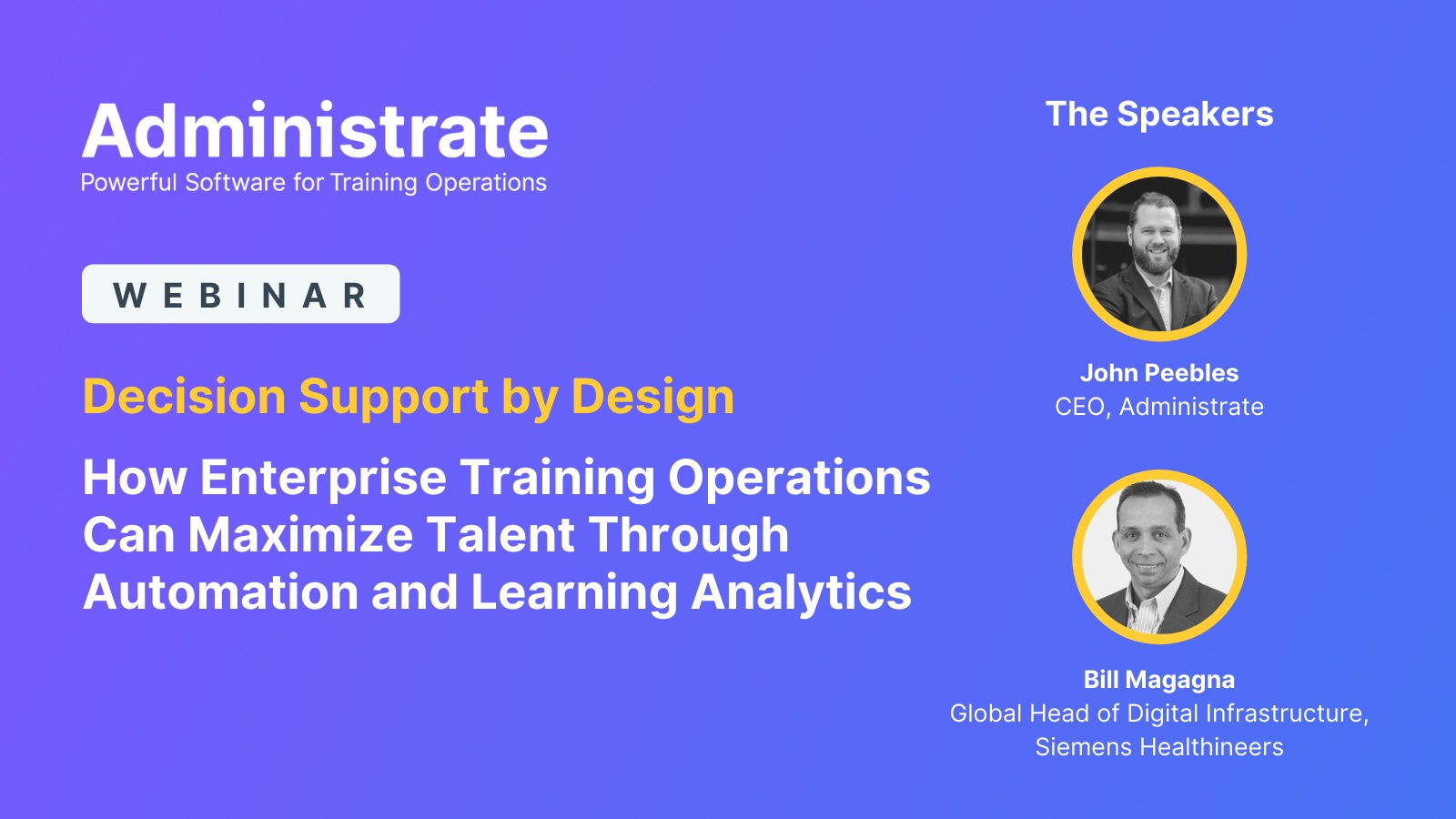
Hosted by Chief Learning Officer, John Peebles, CEO, Administrate, talks with Bill Magana, Global Head of Digital Infrastructure at Siemens Healthineers, about using data to decide where a training organization should invest.
Learn: how to deploy automation intelligently to meet strategic growth targets, understand how leading training teams are using data science to enable decision support at scale, and how rigid businesses rules and processes can form the foundation of data-driven decision making.
57:47 watch · 10,016-word transcript
Auto-generated transcript — may contain errors. Tap a timestamp to
jump the video.
Welcome to today's Chief Learning Officer webinar sponsored by Administrate. I hope everyone's having a great start to their week and as excited as I am for today's webcast, Decision Support by Design, How Enterprise Training Operations Can Maximize Talent Through Automation and Learning Analytics. Now, at this time, I would like to introduce our speakers for today's webcast, John Peebles, the CEO of Administrate, and Bill Magana, Global Head of Digital Infrastructure at Siemens Healthineers. And with that, John and Bill, take it away. All right. Thank you very much. And I think it's a real pleasure to be speaking to everybody today. I am located here in Edinburgh in Scotland, and Bill is dialing in from, his location in Pennsylvania.
But I think we're gathered to talk about a really important topic that is really relevant for all of us, in the learning industry, and that is business intelligence. And it's a big topic. We won't get through the whole thing, but hopefully you can, send us in questions and stuff as we go along. We'll be monitoring that. And I think maybe before we kind of really dive into the meat of that, it'd be just great to hear your background, Bill, and let us know, you know, how did you get into this role? What does your role involve? And, you know, interested to hear about that. Sure, sure. And just, a big thank you, John, for inviting me. And, my wife also sends her thanks because you managed to get me into a button down shirt today, which is which is not something that I get to do all the time anymore.
But big thank you also to the CLO organization for having me and certainly the CLO community. And it's been a while since I've been able to connect with with the folks there. And so hopefully today we'll get a chance to chat, have a good discussion and be able to all come away with something that had a little bit of value here for us. So a little bit about myself is that most certainly the only plan I had is I wanted to be in the field of education. It was my plan since I was very young. I was very fortunate while I was in my undergrad that I had an opportunity to interact with someone who was in the graduate program there at Penn State in this new field called instructional systems. And back then, thirty years ago or so, it was really at the dawn of the digital age.
This idea of CBT, this idea of digital type learning, it was really in its infancy. And so I was fortunate that I was able to see that from the very beginning in my entire career. I have put myself into the field of digital education, in particular global digital education, First enterprise level type softwares and then eventually a little over twenty years ago into med device. And I've been in med device and health care ever since, you know, growing and evolving and learning from our successes and our mistakes. But it has been an extremely rewarding career and one that, you know, because of recent events with the pandemic, obviously, one of one of the few upsides is that I really believe we'll see things in the next ten years in this field that I probably would have not seen.
So and data being and the data analytics and the power of what we can do for decisions are probably a key one. That's where I found myself today. Still very excited for what's to come. Yeah, so, you may or may not be able to hear, but feet outside of my window, there's a large project going on tearing up the street. And I'm told it's going to be amazing when it's all finished. But it kind of reminds me of maybe what some of us feel like sometimes in our own organizations, which is we've got these infrastructure projects that need to get underway. A lot of construction needs to happen. Things need to be torn up. Funding needs to be secured, all that type of stuff. But there's a goal down the line and that is to improve, you know, here in Edinburgh, they're putting a tram in, and it will improve transport for the city.
And I mean, we were talking about this a little bit just before we kind of came on here, Bill, but you talked about how important it is to have goals and have that clearly visualized. And then, you know, how do we map out a path towards that goal? Because it can be a journey. And I think we were talking about that a little bit too. It's just, you know, you've obviously had a very, meaningful career, but you've been on a journey, you've had these goals and how would you be sitting there? What are some of things that you would share with us today around goals involving data and what we're trying to do as educators? So it's interesting you mentioned that because the identification of goals and I mean, it could be as straightforward in an organization as, you know, say revenue growth.
But, you know, a disclaimer here, I'm obviously coming from an area as an educator and an area in the area of digital education. And so a lot of what I'm going to kind of refer to is going to be painted in that light. But I mean, goals can reside in things like your user interface, your operational excellence, your customer satisfaction or differentiation. You can have goals and cost avoidance and sales trends or learning that's actually been achieved and seeing that tangible results. So really understanding upfront where it is you want to be three, five years from now, and understanding what those goals are. You make the investments as part to get there. But as you're moving in that direction and evolving to those goals, what data are you getting that is either validating or questioning your strategy that you could pivot is really critical.
And the ability to be agile enough and to be able to work with those around you as you see things either lining up nicely or not lining up, where can we make changes? Really that data you're collecting, it's all about trying to be as predictive as you can rather than reactive as you can. And I'll just kind of stop there because I'm not sure where you want to go next with it, John, but I do have a second thought on that. I'm sure we'll come back. So I think that no, that's great because I mean, you just listed off a bunch of goals that maybe traditionally, an education team might have difficulty tracking against or, you know, because we've got our tools, they're very learner centric, but we are all working organizations that probably the primary purpose is not necessarily to train people.
It might be, you know, to build something or better medical device, whatever it And how do you make sure that you can weave in, and support the goals of the business, like you said, by picking up the right data points and what was your strategy there? Sure. I mean, like any other business, it's there for productivity. It's there for operational excellence revenue. I mean, from an education goal, it has always been on the horizon for me to move the digital education from that one to one relationship of that traditional push LMS into the next step, which would be a one to many, but then eventually a many to many. And what that meant is that that construct, the control of how people are in there accessing not only the content but affiliating themselves to each other and each other to the content.
And marrying that to a business goal, right, in terms of and how does the data support the presumption of us that, hey, if we could just turn over the control of this digital space to the learner, business goals will follow in a very positive way. So the data we initially gathered was in effect to build that digital community and to validate our path into a digital community. And I think that has been one of the most key components, but then marrying that back to business goals and what that means for the organization. That makes sense or not, but it certainly dive deeper into that. And it's kind of like the scientific method, right? So you have a hypothesis, which is, you know, we think we'll be able to achieve this goal by doing things this way.
Then you got to measure it. Then you got to see how your hypothesis is performing. And it's kind of this cycle, right? And you find out what went wrong or what went well, or usually it's probably a little of both. And then you double down on what went well and all that. Maybe just walk us through that cycle as you see it, as you're kind of, you know, going through that iterative process over years, the months that it requires on your journey? Sure. I mean, there's very basic data points in the area of a digital community, right? It's it centers around usage. It centers around affiliations, and I always look at it at four different levels, right? And I try to identify the four levels of usage and then four levels of response that we get back. And are you seeing that usage climb?
Are you seeing the return rate to your site? Or what are you looking at in terms of bounce rate? What are you looking in terms of customer feedback? What are you looking at in terms of access and time on-site, right? Consumption. And you start to put the pieces of the puzzle together and you start marrying it up against your UI, right? And you look at what is that experience like for that end learner? You know, ultimately they have a question and they come there, they need an answer, right? And what are we doing to facilitate that process in particular if we ourselves do not have that answer? But you need to look at all those data points and get a feel that, yes, things are moving in the right direction so we can make that next investment. We could take that next risk and we could begin to move to that many to many relationship because customers are embracing that. The learners are embracing that.
It's it when you start to see the stability of not just the performance of the site, but the brand of the site and the brand of the digital space in terms of what your community is doing on certainly that becomes very good. Yeah, this is cycle of decision support. You become more and more confident because you see that as it builds larger and larger, that community, you see where those cues are in the data that are pointing you to where it is you need to go. And also you see the cues where certainly things you need to change. And those can be the most difficult because they are very ingrained not only within what you are doing, but in what the business expects in what you're doing.
Yeah. So I mean, what you're talking about is things that maybe you had a strategy, but it's not resonating and you need to change that. And you know, we think about it sometimes in software, but this cone of uncertainty, And you're trying to diminish that cone and narrow it. And it's the same thing when you're evaluating how things are going with your programs, right? And where do we need to improve and where are we running to dead ends and things like that? Maybe you could just elaborate a little bit on kind of how you think about what's working versus what's not. Well, first of all, the thing about a digital community is that it is a very finicky. There's not a lot of loyalty out there right in the digital space.
And in terms of you have a few seconds in order to engage that person, especially in an area where they need an answer. And so your data points become very critical that you can monitor them in real time. There's also some challenges around that, in particular now with data privacy. And we'll probably talk about that a little bit later when you talk about cookies, when you talk about what it is you can and cannot collect and how you can target or not target, what you can and can't do, in terms of that, in terms of gathering data. But ultimately, it's been my experience that when things start to go south in an investment or in a decision you've made in your UI or in how people access or how they are authenticated or how they get administered within the site, you see that pretty quickly and it happens very rapidly.
Quickly And you will see immediately your site drop. You will immediately see your usage. You will immediately see that in your service and support tickets and what you've done. But it has to be in real time. It can't be something that's a quarterly review or something that's a yearly review. You have to be monitoring that twenty fourseven, in particular, if you are globally deployed, right? And that site is available in almost two hundred countries globally in multiple languages. You have to have a dedicated team and you've got to find the professionals, right, to set that up for you to begin with. You've got to work with those who have that expertise, who can listen to your goals and understand what it is you're trying to divine and what it is you're trying to report back on. And that was at times a very rocky journey for us early on because we were exploring new territory in this.
It was just a new area when in the area of learning digitally, in particular in the health care market and the device space. In the beginning, it was it was it was a difficult sell, not just for us, for our learner base. And that data has absolutely helped us make some decisions that have moved it forward and help us avoid some really serious pitfalls. Yeah, I like that a lot. I mean, you're kind of, is it threading the needle or is it trying to unite these two things, which sometimes seem like they're at odds? You've got, you know, this learner centric approach where you're like, you know, what do they need? How do we serve them really well? And then you've got this organization centric approach, which is the organization's got goals and maybe talk about, is there attention there?
Is there always attention there? Have you cracked that? There's I mean, for everyone, regardless of the market you're in, if you're an educator, right? If you're an educator and your goal is for people to learn, you will always learning is an ultimately an investment that that in turn supports overall a business. Right? And so there's it's funny you mentioned thread the needle or what was the other one? What was the other one? Thread the needle or is it like an attention was the other one? Yeah. I let me let me say you're you're under tension being pulled in different directions as you're trying to slide through that needle. How about that? And that's really what it's about. So my propensity was has always been that if if I can find in the data that people are learning and that people are loyal to the brand and people and our customers out there are going there on their own free will to ask a question, get an answer, and that digital community is growing, I always felt that the business would follow, but not the other way around.
Right? Not the other way around. And that has been a critical ethos for me, just not only professionally but personally, that if put that first, right, and we're able to master that and craft around that and grow that, then nothing good things can happen for us, our customers and for the patients. Patients. I really believe that. Yeah, I like that a lot. I mean, that's really almost our next slide here, which is empowering data driven decisions. So, you know, you focus on the right things for learners, you start getting some data, then it's time to, you know, make these bets or make these take these risks. And, you know, what are some approaches that you've seen that have been successful in the past to go to leadership and say, hey, we've got something that's working well here, but we're gonna need a tram line.
We're gonna need a we need to they're putting in these giant sewers outside of my outside of my apartment here. And I mean, I don't know really what they're used for, but they're a lot bigger than the ones that they're pulling out of the ground, right? So they're definitely investing and and you know, we we need to do that as businesses and and our and our leadership needs to hear that this needs to happen. What are some of the ways that you've articulated that?
Mean, for years and years, the discussion around education as an investment was always been about ROI, right? And sometimes you can make that case. Sometimes you cannot. I think more than often you can't because it's so yes or no. Really how I try to approach it is that we've got this data that we are growing at this exponential amount. You know, here are some facts that we have. Here is what it is showing us. Here are our twenty, thirty, eighty, one hundred thousand surveys. Here are the facts of what the behavior is in the digital space. Here's what the portfolio, here's what the outcome looks like. Here's what the level of people affiliating themselves to other people and those other people affiliating themselves to content, right?
If we can grow that continuum to that many to many relationship, to me it becomes a discussion around we need to get where the ball is going to be. All right. That ROI discussion, that next thing, incremental movement of making individual decisions rather than having a long term plan, you're always chasing that ball around the court, right? You're chasing after it. Where for me it was always about, you know, in our in our midterm plan for me is five to seven years. Where is that ball going to be? Where is the customer going to be? Where is the market going to be? And if we don't make those decisions now and make that investment now, then a year over year ROI based on what we're doing, it really becomes a moot discussion.
And so it's more it's more of a difficult and a more complex conversation to have. But without the data that you are gathering off of what is actually happening in the digital space, it would be next to impossible to have. Right? So that gives you the ammunition. The rest is around a vision, a mission, right? And how you are going to put together a strategy and then tactically execute on it. And then the discussion becomes more about who you want to be in five years and not what are we going to get for this X amount of dollars that you want to put this thing, this new innovation or this new feature out there. And that is a discussion that is not a one time discussion. It is a discussion that you will probably have multiple times and with the same people, right?
But you have to build that mindshare of, again, where you want to be and that data becomes predictive for you rather than reactive to the last investment that you made. So maybe just riffing off that because I really like that it is. You got to have multiple discussions, right? And maybe it's kind of that saying, you know, the person you're going to be in a year's time or the friends that you have in the books that you read. I don't know what the analog would be in this scenario, but maybe it's the data that you keep and the conversations you have, right? Or is the organization gonna be in in a year or two time? Because it's this process that's just got to constantly be going because every other piece of the business is doing that, right? Sales is doing that, marketing is doing that.
Why isn't learning and training doing that, within the business? You know, one of the things that I have an opportunity to do is that, I get a chance to work through a nonprofit that I sit on the board with that is dedicated to educators in life sciences is that we do we get a chance to do real peer reviewed research within the industry, right, where we actually gather copious amounts of data via survey, qualitative, quantitative data. And really what we see is when we had the opportunity, when you look ahead, right? Let's look back. Let's look back five years. Let's look back seven years. Think of where this market was seven years ago. Don't think about the technology. Think about the market maturity, right? And look at and I don't believe COVID has changed where we were going to end up.
It simply sped it up quite a bit, right? Quite a bit. And now look where we are today seven years later. All right. And if you see where the momentum is today and you look at where the data is in the market today when it comes to the digital knowledge economy and you go out another seven years, right, you realize there are going to be massive investments you will need to make in your people, your processes, your tools, time and your money in order to put yourself in a position to be a player and to be relevant there. Okay. And the data is out there. You just have to be able to grab it and be able to create a story and tell that story to people in the organization that are going to want to hear it and believe it. Right? And then the discussion is not about it's not about the money, it's about do you want to be relevant?
Because in this space, all right, this space, you can be irrelevant quite quickly if you're not going to be where it's going. And that's really the cautionary close for me is that this is not the traditional one to one relationship, what we've done in the field of education for med device the twenty years prior to COVID. This is a post COVID world where we're not going back to that. And for us to stay relevant, we need to make these investments. And that's where the data positions you. Yeah, so I mean, we've talked a lot about this next slide. Really outdid ourselves folks on, the slide. We had three whole slides, right?
But, the third the third slide was, you know, kind of some stuff that we've talked about Bill a lot, which is alright. There's been infrastructure investments, an entire ecosystem of stuff that has been built. There's a lot of data sloshing around in that thing. And, you know, I think a lot of people identify with this And then it's like, okay, how do you how do you get the data out? What are some things about reporting? And then like, what what where is the ball going to be over the next three to five years? What are some of the things that are kind of itching in your brain that you could share with the audience and just that you've been you've been thinking about? Sure. I mean, you know, when you look around how AI and is driving different data today, certainly when you're in the field of digital education, a lot of it begins to coalesce around search optimization.
A lot of it starts to optimize around affiliation of content to people through smart recommendation, right? It starts to coalesce around a smart recommendation of, you know, hey, Bill, you should connect with John because John knows this or you should connect with this group because that group is working on that. You know, very to me, you know, ten years ago, groundbreaking today, very rudimentary, but still extremely valuable, right? Because it's giving you very, very poignant cues on where your learner base, what they're accessing, what they're looking for, who they're connecting with. Very powerful stuff. But really, I think the paradox in the next three to five years really centers around, are we going to create a construct where that learner is really driving that experience with other learners?
Or is it an experience where they are being corralled right into a certain learning experience that they are not fully in control of? And I think that's one of the areas where either way it will become a game changer. And then that leads to that next level. Okay, once that happens, right, then where does it go? Where does new knowledge come from? Where do new affiliations come from? Who's really in control at that point? And I think that next level of AI is what's really going to be worked out in the education and the digital education field, I believe in the next three, five, certainly seven years. Yeah. And as that starts to happen, right? Because I think when we talk to people about these these problems a lot and some of the things that we're hearing, that are common themes are the idea of, well, first, we have a lot of content, then it's like, want to be a bit prescriptive, right?
Maybe you should do these things in this order. And that might be the second level of that game. And then the third is kind of what you're talking about, which is alright, well, now we start to predict maybe what you might be interested in, what you should be interested in, and you kind of have these emerging patterns that start to come out. And and that that starts to be very interesting. But in order to get there, you know, what are some of the what are some of the tool sets? You know, if you're if you're coming in as a consultant on, you know, big corp XYZ, Inc. Sure. Very, very imaginative name. You know, what are some of the things that you would look for or say or ask about? You know, what are we thinking about in these areas and just in terms of toolset and some of the things that people would have in their toolbox?
Yeah, first questions, I mean, obviously, you know, what again, what are your goals and what what is the current landscape today, right? Where is your analytics? Where's your, you know, what type of LRS or not LRS? What type of data lake are you forming? How are you identifying? Are you doing additional feeds that to other organizations within your group, within your company. But I would certainly look at how are you structuring your data flow today, right from both the administrative side and from obviously the user experience side. And also who are you working with? Who's your data architect? Do you really have in house expertise or do you need to go out and get experts in order to help set that up? But certainly understanding the current state rather than just, you know, you need to use this tool because this tool is what everybody's using out there.
This is the analytics tool everyone uses. This is the cognitive services everyone's using. This is the LRS that makes sense, the market leader. And this is how you structure a data lake. I don't think there's a prescriptive one off in how you go about doing that. Certainly because, you know, what what is it in the end you're going to want? And again, it goes back to this for me is is that do you want to measure your data and information you're getting, right? Do you want to measure it at that one to one level or do you want to measure that like Web four point type level where you're really getting in a contextual and tracking these xAPI statements and really understanding how people are communicating, where people are clicking, where people are searching, where they're going to and from your site, how they're coming in and going out.
Do you want to be able to really gather that? And then once you have it, what AI engine are you going to use and what are you going to get for prescriptive type recommendation on what you should be doing across your organization from operational excellence to your service and support and how you do your ticketing to how you do your incremental innovation and add to it, right? How are you or, you know, that's far beyond just, you know, what is it they want to learn on your site?
Yeah, and I mean that that's a that could be a lot of machinery and that could be very daunting, maybe for some of us are listening and and it's very impressive. That's for sure when you when you meet somebody that that's been working on this for a while, but it doesn't have to be necessarily this all or nothing thing, right? Because we talked about incremental, you know, rollout or improvement. And you know, I think think a lot about the idea that if you if you get the basics right and you get the concept, you build a culture around driving the organization forward with data. I think that you start to see this kind of virtuous cycle, right? Which is, okay, we brought data to make a decision. We said, look, we, you know, we see our user base growing or we see that this content is really resonating.
Let's do more of that. Once you once you then have the success, then it's almost like, you know, your team and the whole operation begins to learn as well, because now the next time they're gonna show up with even more data and so on. And maybe just talk a little bit about, do you think that culture of of using that and that fluency that you know, that that teams could strive for is important? And if so, how do you how do you instill that or how do you build on that? It's you mentioned the fluency, right? For example, it could be any e commerce engine, anything you're doing, you could be selling anything. But for some reason, right, certain things for whatever reason in your portfolio, customers are showing no interest in it, right?
So the data that you have today, the rudimentary data you have is that it cost us this much to somehow source this, get it, put it here. And yet learners out there or customers out there or purchasing organizations, whatever, right? They're just they're just not they're not buying it. They're just not buying it. And so the right that we have to be very careful that without contextual data, contextual data, why is it they're not buying it? Right? How do you know, is it and just the assumption is that, well, they just don't want it. There's so many pieces of data, right? In terms of that you could look at from your e commerce or from that digital site, just in the UI and the navigation alone. Perhaps maybe they don't even know it's there or for whatever reason, the way you've positioned it doesn't make sense in the flow in which that those tens of thousands of people coming to that site would naturally find it, right?
Or the way in which you have described it or in the way in which you have packaged it or the way in which you're recommending it in your smart recommendation is not hitting those audiences in order that would even be interested it. And I think the fluency of what to do with the data, and that's where these experts can really come in and help, is that you really have to be able to look at it holistically because you can make snap decisions around very basic things in what you're doing in that digital space that will have unintended consequences for the rest of your rest of your data set. But it's got to be more holistic, John, is what I'm saying. Yeah, and I think, you know, when you when you start rattling off, it could be one of these fifteen things, right? Each of those could be very burdensome if you don't have the setup ready to be able to easily query and extract that information, right?
And I think that's one of those, like, key litmus tests for us is is, you know, can you run a report, see what see what it's saying to you? That's gonna generate three more questions. Can you run three more reports off it? Can you have that cycle be down in the minutes, you know, or less? Because otherwise, those fifteen questions could take you a year to answer if you're kind of really having to spend a lot of effort and time to get that stuff. Well, and it also brings up another point, and this is something that obviously who gets access to that data and who makes the decision on the data, right? And as much as it is important for the data architect of the architecture upfront and how you do that, it's all about the transparency or the mobility and liquidity of that data to flow throughout the organization, but ultimately who's accountable for not only the data and the interpretation of it, but the decision that's made on it.
And that's an area that I think is as important, right? Because again, people will see people will tend to interpret what it is they may be preconceived to want to believe anyway, And they will look for the data that will support that. And so how do you create that neutral ground where that data then is handled by that group of people or person, whatever, where it really is something that is validated against any decision making that's going to happen. And that's an area I really don't have a good roadmap for when I look at what's going on out there and how those decisions and who gets access to that data and who actually owns that data. Yeah, mean, man, we just saw that in our organization just over the last few weeks where we had an initiative that we think is important.
We have data that we think supports that decision and that initiative. And the simple act of putting the data out in front of our company meant that we had a few people pop up and say, I think this data is wrong in these areas, right? It was like, okay, you know, let's fix it. Let's see. And I think sometimes, you know, the reaction, the initial reaction be like, oh my goodness, you know, we had wrong data. Well, everybody's got bad data in some way, shape, or form, right? But I think if we can get it out in front of teams like you're saying, bring the transparency, you know, then at that point, that's part of the process, which is okay, let's fix that area and rerun the model or whatever it is that we're doing.
And and now we've already improved the organization and and we've already made it a small improvement. But it it often takes many different eyeballs to kind of point out where there where there could be problems. And that that's a key piece of this, I think. Yeah, I think you just just tweak something for me and that certainly in early on and we still struggle with this today is that data has to be pruned from several sources and then it has to be combined. And it's been my experience that when that's done manually, even with the best intention, we struggle to get really strong true signal there, right?
Where what is most important in the future is an analytics engine that can collect those multiple data points and signals and do that for us. And I think I'm not we're not the only ones out there struggling with that, where we know we want this information, we can get it. I know I can get that information. I could get it and I can get that information. And then I try to piece together, right, that those three pieces to get a meaningful report. And we do that every month. And we I'm not I'm not fully confident in that we are able to pull together that data in a way that's going to be that true signal for us. And that's really where these analytics engines and these experts come in that can really help us to really drive to that true signal.
Yeah, absolutely. And so then as you kind of are honing in that true signal, you know, who needs to to hear about that? How do we how do we relate it to the rest of the organization? And I mean, I think I think sometimes, training or learning leaders, they're they're used to being maybe a bit downstream from business decision making, right? Because it's kind of like, oh, we're gonna do this new product or we're gonna do this new thing and training will just train. You know, how do you how do you shift that and and put learning teams and training teams on the forefront of these business decisions? I don't have a silver bullet there, but after having I think it's a matter again, it's an evolution of the ROI discussion for me and it's really trying to have a position at the table and that I think in the health care market, I can't speak to other markets, but in the healthcare market, the med device, think we have turned the corner in regard to the importance of both on the diagnostic and on the therapy side, how important education is to the success of us, our customers and the patients.
And that has helped position us, right? But still today, a lot of what is asked is to show data to that will predict what you want to invest in is going to be successful. And that's that's the wrong conversation to be having that in all of its on its own, because there has to be a visionary component to it where you can describe the market, right? You can describe the market, you can describe where the technology is going and have that discussion, the conversion of, you know, traditional linear based education versus micro learning and upskilling and how that affects what technology is going to do and how the business is going to evolve around that, right? And you're not having a discussion that we need X amount of dollars so we can get these microservices to be able to do that.
And that's the different discussion you need to have. And those data points come from market analysis, market sizing. It comes from trends. It comes not only from the education side, but from the business side as well, from the technology side as well. I think you've got to be able to pull that together and have that next level conversation again about here's where we believe it is going. Here's the evidence for that. And here's what we feel we need to be relevant when we get there kind of discussion. Sound a little bit like a broken record there, but you know, it's always a challenge. You're, you know, again, there's different groups within your organization that have very different goals. And education for the most part, yes, it can be a business, but in the end, ultimately, the infrastructure is a huge enabler. It is an enabler for all of us.
And so what we need the strongest digital community we can create, creates multiple opportunities for us and our customers and the patients in order to take advantage of that. Right, so get the fundamentals in, get them working and then, you know, come what may, right? Because it's always going to be changing, particularly over longer periods of time. So I'm just looking, we had a question come through here. Do we want to hold on that, John? Because I know for me that looks, that's a juicy one. I like that one. Let me see what you're just throwing in a couple of, okay. So the question here is people are always talking about how data can change the paradigm.
Well, that's interesting. I was going down that road. You know, when you talk about a paradigm changer and for me as an educator, I'm going to speak like an educator here. Data has the sheer potential with AI to be able to change the paradigm of this traditional top down instructional design type model where those with knowledge create the knowledge and disseminate or deploy it to those who want knowledge, right? It's that one to one or one to many relationship where it is a very systematic approach to how we gather knowledge. We work with SMEs, we use instructional design, we understand the different domains, all that great stuff that makes educators what they are.
And as an educator, it's hard for me to say this. It was for a while, but I had this epiphany like years ago was that, you know, with the rise of the construct and I wrote an article about this in Focus Magazine a few years ago, where I believe this data, right, this ability for infinite connections of people and people and people to content acting in a global digital construct could not systematically, but systemically give rise to knowledge from the construct, that old wisdom of the crowd component, but on a massive digital scale, right? So as an educator, I'm no longer a divergent type developer of education and disseminator of it. I'm simply a facilitator as it comes from the construct, right? And helping that happen. It's a different role as an educator.
The pure data points that can be gathered is, I believe gives birth to that in the future where it will change the paradigm. And I think it's happening right now on how people learn. I always use this example, who is best to teach me or you wouldn't want to teach me how to sell anything, but to teach me how to sell a medical device. Is it a few experts who are sitting somewhere who use a standard process and teach me? Or is it the millions of people out there doing it every day competing against one another and in the market in order to sell? And if you could gather that knowledge in a construct through AI, through data, you would arrive at that wisdom. And that is, I think, the game changer of the future where that will emerge from the construct, not be disseminated onto it.
I know it sounds futuristic, but I truly believe and I think this again has sped things up where, you know, maybe the next ten to twenty years we will start to see that on an industrial scale where it becomes commonplace in the market. And I mean, you've seen examples to where if you get that right, if you get that construct right, it can start to outpace what might be traditional growth within the rest of the business, right? Because it becomes self fulfilling, it becomes virtuous cycle, all that stuff. And it can actually become a real engine within organizations, right? It becomes a pure two sided value proposition on a platform. Those that want something with those that need something, you bring them to it's not an and you you create so much value for those two sides, right?
That it's perfectly natural for you to take a little bit of value from it, but not as much as you're creating. So yes, and and essentially you can be out of the content business. You can be out of that. You're more in the facilitating the construct type business. And we're seeing that already in the digital knowledge economy. But again, where is the knowledge coming from? I think like that next level where it starts to emerge through AI that can facilitate that into some type of molded into some type of, I wouldn't say a curriculum, but a body of knowledge that can be infinitely massaged. I won't say the word manipulated, but infinitely massaged to where that knowledge is emergent. And there will be entire industry that crop up around that in a way to facilitate that emergent from the construct.
Yeah, it looks like Claudia just pasted in the chat, with collaborative online learning. I'm currently trying to do this. It works really well. It's also empowering for participant learners, so couldn't agree more. You know, I don't know if got anything to mention around that, Bill, but, it's exciting stuff when it starts to work. You know, collaborative learning, it's it's I think it's, is it Christensen who talked about it in the Innovator's Dilemma when he talked about or was it something about I can't remember the book now, have to apologize. I'll put it in the chat when I remember it or come back to it. But this idea of wisdom of the crowd, right? And that I'm with that. I would always bet on the crowd first. I would bet on what a thousand people thought of something rather than maybe two experts, feeling that I would get that.
And if we can build that into the construct where that can emerge from it. And I think that's happening. It's happening a lot already, but in the digital economy, right, where these new market offerings are just not about someone who has knowledge or organization has knowledge disseminating it to someone who wants it and they monetize it. It becomes more about Here's what has emerged. We were able to divine this out based on our AI algorithms and on our ability to facilitate the construct and now that becomes our product. Thank you very much. And now those who want to see where I'm going with that. I think that's but yes, when it comes to learning, the one to one relationship is extremely powerful. But I believe a collaborative learning environment just this is just me speaking as an educator, instructional designer.
I think in the long run with technology, it will take us further. Bill, can I ask a question here? Looks like there's two more questions that came in. Maybe you wanted to talk about them. The first question is curious if you can talk to us about the culture shift team tech tools it takes to manage change to this future scenario you're talking about.
I'm sorry, I'm just reading the question real quick. Any thoughts on tech tools you view as high impact for scaling your training organization? Go ahead, John, you can go first, please. I mean, I think people know that I'm a huge fan of infrastructure, not because I love infrastructure, which is actually quite boring, but it's boring because it usually works hopefully. And I think you know, that's something that we talk a lot about and I think it future proofs you too. So we're just big believers in getting the right infrastructure in, and that means all things we've been talking about, right? Connecting the systems, bringing data in, running reports, being able to marry together stuff and support support business goals. So that that's kind of what we think about a lot in in terms of tool sets because tools will change, right?
The tools that you're using today will need to change as your business grows or evolves or whatever. But if you've got that that thing that you can hook them into and so forth, it can become very powerful. When I'm looking at this question here that says any thoughts on tech tools as you do high impact scaling tools? Yes, obviously some very basics, you know, cloud based computing, your ability to bring a portfolio. But I would go something a little more philosophical. Would argue it's been my experience and my belief now based on my experience that anything you can do to open up your landscape to learner control will unleash scalability you never thought you could have. And that is in content, is in affiliations, that is in administrative what I call the, you know, four A's, the administration, the authentication and, you know, being able to turn that over to those learners.
Right. That will help drive the microservices you're going to go out and find to keep up with that. It will point the way for you. Any thought on that, John, or we want to go on? Yeah, curious if you there's one question here from Ross. Curious if you can talk to us about the culture shift. Yeah, we talk about journeys. It's a journey when it comes to culture shift, the team, the tech tools. I've learned to try to surround myself with as many people as I can who can talk the same way and amplify that voice, both within the organization and external to the organization. And, you know, it's an old adage try to be as proactive as you can, but also have your story backed up by data where it is you want to go.
And that it's a process, but the market is moving at such a pace today. It is moving at such a breakneck pace post COVID in this digital knowledge economy that we will see solutions in that with next year that just aren't in the market today. So I think there's a sense of urgency around that. I think the timing is right. If you want it to change, now's the time. I don't believe we will see this opportunity. I'll see this opportunity again in my career where there's so much urgency and open mindedness that, you know, as you know, a poor analogy, the light bulb has gone off in some of the most stringent organizations in regard to what is possible in the digital space now. My advice is to take advantage of that.
Absolutely. Mary Johnson, just to put you on the spot, Bill said, what are the other two A's? We had administration, we had authentication, or the other you said there are four A's, or the other two? So if you need to think about that for a minute, you know, let us know. Yeah, what are the other two A's? Yeah, authentication, right? You have access, you have administration and you have affiliation. And the ethos of control over those four things. I know control of access is a staple of the digital knowledge economy, but I would suggest you explore the ability to put that brick those bricks down. And how people affiliate themselves to themselves into content.
And when you start doing those things, you will see the I believe through my experience, you will see the response in your digital space. And, you know, John mentioned and you're right, sounds like a wiki. You know, how do you validate the crowd? I would encourage you to do a little research. There's great books about that out there. There's great articles, but I've seen it personally and there are multiple examples going back to early 1900s where truly there's things that are almost inexplicable in terms of how crowd wisdom trumps the individual almost every time. But certainly when it comes to a digital construct, we're just scratching the surface of the millions of signals that are created billions of signals that are created every hour in the digital space in certain topic areas or solution areas.
I just truly believe once we can master it, we can solve problems at a rate and accuracy. We just we can't we can't do today within individual organizations. Yeah, I think there's a there's a great comment as well that Jan made, which is let's not abandon our experts, but think both and right? It's kind of like improv comedy. Yes, and right in terms of the crowd can be super powerful and it can come alongside these experts and the two together work really well often. Absolutely. If your experts are experts, they're part of that crowd. Participating in that discussion. They're part of that
aggregation, right, that Delphi of those experts out there. Again, not going to happen overnight. Very futuristic. Yeah, well, maybe one last question. I think we've got a few more minutes, which is what's your view of adopting xAPI for learning analytics? Any success stories of your own experience of leveraging xAPI?
I mean, you deal with a lot of different customers. Obviously, I could, you know, I can't speak specific to what we want to do within our organization. My professional, I mean, John, certainly something you might want to respond to there on that. Yeah, I mean, so I can tell you that as as an organization, as a business, right? We are all in on the idea of xAPI, which is, you know, who did what, when, where, maybe even why. And these statements coming in, can be super powerful. I think in the real world, when the rubber hits the road, what we have found is that there's a chicken or egg problem out there in that, folks don't have a lot of things or a lot of content that will emit x API statements.
And then on the other side, the systems that can read those x API statements and use them and aggregate them and so forth are also fairly limited. So at least for us, what what we recommend and what we've kind of found to be successful is just because your content or some other system or something does not support xAPI, don't let that turn you off or deter you from still going after the data in those systems because, you know, there are always ways to get stuff out of systems, and there's always ways to get to get data aggregated. And just because it doesn't have the xAPI checkmark doesn't mean that that you should stop or that it's not valuable to to go there. So there's a lot of systems that are out there that we believe are really critical for learning teams and training teams to to have access to.
That will probably never be xAPI aware. I don't think SAP is ever going to necessarily put xAPI statements coming out of their manufacturing systems, but we've got a lot of manufacturing customers that really need to know, you know, where were errors occurring or where did this problem happen so they can feed that into their their plans for better training or so forth. So that's probably a longer answer than maybe you were looking for. But I think, you know, xAPI is just another it's just another tool. It's just another format. Unfortunately, there there's a bit of that chicken or egg kind of, adoption problem. But that'll change, and that'll change probably far faster than any of us can predict. When that's gonna happen, we don't necessarily know. But if you've got the right systems set up and you've got that right mindset and so forth, then you'll be well positioned.
I mean, just my personal opinion on this and professional opinion is that, yes, you should whatever you can do to do it. Because, again, looking five to seven years right now, if you can grab the data, I grab it. I I would absolutely grab it. You can always go back and get it. Yeah. Yeah.
Let's see. See if there's any other questions. We might be almost out of time. A good comment, really. Simulation is also a way to move beyond current state by stretching our intellect in the what if. I think, you know, you'll know a lot more about this than than me, Bill, but, certainly in health care, I think it's fascinating what you can do with simulation. And then what can you do with the results of those simulations and feed them in and make decisions based off of how students are progressing and all that stuff? It's endless, right? I mean,
it's I've been in this for years and years. It's mind boggling to me what device manufacturers globally can do with technology today and the level of imaging that can be retrieved. For me, it is a my interest in it is that it becomes a very powerful tool for the digital knowledge economy, right, for education in that simply because the experiential quality of it, the immersion of it, right, becomes an extremely powerful teaching tool and an AI tool. And I'm not talking about diagnosis and things of that nature or therapy just for us, just the ability to leverage that. But, you know, it's it is one of those things where you wonder when is an image going to be good enough?
It never seems to be good enough. Or when is the technology going to be good enough? It is. But as an education support tool and a portfolio item and just basically a resource, it has unlimited potential for us in the future.
Very well said. Well, I think we're coming up to the very end. If there's any other questions, we can sneak one more in. But I've really enjoyed the conversation, Bill, and it's a lot to think about. I think, you know, I just encourage, everyone to check out, you know, the resources that we'll be sending out after this. And a lot of thought has gone into this. Still a lot of questions as always, but, we really appreciate your time bill and the work that you and your team are doing is is really inspiring and we're rooting for you guys and, you know, always enjoy talking. So, you know, thanks. Thanks for everybody for joining and, we hope it was informative and definitely give us feedback.
If you have any questions that you thought, wish I'd thought of that or what do you mean by this? You definitely send them across and we'll get back to you. Thank you very much. It was a great break from the workday. I really enjoy talking shop and talking about it's always fun. I don't get to do enough of it. So thanks for having me again, John. Thanks to CLO. Thank you to the CLO community. I can't wait till we can all get back together again at one of the conferences. I do miss them. So again, appreciate it. Take care.
AI is transforming training, but it is not the most important technology emerging in L&D. Explore how headless architectures are the engines that feed AI.
In this guide, explore the six attributes of learning analytics, how to unleash data-driven decision making with an integrated reporting strategy, and the fundamentals for applying a Business Intelligence mindset to the metrics you have on hand.