

Get started
How to Take the Next Step
Explore how a platform is uniquely positioned to support success, and some of the tactics leading training teams are utilizing to prepare their operations for rapid growth.
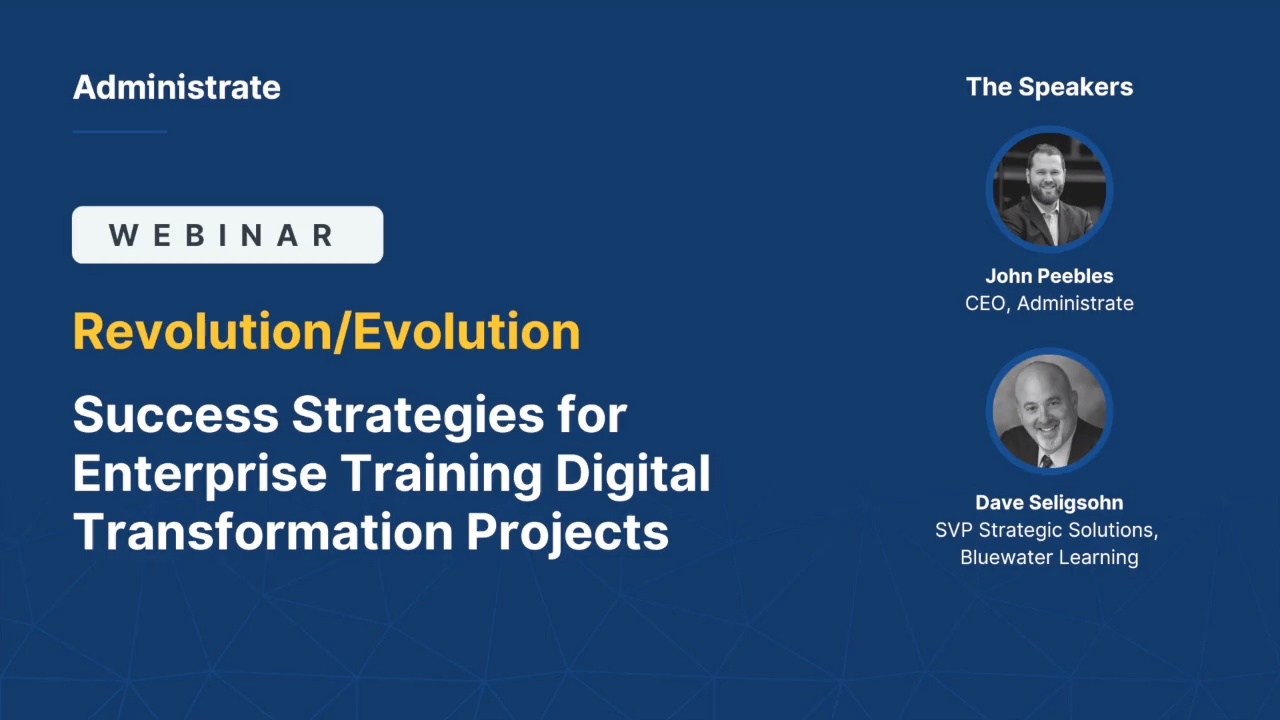
In this on-demand webinar, two training operations experts break down strategies L&D teams can use for successful digital transformation projects.
John Peebles, CEO, and Dave Seligsohn of Blue Water, a former teacher and principal, make the case that most digital transformation projects fail at the start rather than at the end, because organizations define where they want to be and never honestly assess where they are.
What you’ll learn in this webinar: How do you determine and weigh your present learning tech needs, and future-proof your approach to stretch your ROI? Who are your (real) stakeholders and how can you anticipate and manage their needs for a smooth project? What do you want to learn from your learning tech, and how can you architect a solution to empower your data-driven decision-making?
30:29 watch · 5,546-word transcript
Auto-generated transcript — may contain errors. Tap a timestamp to jump the video.
We are joined by training operations experts, Dave Seligsohn, the Senior Vice President and Strategic Solutions at Blue Water, and John Peebles, the CEO of Administrate, a training management platform that empowers leading enterprises learning and development operations around the globe. Now whether you need to rapidly evolve your learning tech to meet expanding training needs or you're revolutionizing your tech stack to build more agile data first solution, how you begin the process will have a huge impact on what results you achieve in the end. So please welcome to the screen, Dave and John. All right, thank you very much.
We are both excited to be here and I think both of us are super passionate about this topic, which is how can we use data to help our organizations achieve more success? So we're going to get excited and we're going get really passionate and we're going to talk a whole bunch, but we're also excited to hear questions and comments that you might have. So make sure you send those in and we'll get to them, throughout the discussion. I think, you know, I've got a confession that I'll make and then I'll turn this over to Dave for some comments, but, previously in a former life I was an engineer. I majored in computer science in college and I still love to program, but these days I'm only allowed on the friends and family venue. And sometimes as an engineer, when you hear things about business intelligence and you hear things about data, there can be this tendency to eye roll a bit and think about, you know, this is very abstract.
It's hard to understand in terms of nuts and bolts and so forth. And I think sometimes many of us in this industry have had that same reaction. And so I think for us today, Dave and I are really going to talk about our passion, which is how do we take this concept of data and decision making and analytics and so forth, things that you hear talked about a whole lot, and then actually tie it to real tangible business success and and what is the process to do that? And so this is where we talk about this idea of assess for success. I'm glad I said that right because sometimes that can be a tongue twister, but it's what are the real needs that we have? What are the needs that we have as a business? Where are we trying to go? And how do we support that with our learning and training operations in a data driven way?
So, Dave, turn it over to you and maybe some thoughts on that. How do you engage with this issue? Fani, you're an engineer, and I probably am at the opposite end of the spectrum, having spent fifteen years as a teacher and a principal in the school system dealing with kids. And so for me, assessing for success also, yes, hard to say, begins with understanding where what you have begins, like what is its current state. And so when we think about education and we think about children, we think about what do they come to me with and then where do I have to get them to? And those are two very important things that we have to understand. And we often neglect the first and we often just focus on where we have to get to.
And so for me to assess for success begins with understanding exactly where I am currently. And if I can evaluate where I am currently in terms of my data integrity, its validity, my technical infrastructure, and then also my process and what are my business goals and objectives that I'm trying to get to in the end. But where am I as I'm working towards that today? Those are things that are really important. We have to identify those gaps. And so again, when it goes to being an educator, if I understand where a kid walks into my class and what he has in terms of his skills and gifts and deficits and needs, then I can begin to work towards how to get him to the end that he needs to get towards to be successful.
Gotcha. And oftentimes, like in life, like in many different venues, we're working off of an incomplete picture, right? And I think this, this next slide that we'll flick over to is one that I really like that tells a story and maybe can lead us through kind of one of the stories that it tells because I think sometimes this is a familiar posture that we find ourselves in, particularly as leaders in training organizations that are trying to achieve things and, there might be unknowns and there might be pitfalls along the way. How do we identify those? How do we figure out where we are and so forth? Yeah, and so I also was a hand model, a little known fact, so you can see some of the that's not true. So, what I love about this slide is there's so many ways to apply it, to the topic that we're talking about.
The most obvious one is is if I only look at what's in the frame, I'm missing issues like I'm not bringing my umbrella if I'm only looking at what's in the frame versus if I'm not looking at what's in the frame and I'm looking at what's outside of it. I don't realize that there's a there's a way that I can get to where there's no storm. And the reality is, is that when I pull that frame away, if we had this animated, I mean, that hand could take it away. That is what we need to consider what's working, what's not working, the integration points or the way that it transitions from sunny to stormy. Those are all the things that we need to begin to understand if we're going to truly evaluate a right current state. And when I think about businesses that are thinking about how they want to begin to move forward in terms of digital transformation, and I'm going to share some statistics with you here in a minute around that, that that almost inevitably the place that they start with is there's this old saying, begin with the end in mind.
Well, they always start at the end and what they're trying to accomplish, and there's nothing wrong with that. But if you don't have an equally valid and time and attention and expertise focused on where you are today, you're very likely to miss the mark. And so if you think about a map, you know, we all use our GPS and our Google Maps. It always wants two locations. Where am I starting from and where am I ending up? If I only tell it where I'm ending up, we're going to struggle to get there. Our business put out a survey. We interviewed or sent out a survey to over a thousand different companies and we asked them, we called it learning insights. And so we found out the following things around learning technology and data. And these are all the highest percentage of the groups of the questions.
Twenty nine percent of our respondents were ready to optimize technology so that they could transform employee learning. Thirty one percent said that they intended to use learning and talent technology to improve employee connection and communication. And then twenty eight percent have too many systems doing different things, preventing them from achieving success. So if you combine that, then what we're saying is one third of our respondents said we've got to do something about our technology infrastructure. And then one third are saying it's that same infrastructure that's preventing us from doing that in the first place. There's a couple other things that we didn't uncover, but that are just generally known. There was a SHRM report and Gartner reports and different things.
Employees use two point three devices every day. Fifty four percent of employees are attending more meetings virtually than they ever did in the office. And employees will access, whether they know it or not, eight to twelve on average different technologies every day. The typical learner will use four to five technologies just as it relates to training and development. Forty one percent of remote employees are overwhelmed by the amount of workplace tech, and two thirds of workers spend up to one hour a day just navigating your company's technology. Think about that. I don't know how big your company is, but if it has two thirds of your company spending an hour a day, think about the cost of doing nothing there. Think about the opportunity cost in doing that. I was going to do some math for a minute and then I thought better of not trying to figure out two thirds on the live webinar.
So those to me are really important statistics that reinforce the need to understand my current state, the technology that supports it and where the gaps or the roadblocks are within it. So I have some more information there, but I wanted to see your nodding and stuff. So I want to see, John, if you had any thoughts or feedback on that statistic. Yeah, I think it's just really interesting. It's probably no surprise to most of us that are listening in. I sometimes wonder as an industry we've focused a lot on learners and learners are really important and they're one of the key outputs of these educational systems that we're building and we're working on, but very rarely it seems like we've got as training teams and as leaders in L and D a real focus on our tech stack.
And I know I'm an engineer and I know that I like technology intuitively and so forth, but you know, even I get frustrated with the plethora of tools and all the things that we need to navigate and that's as a user, that's not as an administrator. And I think one of the things that we find really interesting these days is how do you get a tech stack that is more and more complex, that more that needs to be more and more tuned in and intertwined with the rest of your business? How do you get that under control and how do you use that as a lever as opposed to, an impediment? And we think about that a lot. So I think that's very closely related to this idea that we've all been experiencing, which is more and more tech.
Sometimes that can mean more and more problems. How do we flip that script and get it to be an advantage? Yeah, I think, I mean, the easy answer and it's complex process, but the easy answer is to look at your technology and align it to where you're trying to get to as a business. And so that means that the data flows, what does flow and what doesn't flow, making sure that it's accurate. But that's the easy answer. It's hard to get there, but that's the easy answer. I also, we don't have slides with that data. It's a report that we have, so just reach out afterwards or in the meeting and we'll get it to you. I'm happy. It's something that we did ourselves. We conducted a survey again of over a thousand of our customers and happy to get that out. An interesting thing, kind of funny too, a little bit that an SHRM or SHRM report found that workers say that navigating between technologies is more annoying than doing household chores, which was fifty three percent of them, paying bills fifty two percent and trying to lose weight at fifty percent.
So I respond to that. I wasn't part of that report, but I just thought that was kind of interesting. And I love this quote by Russell Echof, and if you don't know who he is, he's got this unique combination of business savvy. He was an emeritus professor at the Wharton School of Business and also a fellow at the American Statistical Association, which I know you'll probably appreciate there, John, a little bit. And his quote is, We fail more often because we solve the wrong problem than because we get the wrong solution to the right problem. And I think that that in and of itself really speaks to exactly what we're trying to communicate here. We've got to understand the right problem and solve the right problem for your particular business.
So with that, and then my piece, this intro of the assessment piece and understanding current state is we're going to transition into some more detail here, but if we can advance the slide, I want to give you guys a specific process. I want to share with you some things that we do to help evaluate the current state. And the reason why we do these things is we want to make sure that you're solving real problems. We want to make sure that you're answering right questions. We want to make sure that you're seeing the current reality correctly and referencing the right data. So those things are of the utmost importance.
So what we do is we do these four things. We look at prioritizing business drivers and then we break that down into key questions of which we conduct a data analysis. And so what I mean by that is, is if your business priority is we have got to understand more about our top talent and how they move throughout our organization, where they are and how to enhance and improve them. Then there are questions that we have to ask ourselves, starting with how do we evaluate talent? What are our performance ratings? Are our salary and compensation models look like and how do they match up to the people who we consider our top performers? What's our process for evaluation? Do we have succession planning? All those are key questions tied to the driver of wanting to have basically more better, more or better, more great staff, and benchmarking our top talent.
Each question has its own data. So when I look at the question that says, how are we evaluating our top talent? Then what's the data behind that? How are we looking at specific metrics and competency scores? How are we looking at, external training? And do we have the ability to track experiences and mentoring and volunteering and training? And, you know, if it's a sales organization, sales results, whatever the outcomes are for a successful person in that job, there's data that sits behind it. And as we begin to look at the data and its credibility and how it ties to the question that supports the business driver, we begin to align all of those disparate pieces.
And then the last thing that we do is we have what we call a stakeholder profile and really simply who needs that data and what do we expect them to do with it? And then how are we going to know that what we thought they were going to do did what we thought it was to do? That's a lot of do's, but that's the answer there. And the one last thought that I'll leave you with before passing it on to John for his thoughts is concept of this cost of doing nothing that I mentioned earlier. It is so important to consider the opportunity cost of not making the change while you're also considering the gains that can be made from the change. So, John, pass that on to you and love to get your thoughts there. No, I totally agree. I think, you know, that process of figuring out the right questions to ask, understanding how we can achieve an answer to those questions, and maybe we'll like the answer and maybe we don't, but we need to at least be able to answer it, is really important and I would just say that one of the things that we've seen in a trend that we believe that we're pushing is to work with customers to basically bring in what I would consider to be or maybe many of us would consider to be nontraditional learning data into the learning infrastructure.
And what I mean by that is, take for example a manufacturer. They have tons and tons of data about how their business is operating, things like error rates, where are the problems in the assembly line, how are customers liking the finished product, and so forth and so on. The problem that we see, and this is endemic in our industry, is that this data does very rarely or at very high cost and very time intensive effort does it get matched up to actual data that comes from the training or learning team. And so if we can cut down that process, that time that it takes of what is the right question to ask and how do we get that answer and we can shorten that time frame, that's something that we're very passionate about because both are really required in our view.
You've got to be able to have the freedom and the ability to ask the questions and get the answers, and you got to have that time to an answer that's short and can be iterated on. So we think about that a lot and this goes for any industry. If you're a software company like us, maybe you're tying into your CRM or your sales data like you mentioned. There's a bunch of different things, but what happens when you can do that is a) you probably have a much nicer life because you can start to answer some of these things, but b) you really start to lead the business as a training leader and as a training organization, you're not behind the horse anymore. Maybe this is a bad analogy. Now the cart is in front of the horse, which is usually a bad thing, but I think everybody gets what I'm saying. You now, the training team is now on the forefront of helping to affect change and that's something that's very satisfying for us to see when those two things come together.
And so I think, you know, this all sounds great, but, you know, how do you actually design that data model? How do you find the infrastructure that you need? How do you get a place to put all that stuff together? That can be a challenge. So, Dave, you've had some experience with that. Maybe you get some things to contribute there. Yeah, for me, a lot of people spend time with the strategy, but then they lack the ability to dive into the weeds and focus on the data itself. And a lot of people then conversely spend time in the data and they never think about strategic. And so what we have to do is we have to align those two together. And so the thing that really works in our process that I shared with you earlier is we start with the strategic, but we very quickly get into the data analysis and how you design your data then tied to the things you're trying to accomplish.
In other words, whatever that thing is that you're trying to do, what data pieces do I need? Where are they today? And do I trust it? Can I find it? And do I trust what I find? And is it important to answering the question or to achieving that? And so the design of the data becomes mission critical and how I'm going to be able to run reports. I'm going to be able to bring data from different databases and tables together to provide some of that comparative analysis. Yeah, and I think one of the things that we think about a lot is you can get the data one time if you're not getting it repeatably and, on some sort of reliable schedule, that data is aging very, very quickly, right? And so what you don't want to have to do is you don't want to have to do this quarterly process or monthly or weekly process to collate all this stuff and bring it together.
You need to have this culture of using data, being able to ask questions, get answers because the questions are going to change and the stuff that you're going to be, looking to evidence that you're on the right path, that will change too. Your strategy will probably be more or less the same quarter to quarter, year to year, but the tactics of how you get there and how you know you're on track will obviously change a lot. I think we've got, another slide which, our company is headquartered in Scotland and this actually looks like a, Scottish winter day looking out over the North Sea maybe. We got a guy here standing on a rock. Tell us a little bit about what this represents to you, Dave. Yeah. I mean, this this this is doing something in isolation.
Right? This is I am responsible and I'm not looking at the bigger picture and I'm doing something in isolation and everything looks like it's a mess. And so how am I going to make sense of this so that I can move forward? This guy in that picture is stuck. He doesn't have the ability to step off that rock and move forward in any way, and he's also at the whim of the weather and the ebbs and flows of the tides and everything else. And so again, when we can begin to start thinking about where our business needs to be, the data and systems that can be aligned to support it, then we're not working in isolation any longer. Yeah, I love that. And, you know, I think sometimes, you know, we're sitting here, we're listening to these things and it can be difficult to understand what could be the next step.
You know, we all have IT departments, we all have systems, we all have investments that we've made. How do we go about figuring out what it is that we need? How do we start engaging with this tech stack? How do we start saying, you know what, we need this infrastructure to get off that rock in the middle of the ocean and make our way forward? What's involved in that decision process as you see it, Dave?
For me, it's alignment across all of the different groups that are impacted by this part of the business, for example. So if the goal of the business is to recruit more effectively, for example, then you need stakeholders from across the various departments that are part of that, including IT, including senior leadership. We need everybody in that business focused and looking direction. And then we drill down into the detail behind it because we've got them all invested. And to me, that's one of the most mission critical things is it's not just an IT issue. It's not just an administrative system issue. It's also the you know, for all of the stakeholders that are that are, around the business, your example of a manufacturing business.
You know, a lot of times the rules around manufacturing and the compliance and safety standards change on any given day. So how are they going to manage that, especially if they're regulated in any way with the state or federal level or whatever? And so as that changes, I have so many people that need that change almost like that, where I'm doing something that essentially caused me fines and whatnot. How do I make sure that all the stakeholders are still focused on keeping the keeping the main thing the main thing? Yeah, and one that's a great point. One question that I get asked a lot is, you know what, how do we convince, IT or technology stakeholders in a business that A, I need this, B, this change is worth making, and C, I can get higher up on their priority list?
I think, you know, a lot of us have been through a procurement process that can be plagued with the idea that, you know, IT is burdened. They've got lots of things going on. And I would just maybe remind everyone, because it's a common question that we get, One of the things that we found is that we're talking and we're using this metaphor of a tech stack, but that's not actually what happens in most businesses. Things are not stacked up on top of each other like Jenga and you pull a piece out and the whole thing collapses, although maybe it sometimes can feel that way. Instead, we've got this array of technologies that the IT team is working to make sure can all work together. And so one of the best ways that we found to get the IT team on side is to really find systems that understand that change is the only constant, that can be easily integrated, that have APIs that are catering towards that engineer.
You may never use it yourself, but your engineers will appreciate the fact that they've got to change out these systems often on a schedule that could be a year or two into the future. And the more that our learning products and the tech that we're using internally can be easily integrated, the faster and the better that things will go for the IT team and the more you'll get their buy in. So that's a common question that we see and often is something that is sticking in people's minds when we talk on this topic, on talks like this. We've got another picture here, Dave, and then we probably need to pause for some q and a, but walk us through walk us through this image. Yeah, for me, this slide can have a lot of applications. Certainly it's making decisions in a vacuum.
It's not having the right data to make the decision and knowing that you have to act anyway, because it's your career and it's your job and it's what you need to do. But but there's one that's maybe less obvious, and it really ties to not only the cost of doing nothing, but but and hear this clearly the cost of doing the wrong thing.
Understanding and almost goes back to your previous point of how do we get the IT group to know and to listen about the changes we want to make? It's almost creating a business. It's not almost it's creating a business case that says, here's the opportunity cost of doing nothing, and then here's the cost of doing the wrong thing, and here's how we can gain confidence in doing the right thing and what that brings us. And those three things together, is really what makes this slide, come alive for me. And again, I think no matter what your job role is, this is all about what it feels like when you got to make a decision and you just don't have the right data behind it. You're not confident around it. That's what it feels like. We've all been there, that's for sure. Thoughts on next steps, but actually I think there's a really relevant question that came in that maybe we could speak to because I think it does apply to next steps.
How can I identify if my current learning tech isn't ready to scale to meet digital transformation? So how can I tell whether my learning tech is there at a position that will help me scale? Great question. Dave, to you first, because I got to think about this. Yeah. I'll answer quickly in the past. Mean, my first question is, what do you mean by digital transformation? And so if we don't identify and define what digital transformation is, because I can tell you across hundreds of customers, I don't think any two of them, I think that it's the same thing. And so once you understand what digital transformation is, again, understanding what you're doing today and then looking at where those gaps are, where are the places where we have to leave an online system and do something manually where I cannot follow a process from beginning to end?
I can't auto assign. There's no reporting pieces to it. Those are the gaps that you're looking for from where you are today to whatever digital transformation means in the future. John. I think it's great. I look at it in terms of one of my favorite shows of all time, which is the West Wing, which maybe dates me a little bit. And in the West Wing, which is about, you know, the US political situation, you have the press secretary of the White House and one of the senior staffers gets into a bit of trouble. Right? And he tries to muddle through this situation and it kind of gets worse and worse. And basically, the press secretary sits him down and she says, you got to remember something, I'm your first phone call, right? Whenever you get into some sort of trouble, I'm your first phone call.
And for me, if you are at a point where you're on the cutting edge or the leading edge of where you need to be for digital transformation, when your organization is going to make a change, whether it's a new product line, it's a new initiative, you're making an acquisition, you're growing, you're downsizing, whatever it is, I think the learning team and the training team needs to be the first phone call for the business. And if you're that first phone call, I think that's a good indicator that you are there and ready to scale. And if you're not, I think that's a point of reflection maybe for you and your team. How do you get to be there? Because we all say that training is the most important thing or human capital is the most important thing, and we all know that change is hard and transformation is difficult.
Where we see training teams really doing a fantastic job at this digital transformation is when they're that first phone call, when they're that team that is relied on to help lead the organization. And that's what I kind of see in very tangible terms, really, that you can use to measure how effective and how ready you are for that.
I think maybe we have time for another quick question if we can squeeze it in. And, it looks like what are some of the attributes of a future proof learning tech stack? And for me, the answer is how is it integrated with other technologies and how is it open and ready to bolt on and integrate new technologies? And so you almost have this thing in the middle and it has tentacles going left and tentacles going, you know, how am I integrating now so that the data flow works? But then how am I also ready to take in new sources of data at any time and how quickly can we do that? Because it has to match the speed of business. Yeah, one hundred percent. I'll leave just the last ten seconds here with the thought that over long term relationships and partnerships that we have with customers, we see them cycle through numerous different technologies that are solving the same problem, whether it's your survey provider or some sort of LMS or some sort of content, it doesn't really matter because you're going to change.
You're going to change your mind. You're going to have additional needs. You're going to not have needs anymore that you used to have. And if as long as you can have that, ability to change quickly, then you know you're in the right position. If that's difficult or that seems to be impossible, then that's probably a question for you to, ponder on a little bit.
I think that is, I can keep going forever, but I think, I've got a flashing light at least on my end, which is it's time to wind down. But we've really enjoyed the time today. I'm particularly pleased that my niece and nephew had not barged in during the call, which was a risk, maybe a high risk over here. And I think we've got, some resources and so forth that we're going be sending out, a couple from Bluewater and a couple from us here at Administrate. And we just if you want to talk about this topic with us further, I know both Dave and I would love to hear from you and we'll be in touch. Absolutely.