Get started
Get in touch to learn more about how a TMS can help you
Training Management Systems make ILT easy.
Webinar: Administrate joins Training Magazine to help you build a 90 day plan to get out of firefighting mode.
We join Training Magazine Network, to explain why training teams get stuck in a reactive footing, unable to move forward strategically because they are buried in work that should be automated. The culprit? Usually it’s the LMS, being forced to do a job it was never meant to do.
In this webinar, learn how to audit your problems, scope attainable goals, review your tech landscape, and examine your processes.
54:49 watch · 9,560-word transcript
Auto-generated transcript — may contain errors. Tap a timestamp to jump the video.
Good evening, and welcome to Training Magazine Network, and welcome also our members from SMM Connect sales and marketing management magazine. Today's topic, training management Road map. Get out of the firefighting mode in ninety days. We have the CEO of Administrate, John Peebles, and I know you're going to like him. I'll introduce him in just a few minutes. Today's event is sponsored by Administrate. I'll also share a few words on, what they do as well. So thanks for joining us today. My name is Sandy Masters. I'll be your producer just helping out in the background in chat. And here is the lineup of some upcoming events that might interest you on October twenty second. We have Joe Appelbaum, and the topic is LinkedIn for learning and development, build your network and leverage AI.
And then we have Randst Green on October twenty second, story design, a foundationally human approach to instruction. And then Trevor Cox is joining us on October twenty third when the brain says no using neuroeducation to navigate fear, stress, and resistance in learning. You can register for all of those events at the calendar at TrainingMag Network or just click on that blue link right now. It'll open up a browser window so that you can get registered for those events. A special thank you to our sponsor today, Administrate. And this is a training management system, and it's different than a learning management system. And it works in tandem with a learning management system.
And it enables you to plan and schedule hundreds of trainings in minutes, keep your calendars in sync, and easily send communications all in one platform. Whether you're running hundreds of trainings across the globe, this could be your one shop plan to schedule, communicate, and resolve every detail in person and virtual. Special thank you to our sponsor. And John Peebles is our speaker today. And one other thing I want you to know about John is that he's passionate about education, teamwork, technology, and mental health in the workplace, and he's coming today to share his expertise and what he has learned about training management. Please help me welcome back to Training Mag Network.
There he is, John Peebles. Welcome. Thanks, everybody. It's great to be here. I've been kinda looking forward to this all day. Public speaking is one of my favorite things to do, but I got a small confession to make, and that is I don't love the webinar format, and we can all go boo or whatever to ourselves. That's safe. Yeah. And the reason for that is not because I don't like, you know, you know, engaging with you folks, but I don't get to have the kind of chats afterwards that happen or the interactivity. And and I've got a massive ego, it needs to be fed. And I just love seeing everybody on the audience laughing at my bad dad jokes and things like that. And so the deal is the hack to defeat this kind of, small bit of, annoyance that I have on the webinar format is if you guys keep the chat rolling while we're talking, then that lets me interact with you and you with me, and we can all kind of have fun together.
I am dialing in from Scotland, which is where I am based, which is where our company is headquartered. Although we have a huge, team over in the United States and most of our customers in the United States. Administrate is actually headquartered here in lovely Scotland, which means it's about eight o'clock at night, and it's getting towards the fall or autumn as we'd say here in the UK. And that means it's already been dark for a number of hours, and that will continue on as the we get closer and closer to winter. So if anybody could guess without googling or looking at a map what parallel is the same in the United States, what what American city is the same parallels, Edinburgh, Scotland, you won't win anything, but you'll get a huge bragging rights. So might as well jump into this.
This is a little bit of a a background side for me. We don't normally do these, and I have to be I gotta be honest. I have no actual memory of this picture being taken, which may mean it was AI generated. Who knows? But it was taken at some point. I cannot remember this picture. But, yeah, I'm the CEO of a company called Administrate. I'm really proud to represent our team and basically talk about what we do a little bit. But, also, I wanna talk about a few other things that I love. And when we were talking about, you know, mental health, I've kind of had a stressful day, had a bit of a stressful week, stressful month. I'm sure you all can relate. It would be interesting as the folks are coming in for the parallel.
Michelle has nailed it. It is Southern Alaska. It's on the same parallel as Edinburgh here in Scotland. So Juneau, Alaska is roughly the same parallel, which means we're very far north. But as the as you talk about that, maybe we could just talk about what are some things that help us destress at the end of a a long day. For me, it's two things. We Sandy was talking about earlier. We were exchanging heavy metal band recommendations. So I love listening to hard rock music, heavy metal music, and I'll give you a couple recommendations towards the end or throughout the the presentation today. And the other thing that I love is assembling Lego. So those are two things that I love, and they help take my mind off of work or whatever it is that's stressing me out.
And I find it very therapeutic. And so I'd recommend, you know, either if you've never tried it before, some heavy metal music. And I'll have three recommendations for three different eras of heavy metal music as we keep going. And also go out there and assemble some Lego or steal some from your kids and put it together. So this is a picture of my hometown. Okay? And you can probably guess that it's a Chinese city, but you may or may not be be able to guess which Chinese city. So, again, if you think you might have an idea where this could be, you could put it in the chat. Case saying not necessarily a healthy choice, but distress is lying. I think we've all been there, and we all probably partake in that.
It's usually one o'clock here in Scotland at eight PM. Some guests are coming in. We've got Bangkok, not quite in China. Shanghai looks close to that. It is not Hong Kong. It is not Shenzhen. And if you're Chinese and you recognize this city, you would say, well, this is a tier two Chinese city. It's in the tier one city like Shanghai or Hong Kong or Shenzhen. This is the city of Tianjin, China, which is in the northeast about a two hour train ride away from the capital of Beijing. At least that's how long it took when I lived there, which is when I grew up. Now it's about a twenty five minute bullet train trip, so it's changed a lot. And it did not look like it looks like in this picture when I lived there. This is a picture of me and my mom at the Forbidden City nearby about two hours or twenty minutes these days away in about nineteen eighty six, and that is me right in the foreground, the only person in this entire photo with blonde hair, which made me quite the unusual thing, walking around the streets of China in the in the early eighties.
That's my mom. And, my mom and I have a lot in common, but one of the things that we really love is history. She was a history teacher for many years, which meant, that she was my teacher for a couple of years, which is, strange and wonderful at the same time. But we love history. We could spend all day in museums and talking about stuff. And I wanna take you today on a whirlwind tour of about two hundred years of Chinese history where I grew up, from the time that I was three in nineteen eighty four until I left to go to university in in when I was eighteen, in nineteen ninety nine. And I wanna relate it to this idea of firefighting and how we often find ourselves trying to manage huge volumes of training, and It sucks in many ways, and it could be stressful.
It means that we need to go out and buy Lego and all of drink wine and all these things. And so, I wanna take you through two different periods of Chinese history, which are very closely related. You know? And sometimes history can be controversial and so forth, but it's really fascinating to me the parallels between kind of this idea of investing and making sure that we're preparing for what's to come versus kinda just playing it by ear and maybe being a bit more chaotic. So looks like Lee has visited China in nineteen ninety seven, so that is a long time ago. Most people will say, oh, I was in China a long time ago, and they'll say it's, like, two early two thousands. Anyone that was in China prior to two thousand is relatively rare, so it's changed a lot.
Anyway, on to Chinese history. Okay. This is a photo of a man that many of you will recognize, Mao Zedong. He was the founder of the People's Republic of China. He was born in Hunan province, which is actually where I live for the first seven years of our stay in China in the capital city of Changsha. Hunan is a really beautiful place, but it is also a little bit remote. It's one of the inward provinces famous for spicy food. A lot of people will tell you, oh, Sichuan food is, like, really, really spicy. Well, Hunan is much spicier, not as well known outside of the country, but it was wild living there in the early eighties. Mao Zedong was born in Hunan province. In nineteen thirty five, he became the leader of the Chinese Communist Party during what was known as the long march.
We won't go into that, but it's a fascinating piece of Chinese history. And in nineteen forty nine, the nationalists had been defeated, and Mao Zedong proclaimed the formation of the People's Republic of China. And it was kind of this moment. It was like, be careful what you wish for. Right? He had just inherited him and the Communist Party just inherited over a billion people that they needed to care for that are poor, had been going through over a cup you know, couple hundred years of very destabilized societal, economic, cultural transitions. China was poor. It was backwards. It did not have any industry to speak of, and it had been at war almost constantly for about the last hundred years, at least very destabilized. And so something needed to be done. Right?
And, this People's Republic of China thing reminds me of one of the first nicknames that I received when I went to college in the United States. Was fresh, off the boat from China. Not really, but off the airplane. I never lived in the United States. And, my last name is Peebles, and so my first nickname in college was the Peebles Republic of China. These are Very woody classmates of mine, and, you know, we got through it. So onwards. So and so takes over, and they're like, man, we've gotta industrialize. We gotta get this country together. We need to build a better life for our people. We need to do all the things that a modern country should be doing, and this is a poster of what is basically extolling the virtues of what was to be known the great leap forward.
The great leap forward is, one of the I think it's, like, the second of, a series of five year plans that the the government put together. And the idea was that China needed to industrialize. In order to industrialize, it had to move huge amounts of its population away from farming in the interior of the country to then modernize the farming equipment and methods and so forth, get those people into factories where they could start making goods and, you know, jump start this economy. And one of the goals was that they wanted to surpass the UK in steel production within fifteen years. This is an astronomical goal when you think about it. China had, you know, literally ruins for cities in many cases. There was not any industry so to speak of.
And so in order to do that, they had to increase agricultural production. They had to have less people working the fields. They had to do it in much more modern ways. And a wrinkle here is that Mao was always very suspicious. And so as part of this kind of implementing of this plan, they purged all the intellectuals. So all the people that had any know how on these topics were basically purged from their positions, sent to labor camps, or put out to work in the fields, and they said, we're gonna figure out how to do this on our own. Right? And thus begins this five years of the next fifteen to twenty firefighting mode for this country. And so what happened was they said great countries make a lot of steel.
We wanna be surpassed the UK in steel production, and so we must make steel at all costs. And, basically, this is a picture of these what are known as kind of backyard steel smelters that got built all over the country. You can see here there's about a dozen just in this photograph. There are hundreds and hundreds and tens of thousands of these built all across China. And, basically, they found every piece of metal they could find, melted it down, and tried to start making steel because that's what modern economies did. What happened was they even melted down farm implements. And all of these people came in from the fields and started working at these furnaces and so forth, and a couple of things happened. They made unusable steel. It was basically like a weird form of pig iron.
It just didn't work. They melted down all the available metal, and they didn't have implements and things that they needed and tools and so forth. And what eventually happened was twofold, a thirty percent economic contraction, but also it kick started one of the most devastating famines in human history, the great Chinese famine, which lasted from nineteen fifty nine. They don't even really know, but it's between nineteen sixty one and nineteen sixty two. So for three years, the great Chinese famine happened, and they think that between fifteen and fifty five million people died during this. And this is an extremely sad thing. It is, heartbreaking. When I moved there in the early eighties, there were people that had lived through this, and experienced this.
And as a result of the famine, Mao Zedong really lost a lot of credibility. He kick started the cultural revolution, which then devolved into mass chaos. They purged all the intellectuals again, and it upended Chinese society where you had Basically, hundreds and hundreds of years of Confucian thought upended where students were ridiculing their teachers and their parents and authority figures and all kinds of this very, very sad chaotic thing. And it all kinda stemmed from this idea of a war was won. There was not a good plan put in place. There was not infrastructure, and chaos kind of basically consumed the country. And there were huge unintended consequences. And not to, like, bring us all down by this kind of thing that happened in history.
But my hope today is maybe you wanna learn more about China. It's a fascinating place. It's a place that's very dear to my heart, but the history of the country is rich, long, and there's plenty of lessons to be taken away from it when we think about our own lives today. And so at the end of the cultural revolution, it only really ended because Mao himself passed away. And what happened was this man eventually succeeded him, and this is Deng Xiaoping. And you may have heard of him. Deng Xiaoping was in power when I moved there and pretty much through most of the time that I lived there for fifteen years. And one of the things that I'll never forget is in the eighties and nineties, a hundred percent of Chinese men in particular, about a lot more the majority of Chinese, but a hundred percent Chinese men smoked to the point where you'd show up at a meeting and somebody would offer a cigarette just out of habit because that's what you did to be polite.
And, yes, Sandy, that is a very, very good observation. That is Jimmy Carter in the background on one of Deng's trips to the United States when the US and China were normalizing relations. And Deng Xiaoping is a really interesting guy. He was part of the long march in the civil war. He had been purged twice, by Mao as he was coming up through the ranks, and so he had had the to kind of come to position leadership and then had these setbacks and so forth. And he became leader in nineteen seventy eight. And, basically, he said, we cannot continue the way that we are going. We need to have a different plan, and this plan needs to be rooted in a foundation of infrastructure, a foundation of repeatability, a foundation of really trust between the the population and the government.
And he said, we're going to do it differently. And he put in a huge number of reforms, And, basically, that meant that, as opposed to the picture previously in black and white where we've got, kind of these backyard steel smelters, China eventually started to look like this. And this is a picture of, Tianjin where, again, I grew up in my hometown, and it's, looks like a very modern place, almost blade runner esque. And the way that he did this was he instituted a bunch of reforms. Some of them, I didn't even know about until recently when I was kind of researching for this talk. And by the way, we've done this talk in a variety of different cultural and historical context. I think we did one about, the Panama Canal and the difference between the French and the Americans, trying to build the Panama Canal.
We did one, about serial killers and what that has to do with managing large volumes of training. It was after that that marketing really put the clamps on me and said I was not allowed to pick my topics or do my slides completely independently. And so here we are today. These are all marketing approved slides. But one of the key things that put into place was this idea that we need to build an economy. And the way that we're gonna build this economy is we're gonna start small, and we're gonna do some tests as to how capitalism could work in China. This is very progressive at the time, and you can see that they started with just a few of what are known as special economic zones. And so we had mentioned Shenzhen earlier. That was one of the very first special economic zones.
And it was really interesting seeing it before it even got instituted in going through and into training in nineteen eighty four. It's just couple of dirt platforms, and now it's some of the largest, you know, urban areas in the world. But he said we're gonna start small, and we're going to invest in education. He made education compulsory for the first time in Chinese history. Everyone had to go through at least nine years of education. That's the fact that I didn't know about while we were researching this. He also said that the economic strategy of China over the next hundred years is gonna be three things. Every Chinese citizen is gonna have enough food and clothes. Right? So this is not pie in the sky lofty goals. Right? We wanna feed and clothe every Chinese, person in the country.
We wanna quadruple the GDP by the end of the twentieth century. So by the year two thousand, we wanna quadruple GDP, and they said this in nineteen eighty. And then over the next twenty to thirty years, they want to achieve a medium level of economic development relative to the rest of the western world. Okay? So three things that he wanted to achieve. And in order to do that, not only did you have to put in the right framework, like these special economic zones, but you also had to report the right know how. And so this is a picture of my dad in nineteen eighty four, the first year that we were in China. He is teaching a class. He had a PhD or master's degree in economics. He was brought in as a contingent of foreigners to attach to a university to teach economics to Chinese because you remember all the intellectuals have been purged not once, but twice.
And after the second purge, you kinda get a little bit nervous, and, also, there's not as many intellectuals anymore. So he taught, and this is his interpreter. So we couldn't he couldn't speak any Chinese at the time. We'd have to say his thing. The interpreter have to interpret, and that's how it went until he became fluent enough to teach his own classes. Right? And and so that was something that was a very strategic thing that put in place, and it started to roll out in the mid eighties, and it began to pick up steam. And as forward and foreign direct investment started to increase, then it's basically took a life of its own. Okay? And so, basically, this is a graph of Chinese GDP growth from nineteen forty nine when the country was formed until basically this year.
And you can see this dramatic depression here on the left in nineteen sixty one. That was the great leap forward when everything just went off, off the rails. And you can see the famine and the cultural evolution that, impacted it later. And put it another way, this is basically the GDP growth of the country, again, from nineteen forty nine till twenty twenty five. The Mao era is in red. The reform era starting with Deng Xiaoping is in the green. And so this is one of the most dramatic transformations in human history. There are you neither of these men are perfect. The Chinese Communist Party is not perfect. The Chinese government is not perfect just like the American and British governments and so forth.
But they did achieve a remarkable thing by putting in these consistent steady reforms. One of Mao's favorite sayings about about his policy was he was asked, you know, What what is the what is the game plan here? Is this a five year plan? Is this a ten year plan? And he basically said, we are gonna continue along this experiment for at least a hundred years. And he also said, we don't care if the cat is white or black. We just care if it catches mice. And by those two statements alone, which were infamous to all Chinese, they signaled that the era of kind of this top down economic planning, which wasn't gonna gonna work for the country was over, and a new era was starting that rewarded individuals and entrepreneurship and so forth.
Okay. So that is the history lesson, today. Hopefully, you'll find you informative. But, you know, why did you join this webinar? Why are we here listening to a guy in Scotland with guitars on the wall talking about metal music, Lego, and Chinese history? And by the way, my first metal recommendation for you is a classic Iron Maiden. You if you never listen to Iron Maiden, go listen to them. Melodic singer, fantastic, great album covers and art. Just just a wild, band, and they're still touring and going at it today. So here's three reasons. Right? You're sick of training management taking all your time. You're in a reactive mode. You wanna stop the chaos. Right? These are typical reasons, that people come and join a webinar like this. People are answering in the chat.
Yeah, it's it's very, very common. In fact, it is rare that we will talk to people who are doing lots of classroom synchronous training. Right? Doesn't necessarily have to be in a physical classroom. It can be like we are today that have this nailed and are enjoying it and getting a lot out of it. So what you'll get at the end is this handbook. We believe, and we believe we have a lot of proof behind this and a lot of success stories behind this that in ninety days, we can get you on the road to a sustainable, less wine required, less Lego required posture that helps you manage your training at scale and focus on the things that actually matter, not fighting with all the things that we fight with.
So you'll learn why you get stuck, what a training management system is, and maybe how to pinpoint and solve your biggest bottlenecks. So here's a poll for us all. How often do you have to deal with a training wildfire? The poll has popped up. I and the voting starting This is cool. This is very interactive. Maybe I'll completely change my mind on webinars. I hope you do. The chat's been going wild, and you have to tell us the name of your cat too. Oh, can you hear her? She my apologies about that. No worries. We we my ancient Brazilian gray Brazilian shorthair cat. Originally from America, probably speaks Spanish, because she's from Miami.
And she's turning twenty one next year. So Oh my gosh. She's very, very old and opinionated. Wow. Well, I feel for the thirteen percent that are dealing with this wildfire every day. I'm feeling it. I'm feeling for you. Yeah. But it looks like, the most answered fifty four percent once once a week, and that's a lot. Right? Yes. And and that's pretty typical. Like, if you're sitting there thinking, oh my god. You know, that's that's bad or whatever. It's normal. Okay? There's not, like it's not like you're doing anything wrong. Right? So Eric said he just saw Alice Cooper and Judas Priest. I would love to see Alice Cooper in particular. And fun fact, if you've ever seen the movie Rockstar with your man Marky Mark, Eric, that is loosely based on the Judas Priest story, a true story, actually.
So check that out if you get a chance. Okay. This is one of the big reasons. Right? Your LMS is not enough to help you manage synchronous classroom training. They are really great at delivering training, but they're not very good at this acronym down here, which I think is pronounced as.
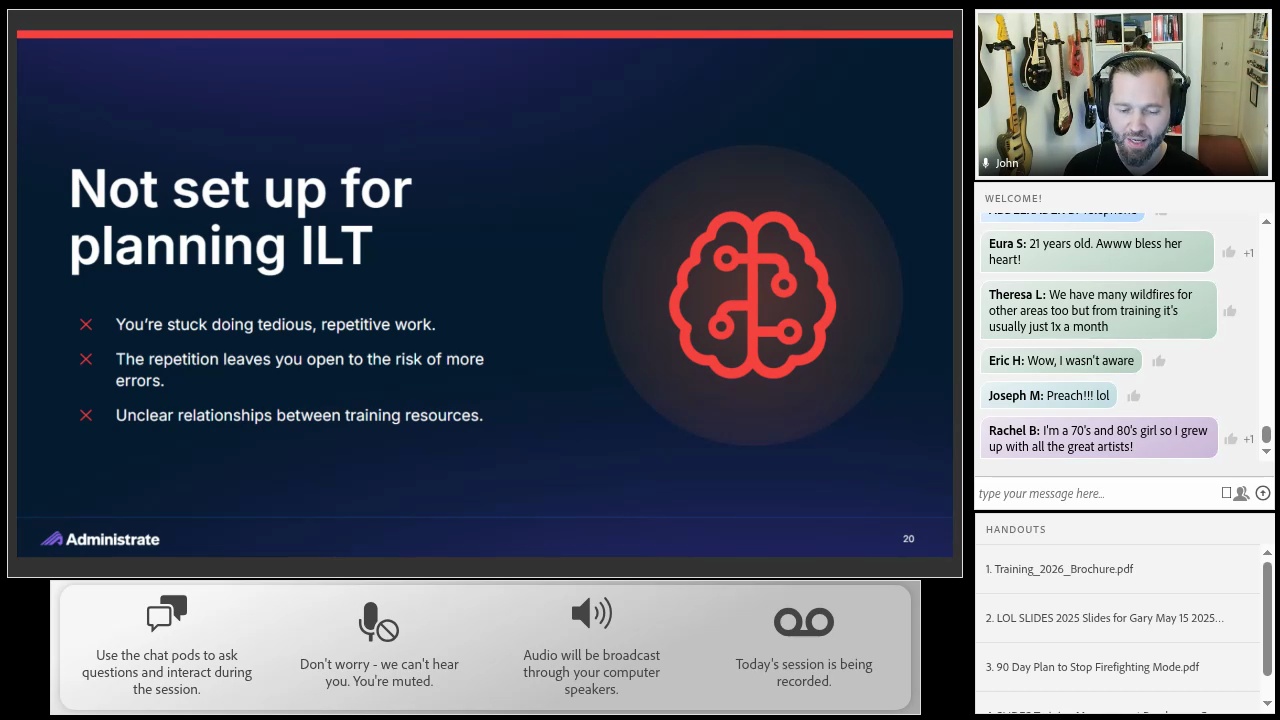
Okay? So I'm sure we can all, I'm sure we all instantly know what that means. But, that basically is an acronym for the concept of identifying and moving large groups of people through large amounts of training as efficiently and automatically as possible. Okay? That is what an LMS is not great at. Right? Large groups of training through large amounts of large groups of people through large amounts of training as efficiently and automatically as possible. Alright? And the thing is the traditional LMS is not set up for planning instructor led training. It's just not. Right? It they are designed to be great at elearning. They're designed to be great at the kind of fire and forget content delivery mechanism.
They're not great, and they're not designed to do all of the repetitive work that's required to manage a classroom, to get people together in a specific place at a specific time. And if you've got resources that you need in order to bring to that classroom, that could be anything from a lab environment to a virtual lab to maybe some type of expensive equipment that you're trying to train people on, and LMS is not designed to do that. And another area that LMS has struggled with is around scheduling. So if you think about it, there's a two phase scheduling problem that happens in synchronous training. The first is, like today, all of you need to show up at this webinar at a specific time in a specific place.
Okay. There's a recording, but, you know, if you wanna be there for the live thing, you gotta get there. You know where to go and so forth, and are you available as students or as recipients of this training? But there's another scheduling problem, which is what, Sandy and Rob from our team were dealing with over the last few days, which is I need to be here to speak, and Sandy needs to be here to help moderate, and Rob needs to be here to help support on content and so forth. And so there's a there's a staff or a crew of people that need to be available and free, only just for the event, but maybe for pre and post work. And that is those two kind of that two phase scheduling problem is very difficult. And it means that most people are just spending all of this time rifling through calendars and trying to figure out when people can be available to get this important training that is required, and LMSs are not Good at that.
So just to kind of take a temperature here, How long does it take you to schedule maybe, say, ten plus ILT sessions? If you've got a calendar of ten things that are coming up next week that you need to get scheduled, how long would it take you to do that? And we're talking, like, everything from kind of figuring out when it's gonna run to sending out the emails to everybody that it's you know, here's what's gonna be to making sure the instructors are there and and all that So as the votes are coming in, we'll see what we see. And it looks like Several hours and a few days. Few hours to a few days are in a dead heat, but a few hours to a few days is quickly taking the lead.
There's this there's this YouTube channel that I got obsessed with about six months ago, and all it is is this guy that drops, like, four die cast cars, metal low metal cars, the matchbox cars, and he's got these elaborate tracks, and he commentates on the race. That's what I feel like I'm doing right now. That's funny. It was fantastic.
Okay. So looks like this has taken a lot of time, which, again, super typical. And that brings us to my second metal band recommendation of the day, which is a little bit a slightly more modern era, and that is the band Tool. If you've never listened to Tool, they're kinda like the Beethoven or Mozart of heavy metal music. It's very intricate. It is very they do a lot of different time signatures. They they're just phenomenal. It's like it's like even if you don't love the music, you'll appreciate it. You know, if you go see a great symphony or something, you'll you'll really appreciate it. So Teresa saw them a few years ago. They're hard to see, actually. They don't tour a whole lot anymore, but I've gotten to see them once or twice.
Okay. Yeah. It's more difficult when you're wearing all of those hats at once. Like, we got three people doing this session today. But if you're just the one person, then you gotta do all of those jobs, and that can get really, really stressful. Okay. So what are the reasons behind this? Well, there's limited tools for communications. Right? If you remember LMS, traditional LMS, it's designed to you register onto the, the course typically by yourself. You get a link maybe some other stuff, but you don't have the volume of communications that are required to remind people of where to go and to answer questions like where do you park and which room and what is my login to the workstation when I get to the lab and all that other type of thing you have to do when you're doing synchronous training.
And so LMSs just don't have usually as many trigger points and as many avenues of communicating with folks. And if you think about it, one of the things that, our customers love is they can get text messages sent to the students that are really handy for, like, morning of or, you know, an hour before, that type of thing. So these are just things that you don't need to worry about when you're doing asynchronous training like elearning. So that's one of the reasons. Here's another one. Too many points of failure. Right? What happens if there's a conflict? A conflict could be your student can't, make the event. The conflict could be many of your students couldn't make the event. Could be that your instructor got sick, or you have to figure out, hey.
Why did this room get double booked all of a sudden? Maybe you're sharing meeting rooms with the rest of the business or the rest of the organization. That happens all the time. We see it a lot. And so, you know, all of these things could happen, and all of them could happen for every live training or synchronous training that you're running. And, that often means that we see customers and folks out there with huge teams of coordinators and admins and so forth that are working really, really hard to make sure there's a smooth training experience. One of the, like, horrible ironies, I think, of delivering education or delivering training is that students, more than any other factor, equate high quality administration or slick admin with the quality of the training.
So if the if it's a breeze getting booked on and getting told where to go and getting everything and your meal is correct and all that type of stuff, they'll think that that training is way better than the training where it's difficult to find the emails and stuff was a little bit disorganized and so forth. Right? And that means that this stuff's really important, and it's really important not only for delivery and absorption by students, but also for student and the perception of quality.
Yeah. So here's another challenge, which is premade reports are difficult to obtain or maybe they're very limited or you can't, alter the data or, you know, figure out what what's happening in one area of the the the training operation. And so that limited connection to data means that in this fast moving environment where everything's changing all the time and people are getting sick and classrooms are getting double booked and training's getting canceled and rebooked and people need to be transferred because they were sick. All that becomes much, much harder when you don't have a clear and consistent way to access your data that's fully under your control. Okay. So another poll. When building a training report, how often do you wish you had access to more data?
Maybe you're not even building the training report. Maybe it's just the reports that you have. How often do you wish you had more access to more data? Which brings us to heavy metal band recommendation number three, a modern heavy metal band. Now Let me just preface this by saying I do not enjoy the concept or really any masked bands. Right? Bands that wear masks or costumes or whatever and play. I think they're stupid, frankly. And I know we're not supposed to judge art as art, but let's just judge a little bit. Right? They annoy me. I've never liked Slipknot, for example, or any just because they had mass.
And so when this band came around, I was like, this is really stupid or whatever. And I started listening to them, and this is the band Sleep Token. And they do wear masks, but, they have a very genre defined sound, and they are very unusual and a bit of kind of kind of like tool in that they use a lot of different time signatures and weird song structures and all kinds of stuff. I promise if you if you check them out, you'll at least be interested, and I've been evangelizing them for quite a while now. But The the the thing that Iron Maiden and Tool and Sleep Token all have in common is they are at on the one hand, can be very, very heavy, but they all have very melodic talented singers, which is something I enjoy. I don't love the screaming metal stuff as much, but we're digressing.
Okay. Okay. When building a training report, how much how often you wish you had access to more data? Every single time wins and most of the time and yeah. So this is a challenge. Right? And So now those are all the problems. And, if this were a new country that had just been formed after a hundred years of tribulation and, upheaval, it would feel a little bit like Mao Zedong's China. Right? A bit chaotic. Stuff's all over the place. How do we fix it? And, okay. So here we go. First phase would be audit your problems. Now a lot of you are saying that you have some of these problems in the polls, but not all of you have all of these problems.
Right? Some of you will be really struggling with the scheduling aspect. Some of you will be really struggling with the planning aspect. The delivery might be a problem. Right? There's all these different phases of things. Some of you will have stuff really, really well nailed in in some of those areas, but figure out where your problems are. Where are the biggest problems? Okay? Then, figure out, well, how do we prioritize these problems and what could be the scope of this project? Sometimes, we have folks coming to us, and they're like, we wanna solve this entire huge thing in a year. And we're like, woah. You're not gonna be able to surpass Britain's production of steel within fifteen years. Right? But what we can do is we can get a plan to make sure that everybody is clothed and fed, that we quadruple the GDP of the population, right, and ultimately become a country of first world economic output.
And and that just takes planning. It takes scoping. It takes decision making. And, you know, we're doing that right now with a prospect where they've kind of got a one year plan of where they wanna solve a bunch of, like, five or six key things, but they're actually working on a three and a five year plan. And it's it's really interesting to to work through that with customers and prospects. So you wanted to find the scope of this project. And it's kinda one of those things. Right? Everybody overestimates what they can get done in thirty days and underestimates what they can get done in a year. So there's, a flywheel effect that starts to happen as as you, go through this. Reviewing your tech is really, really important. Most of us on this call will have many, many different systems that we are using to deliver training, particularly at scale.
You know, some folks have multiple learning management systems. That's pretty normal, like three, four different learning management systems. I think the the most interesting case we ever saw that was, we had a customer that had fifteen different LMSs. Now some of those have come through acquisitions and so forth, but, you know, this is a this is a challenge. You'll also have other non training systems or non educational systems that will be in play that are important. Things like maybe your ecommerce system, if you're selling, training your business sells training alongside your main product. Or maybe it's a CRM that's out there that has a lot of access to customer data that you might want if you're trying to deliver training to make sure that everybody's up to speed. Figure out what your tech landscape looks like and make sure that, you know, you've got an idea of what tool is there for which job.
Okay? Look at your team's processes. So workflows and habits and things. Croft builds up over time. Even in Administrate, we're a small company, and we still have weird stuff that happens because we haven't looked at it in a while or we haven't kicked over that rock in a while. You know you know how it goes. And then if you are doing high volumes of synchronous classroom training, I mean, than, you know, a few dozen classes a week, you should consider a TMS, a training management system. Administrate is a training management system. We are not a learning management system. One hundred percent of our customers have a learning management system, and we interface with that, and it we complement that investment that you've already made. We are not looking to do any elearning, but we are looking to solve that classroom and blended learning problem that a traditional LMS does not help solve very well.
Alright? Because this is what it looks like when you don't have a training management system. You've got all this stuff that has to be done, all these systems that you have to move between. And, all of these arrows, by the way, are, like, time required and people required and often spreadsheets required. And what we are going for is the this. This is kinda what we want, which is a training management system that is providing the data and reporting, that provides certificates and badges in an automated way that can interface with your website that handles all those email and SMS communications, interfaces with folks' calendars, other integrations that you might have, and really takes the burden of all this managing training at scale off of you and your team's shoulders.
Our goal is to automate ninety percent of the classroom training activities that you have to do from an administrative thing, hence the name, Administrate, and we wanna do that in a typical ninety day implementation. Hello? So here's the last poll. Have you heard about training management system or TMS before this talk. Hi.
Hello. And I'm all out of metal band recommendations. At least you're Can I recommend what? Yes. Go for it. I really loved Rush back in the day. Great. Great recommendation. You know what? Probably one of the best drummers of all time. Right? I got some thumbs up there. Yeah. Rush is great. I don't I haven't listened to them loads. Growing up in China, it wasn't like you could just turn on the radio and get exposed to music. You had to Yeah. They had to be all hand carried across in CDs or cassettes, and so it made my music taste very narrow. Oh. But, yeah, Rush is, Rush is great. One of the things I love about TMN webinars and our speakers that that present information is you're you're just always so interesting and informative because look at this.
The majority, eighty three percent has never really thought about a training management system with all the technology changes that are happening all around us. I mean, we're overwhelmed with tools, but just the fact that you're introducing us to this training management system approach. So thank you for that. Yeah. No. So and that's not uncommon. Right? Which is this is a category of product that has not been around as long as the learning management system. A lot of there's been thirty years of investment by LMSs who, you know, are friends, over there, but they are have been thirty years of elearning is gonna be the end all, be all of training. Right? And it's just not the case. So we get it. But what I wanna do is I wanna just really quickly talk about what a TMS does and what we do and how we could help you with this problem.
And maybe you're interested. And, if not, maybe you, you know, can help out a friend or a colleague that is struggling with this and point them our way. Okay? So, here's the kind of four pillars of what we do in in terms of a training management is we're gonna help you plan. Okay? We have things that we call course templates that are reusable, that let you get all the information out of people's heads, off people's whiteboards, out of spreadsheets and pieces of paper and say, this is what is required to run a class. And if you go to schedule it, the system will walk you through and say, don't forget. You need an instructor. You also need a coordinator. You need a supervisor. Whatever the roles are, you need these this equipment. You need a classroom.
Oh, you wanna try to do twenty two students? Sorry. That classroom only holds eighteen. We should swap to this classroom. Those types of things. Right? We're gonna help you plan, and it's gonna take that scheduling component and planning component down to seconds or minutes as opposed to hours like we were talking about before. So this is a great example. Right? Our customer, Roche, love Cristy and her team for a couple of reasons. One, they're just great and super smart, and they do tons and tons of training. And this is, like, really, really cool life saving stuff. Right? You go there, and it's all kinds of blood analyzers and cancer detection. And, you know, their their trainers are all PhDs, and they took us on this tour, and it blew my mind. Like, the chemistry, I didn't understand any of it. But the other reason we like Cristy and her team is they're in Indianapolis, and they're Pacers fans, which is close to where I went to college.
So Colts and Pacers, we relate a lot on that. But, you know, before they were using Administrate, they were using hundreds and hundreds of spreadsheets that were then being consolidated up to one from all over their global organization, and, it took them days and days and days. And so we're delighted to be able to help them with that problem. The other thing we can help you do is we can help you with the actual mechanics of scheduling. Right? So you got this plan that might be your three month or your six month plan. And believe me, some of those plans, they involve hundreds of different courses, and they're trying to do it globally and make sure that the training that's done in China is the same that's done in Scotland, is the same that's done in the United States. That's really difficult to do at scale. And so then we come to scheduling. Helping you make those scheduling decisions is really, really critical, and that's where we link into folks' calendars.
We will show you just the approved instructors that are available for what you're trying to do, and it just takes all this guesswork out of and leafing through tons of calendars and trying to find folks and so forth. And this is another great customer of ours, Leonie and her team. She's talking about just in the first quarter, they say forty two hours in ILT scheduling. There's so many great stories from Ping. And before Ping, they were actually known as ForgeRock, which is our original customer, and then they merged with Ping. And Leonie and her team have just done a fantastic job, and, you know, we got a lot of these things, on our website if you want more information. So, communication, super important. Right? Because it's not just getting the schedule out there and the plan and making sure that it's all ready to go, but you need to tell everybody where they need to be.
And so we want communications to be automated. We want them to be personalized. We want them to be delivered in the mode that makes sense, whether it's email or a text, and we've got all these different audiences that need to be communicated with. And so most of our customers don't spend any time at all delivering these communications anymore because they're entirely automated, and they just deal with the exceptions. If an email bounces or, you know, a text doesn't go through, they'll kinda wanna know that and so they can figure out what the problem is.
Anna and her team, incredible crew over here down south in London. Email saves time, but it also makes learners happier, and they complete more training. And it makes for a better product. If you communicate with learners ten times, maybe five pre and four post and one gearing. That is so much more impactful in the perception of the quality of that product, of that training than just getting one email that might even have some mistakes in it or, it's clearly a mass email. Right. And problems always happen. You have a great schedule. You have a great plan. You've checked everybody's calendars, and everybody's available, and then somebody gets sick or a classroom doesn't exist anymore.
You know, we've had wild stuff like, you know, things burn down and things happen. Right? And so you need to able to identify those things and resolve them. And, you know, this is something that Melissa and her team over at Siemens, they were fighting with this tooth and nail until came in. We worked with them, and just the idea that they can get told when stuff is about to go wrong and has gone wrong is, really, really critical and, transformative in how they spend their time and their mental energy and what they're gonna plow that time into, and it's it's been great to see. And lastly, we talked about reporting. So a TMS should have a comprehensive report builder that can help you build your own reports, drag and drop from any data point within the platform.
That's really, really important to us because, one, it's cool and we love it, but, also, it's transformative when you can basically interrogate your own data in real time, build these things yourselves. You do not have to pay us. You do not have to submit a sport ticket or anything like that. That's really, really key. And so Will, again, on the, Roche team, basically, he's a reporting, master in Administrate, has all kinds of stuff. These can be set up to fire automatically and deliver to people automatically and so forth, and it's a great feature, that is really, really popular. Yes. And, ultimately, this is what we wanna see. Right? We wanna see your training cost reduced. I just saw something the other week. Sixty percent of the budget today is is being spent on training team personnel. So sixty percent of all the money spent to deliver training in corporate America is spent on training team personnel.
Now we we want to unlock that training personnel and make it so that you can deliver way more training for the same cost and same effectiveness at better effectiveness and plow more time into your students, into your product, and all that type of thing and not spend time in spreadsheets and monkeying around with calendars and all that kind of stuff. So time to workforce readiness is slashed. Right? If you are in charge of getting people out on the job where they're effective, this will really help you. Your learner experience will improve across the board, which means the perception of quality will improve, which means that the outcomes that the learners have will improve. And, ultimately, you'll be able to say, look. If we spend a dollar on training over here, it's gonna be efficient, and it's gonna it's gonna translate into this business outcome over there.
Right? And you'll be able to do that and report on it and show it. That's what a TMS is designed to do. And so if you have a bunch of synchronous instructor led training that you are struggling to manage, that is involving thousands of learners or you're in a high compliance industry. If somebody is gonna get injured or for you know, might die because the training is not, done well, or if you really need to understand your data, these are the folks that use a training management system. So, just kind of a callback here to what we were talking about before. Two men, right, that both were leaders of China, both deeply flawed individuals, both had some positive qualities as well, complex characters. The one on the left did not invest in infrastructure, did not invest in systems, did not put into place the right things that were required to achieve a reasonable plan.
Right? And the one on the right learned from that and said, can't keep going the way that we were going. We need to invest. We need to put up these structures like these special economic zones. We need to invite in foreign expertise. We need to get investment. We need to provide the safety for our citizens to know that this will be a long term thing, and it became one of the the greatest achievements, certainly one of the greatest economic achievements ever in human history. Right? So, hopefully, you found this useful. We've talked about if your bingo card had Lego, heavy metal music, Chinese history, communism, capitalism, classroom training, you know, whatever, then then you win. But I've really enjoyed it. I really enjoyed the chat.
I've got some rock band recommendations that I'm gonna hunt down. I've made been making notes over here, and I really appreciate the hosting and and so forth. So I don't know if we have time for questions, but, you know, if not, you can, shoot us an email, and, we'd love to to interact with you on LinkedIn and stuff. Yeah. I am gonna change the layout real quick. But first, I John, thank you for bringing you, your whole self, to our webinars. It's not often that we get this type of history lesson and integration, but also a resource and a guide to help us get out of that firefighting mode. And that's what life is about. It's it's not work or life. It's work and life and history and everything.
And I just I really enjoyed it, and I hope our audience did too. I am gonna change the layout. John's gonna stick around to answer questions so you can either raise your hand. I can activate your mic for questions, or you could type your question in the lower left corner, which is the chat pod. Look to the upper right corner. That is our rating for the session. We always like to get a rating from you. And then we're always looking for ideas. What other topics are you interested in? Gary Van Antwerp, our executive producer, always wants to know. And what I wanna know is what's your one takeaway? What is one action step besides checking out all of these wonderful metal bands that have been recommended.
What's your key takeaway? What are you gonna take action on? Put that in the takeaways pod in the lower right corner. And on behalf of Training Mag Network, I would like to, thank John Peebles, our our speaker today and also Rob Waltz who really has been helping out in the background in chat and helping out before the event as well. So beautiful. Beautiful. Alright. I don't see any questions. I'm gonna go ahead and pause the recording because I know some of you don't like to speak on recording, so I'll go ahead and