

Get started
Get in touch to learn more about how a TMS can help you
Training Management Systems make ILT easy.
Webinar: Administrate joins Brandon Hall Group and Roche Diagnostics to talk about how a training management system refocuses your team.
Hosted by Brandon Hall Group, Administrate’s John Peebles, CEO, joins Cristy Mangin of Roche Diagnostics, and analysts Michael Rochelle and Matt Pittman to discuss how training teams can master proactive training management.
If you are stuck wasting time and resources because L&D is stuck in a reactive, firefighting mode, this panel discussion with Brandon Hall Group and Roche Diagnostics will help you break the cycle. Learn how to find data showing how much time, money, and effort are lost to reactive training management. See how Roche Diagnostics stopped being reactive and how it transformed their team. Get strategies to evaluate your own training management to be more proactive.
59:39 watch · 9,610-word transcript
Auto-generated transcript — may contain errors. Tap a timestamp to jump the video.
Well, hello, everyone, and welcome to today's webinar. Today, we will dive into a very exciting topic, your training management road map, get out of firefighting mode. This session is eligible for HRCI, SHRM, and ATD professional development credits. Now let's meet today's speakers. First, we have John Peebles, the CEO of Administrate. We have Cristy Mangin, manager technology and administration at Roche Diagnostics. We have Michael Rochelle, the chief strategy officer at Brennan Hall Group. And we have Matt Pittman, the principal analyst at Brennan Hall Group.
A big thank you to today's webinar sponsor, Administrate. Administrate is a training management system that gives teams back thousands of hours by automating ninety percent of critical but time consuming and error prone task. Administrate works with companies that focus on instructor led training like Roche Diagnostics. Now before we dive into today's content, let me tell you about Brennan Hall Group and some incredible opportunities that could accelerate your career. Brennan Hall Group is a leading professional development firm that has been serving learning, talent, and HR executives worldwide for more than thirty years. We've advanced the growth and performance of millions of employees and leaders through our cloud based platform, delivering evidence based research, data, and certification programs that empower organizations to achieve excellence in every area of human capital management.
Our impact spans more than ten million employees and executives globally, supported by our comprehensive research library, strategic insights, and prestigious awards program. Below is a sample of the organizations we are proud to partner with. Registration is also open for the HCM Excellence Conference happening next year, February ninth through twelfth. This is where the top minds in human capital management come together. We also have our upcoming woman in leadership event on November nineteenth at our headquarters in Boca Raton, Florida. For more information, please visit brennan haw dot com and click under the events tab. We also invite you as always to participate in our research studies. Links will be available after the webinar. And once the results are analyzed, all participants receive a piece of complimentary research and other exclusive benefits.
All details and applications for everything I've mentioned will be available in a PDF you'll receive within twenty four hours after the webinar. Now if you have any questions during the webinar, please use the questions panel on your control bar. We'll be answering them throughout the session. We're also recording today's webinar, and you'll receive an email within twenty four hours with a link to the recording and a PDF of the slides. The chat box is open, so feel free to share your thoughts as we go along. Your input makes this more valuable for everyone. Now we're also excited to announce that at the end of today's webinar, one lucky attendee will win fifty percent off in HCM Excellence conference registration. Stay tuned to see if you were the lucky winner. You must be present to win. Now I would like to pass things off to Matt.
Thanks, Ivy. Appreciate that. And welcome, everyone. If you take a minute and find that chat window, let us know where you're joining us from today. We're glad to have you here. And here's a quick look at our agenda. We're gonna touch on all of these key components of live training management, crisis mode, reality check, some hidden cost conversation, the build versus buy dilemma, beyond efficiency, the strategic value proposition, the road map reality. Oh, look. We got some folks from my neck of the woods, Raleigh, Atlanta area, as well as Louisville. Hello from Miami. So a neighbor to the south. So as we get started today talking about our topic, we know that
live instructor led training management is a challenge for a lot of organizations. And we know that from recent research and work that we've done that organizations are not backing down from that, even in this era of AI and technology. In fact, we know if you look at this slide, what you're seeing here is the planned increase in staffing around instructor led training support. So organizations in the green are looking to increase training staffing or keep it the same and increase or keep the same their learning operations support. And that has been universal among a lot of our clients that we have spoken with.
And I know that John and Michael have seen similar trends among conversations that they've had. Anything to add there, gentlemen, before we before we move on? No. Just that our experience echoes yours, Matt. I think for us, the pandemic was an interesting time because, you know, everything the world is upside down. But when you're talking about software that's designed to manage classroom training, all of a sudden, can't go to a classroom anymore or you're stuffed into a virtual classroom. That was a moment where it's like, well, that's it. This could be the end. Right? And yet we actually saw those trends increase slightly amongst our customer base, and people got even busier with with that type of mode of instruction, which, you know, was maybe a little bit counterintuitive at that time.
It's also from our end, building off of what you brought up is it's interesting to see how people are even gonna navigate increasing in staffing, you know, in the in general. It seems to be like a salmon swimming upstream as far as being able to add people in this environment, which kinda, I think, is a great segue to what we'll be talking about today. But those are the few in the chosen and the fortunate that can do that. I think most of the people in the audience would do a head nod knowing that they're probably facing budget cuts, maybe reduction in force, not as many people, rescinding hires. So they're looking to optimize the folks that they have, which I think is a great conversation we can have today about what Administrate does.
Absolutely. And with that, we're gonna jump right into our first poll question for today. So if Ivy, if we can if you guys could take a second to respond to that. What is your organization's biggest pain point when it comes to managing instructor led training? Is it resource scheduling coordination, lack of connectivity and integration, difficulty standardizing those operations, course planning and capacity management or reporting and demonstrating training ROI, or manual administrative tasks and data entry. Any predictions on what we'll see on this poll?
I I think some people will be upset that there's not an all of the above option. Right? Because that's what we tend to see out there. Yeah. I think you're right. And we hit just about all of them. But overwhelmingly, that reporting and demonstrating training ROI seems to be the leader of the of the pack in that question. Alright.
Let's go on to poll number two. Are you guys seeing the poll? Okay. Poll number two, when it comes to training management technology, where is your organization today? Have you identified that need and you're actively evaluating it? Or you know your problem, but you haven't really started trying to figure out how to solve it?
Alright. And it looks like we know we have a problem, but we don't haven't really started looking at solutions just yet. And that sounds like you're in the exact right place then because we wanna talk about how you can start solving for that problem. All right.
Well, you know, just just a thought there, Matt, as well. And I think John might jump in on this as well as I think a lot of folks don't know that there is a solution out there to look for. Like, this is an area where traditionally people have thought about, I'm just gonna have to keep slogging away with with people on spreadsheets trying to figure this out. But I think what's interesting too is the advancements like Administrate has made plus the idea that AI can be harnessed to do great things together is really made for, a breakthrough. And I think that we have to figure out a way to create frictionless environments. And I think, you know, we need to talk more about the fact that there's the opportunity to find a technological advancement, which for many years no one thought about that could be in this in this area.
So it's pretty exciting that people are at least it's a much bigger percentage than I thought was that people would be out there knowing that there is a solution to look for. So couldn't agree with you more. And, John, I know that fits right into your wheelhouse as well as what you're seeing.
Yeah. And it's interesting because you're coming from the the practitioner side of this. I ran live training programs for many years in very complex organizations. And we were always trying to piece together how how to do that best. Going all the way back to the days when I used to tape, didn't even use post it notes. I would tape index cards to the wall in my office, trying to keep all those pieces moving in the right direction. And we would hope that the LMS might be the solution there. But what we find is that just doesn't work. And when we've asked in the past in our research about why are you looking at changing your LMS technology or why are you looking at adding additional capabilities to your learning tech stack? Not being able to manage ILT is a big part of that conversation.
And out of that, organizations looking to add a training or learning operations technology solution. And that has continued throughout the last couple of years, staying relevant and top of mind for a lot of organizations.
So fifty four percent of leaders are citing deficiencies in their LMS in this in this area. I think the other forty six percent probably didn't get asked. I was just gonna say, I think the hundred percent would probably be if they don't cite the deficiency, maybe they're just not aware yet or not talking to the right person. Exactly. Exactly. Alright. Okay. Well, are we ready to jump into our next poll then, which is the the kicker?
This has your organization calculated the actual cost and staff time errors or missed opportunities of your current training management processes? And what people are thinking through that, I couldn't agree with you any more than I can, Cristy, on this idea that, like, people just have to start thinking about it. You know, LMS is not designed to do this. You know, it it should be pretty evident to everybody that their LMS just doesn't do this level of functionality, and we've got to come up with a technological way that makes it agile, adaptable, flexible, sustainable, scalable. I mean, couldn't agree with you more. I don't think anyone needs to go back and say, did I miss that functionality in my LMS?
When they look it up in the manual, it's just not there. Yep. And if you see that, our our folks say it's it's a no across the board, or we don't see it as a priority. Now, not knowing, being able to understand the impact that this is having on your budget and on your organization. It it it it's that hidden cost that we get caught up in a lot. So we wanna we wanna how do we even begin to tackle that problem?
So those of you that, we didn't really have anybody. You guys didn't think you could you knew it. Do you have an estimate? How much do you think your training operations management is costing you? Yeah. And again, while people are thinking through a poll, I know we're we're we're hitting you with a lot of questions. But going back to the answer before, I think it's the same group. Know, if if you can't measure it, then you have no idea how significant it is. And we're talking seven figure significance for a lot of organizations that are decent sized organizations. So we should talk a little bit more about how to be able to get into the calculations of those costs.
Yep. And it and if you look at it, the less than two hundred fifty thousand are really we just don't know. So what is the the high cost of not not being able to quantify that? And and where does that where does that fall, John? How do you guys see that showing up with your customers? Oh, man. We could talk about costs and measurement and stuff all day long. And I think but I think one of the things that's most interesting to us anyway and we're we're in the business of solving this problem, so, of course, we're passionate about it, and we're a little bit biased. And we think that the number is way higher than most people would intuitively understand. But I think one of the reasons that this problem is so acute or becomes so acute and the measurement of the cost is so difficult and the actual cost is so high for most organizations is because it kind of sneaks up on you.
Right? The complexity of running classroom training at scale is not a linear problem. Right? You start off managing one classroom and one instructor and one class and maybe five students. Right? And then if you add just one to any of those dimensions, you've now exponentially increased the workload, the the opportunity for mistakes to be made, and you have introduced a ton of manual work. And all this is costly in whatever dimension or or way that you would think about this. Right? So some people care a lot about revenue or lost revenue. Some people care a lot about not spending money. Some people care about maximizing x or minimizing y. Whatever dimension you think in terms of or whatever cost you're afraid of or whatever thing you like, that is going to be exponentially ruined as the organization builds out any type of complexity or additional throughput or any type of additional, kind of delivery.
And so I I think, you know, I didn't really answer the question maybe, but it's the it's just that mental model does not it's not very intuitive for people, particularly when you start an organization that's doing things in a way and then growth starts. Maybe you're acquiring a company or maybe you launch a new product or whatever it is, and then things just get really, really complicated really quickly, and that that all consumes time, money, whatever the thing is that you're you're interested in optimizing. Cristy, what are your thoughts? I mean, you know, you've got an additional perspective here. Like, how do you see Yeah. I think the management. It's it comes at you from a lot of angles, like John said, the cost being one that some of it is hidden.
You know, who do you have making these kinds of decisions or working through these problems or those kind of things? That's what happens or happened a lot at Roche, was that we had people on a manager or director level working through problems that could have been avoided had we, you know, had a little more robust scheduling process other than the, you know, spreadsheets and sticky notes and and all that stuff. We just the cost alone of having the team who's responsible for it is is that, but I think one of the things that really gets eyebrows raised, especially in upper management and director level, is, well, who is spending that time and how much does that cost?
So that's something that we definitely was probably one of the biggest pushes for us to move towards Administrate was the or or just a training management software in general and ended up choosing Administrate, but just that final push of, like, wow. This is costing us so much time and money. So Did you, Cristy, just not to put you on the spot, but just curious, did you also look at the opportunity cost as well? Like, if you could put reallocate people's time. Absolutely. Absolutely. So, again, we kind of did it ad hoc and no formalized, like, you know, here's exactly how we're gonna do it. Most of it was, like, whoever yelled the loudest, which is kind of how we, you know, react to a lot of things here in in training and development is, oh my gosh.
You know, this is nuts. But what it it ended up being is that transition from the COVID days of like, oh, we can do this, this, and this with this many people, we never stopped because of the nature of our business, so that transition, when we started increasing our business so much, like you said, we didn't have the capacity to keep up, and so that's when mistakes started happening. So yeah. Definitely. Yeah. And I know, John, your team have spoken to many times. They use the term, you know, frictionless or creating less friction environment. I mean, that costs a lot of money to have that kind of drag on the training department.
Yeah. I mean, you're driving with a number of hand brakes on. Right? And those and I did that once, as a teenager. I I did not get my driving license till I was eighteen because I grew up overseas, and my dad let me drive, thankfully, a rental car once, and I didn't put the hamper right down in as an unlicensed driver. It you stop after a mile or two, and and things are smoking. Right? And and that kind of what we feel like when we when we go in and and look at, you know, these great companies or great organizations that are doing all of this good work and working very at very high speed being way more competent than they should have to be because they're juggling all this stuff and not making and then you go faster and faster and more and more stuff gets on catches on fire.
And and that, I think, is is normal. But hope, you know, thankfully, hopefully, there's there's a good there's good solutions out there for this. Maybe just to circle back to the comment around the LMS, one of the real tragedies, it's, like, kind of heartbreaking almost, is when we see organizations that have really done a great job implementing their LMS no no matter what it is. Right? There's a lot of, you know, LMS products out there that are really great. It's almost like it's worse for the ILT team because they could use Post it notes, and they could use whiteboards, and they could use spreadsheets until the LMS comes in, and then everything must be put into that. And all of just the typing and typing and the the screen navigation and so forth that's that's really not intuitive for a learning management system to track this stuff becomes an even worse burden than before the LMS was was fully implemented.
And so we we that's a that's a problem we see all the time as well. Go ahead, Michael. We also see the same thing, you know, when we're working with organizations on text selection, unless you're talking to the old fashioned big box manufacturing group that's got a training center that's trying to manage where the slide projector was or classroom availability or instructor availability, you know, it's just not suited to to really say you're allocating your training costs the wrong way. It wasn't solving for that equation and how you could make it better. So I'm gonna use a word that might be a little bit controversial is that you need it. We gotta raise the intelligence of platforms in order to be able to solve for these intelligent ideas and be able to have the analytics to and the insights to be able to say how how should we be doing it better.
You know? And I'm curious, John, and maybe even Cristy could weigh in on this too. But, you know, what is it that finally becomes that breaking point that pushes organizations to say, okay. Enough is enough. We need we have to solve this problem. When does that when and when does that hit and where does it come from typically?
I mean, from the Roche standpoint, that really started happening when, again, the the wrong people were managing the, you know, high administrative type of tasks. We had instructors here at Roche. We don't hire instructors from the outside. They are our subject matter experts, so we have subject matter experts that have been at Roche for thirty years instructing, trying to figure out what room to go into, or which lab is available, or Oops, sales just walked in the door, and can we show them a lab? All kinds of stuff that was happening, and we have multiple buildings on campus here, too, so all of that was happening, and it just got so painful that, again, the yelling was getting really loud, and so it finally got smart enough to say, Hey, You know, this is silly.
Why are we doing this? The other part that was a big thing was the because Roche has just, you know, team members that have been here for years and years and years, we had a lot of native knowledge, and as that native knowledge started cycling through, we weren't very good at documenting it at all, and so it was like, well, know, Phil's always done it this way. Phil's been here for thirty five years. Let's you know, keep doing it that way. Why wouldn't we? And then, oh gosh. Phil's getting ready to retire now. What are we gonna do? So a lot of that happened too, all kind of at the same time.
Yeah. I I think one of the things I love about my job is just being able to visit customers and prospects because some of the training that is being done out there is super cool, like the the Roche tour. I don't know if you sell tickets, Cristy, but it is super cool, and it's, like, literally PhDs, like, who are their instructors leading you around and showing you all these machines that help people fight disease and diagnose problems and all this stuff. But one of the things I look for when we're on a on a sales visit is I'll kinda you know, and I'm not maybe I shouldn't say this because it's probably some security problem. But I try to just look at people's screens as I'm walking around the training facility because usually if I can catch sometimes the front desk person or an instructor that they're working with the spreadsheet or trying to do some of this administrative work in the LMS around scheduling, then you know they're they're at the they're at the high volume level, right, in terms of screaming and paying because these are people that were hired to do other jobs, but they're having to do this scheduling and admin stuff kind of in between people coming in, checking in at the front desk or things like that.
So that happens super commonly. I think, you know, we're all kind of used to the story of, like, the content developer gets hired, but actually doesn't get to do a whole lot of content because they're running around chasing after students and and so forth. And we just that's one of the best things is when we then visit after implementation, you see people, and they're just delighted that they can do the jobs they were originally hired for. And I and I think that's a that's another thing to think about.
Yeah. I was actually just sitting here wondering for the for our audience today, how are you all managing this need today? So we know from the earlier poll results that that you've recognized there's challenges and issues. What are how are you doing it today? I'd love to hear from you guys in the chat about that challenge as well.
Are we and while we're waiting for those responses to come in, are we ready to move on to our next poll? Alright. So next up,
True or false? Our training leaders have the data and insights they need to make strategic decisions about training programs and resource allocation. I have a guess.
Oh, we're a little that's coming in a little more mixed than I would have expected. What do you guys think? We're staying right in the fifty fifty. I think we're ready. I think we're waiting to share the results.
Oh, last minute jump. So we skewed to the false, which is what I would have expected. But, you know, I'll throw this back to Cristy and and John is so two out of three people say it's false. Probably not a big surprise. Why why do we think it's false? That's from the two experts here. Why do you think it's false? Why what do you think is not allowing people to have that information to make those decisions? Is it a lack of data within the company, like the size of your company? Because there's a the stratification scrubbing the data. John, do you think, you know, do you think clients just aren't data oriented?
Like, why do you think so many people answer false? So Cristy unmuted first, so I'll defer. Great. I think it's false mostly because, and and, again, not just my experience at Roche, but in prior, you know, consultative type of relationships, it's just been, you know, they literally, who's yelling the loudest? So, you can react that way for a short period of time, and depending on your volume, you may be able to do that for a longer period of time, but when you start doing things like, Oh, you know, Joe said this is happening in his department, and here's what we're doing, when you start reacting to those and making big decisions on processes and technology based on them, That's really that's the epitome of firefighting mode is, you know, oh, we're gonna, you know, dump all kinds of water on this, and it's actually a grease fire, and we had no idea.
Or the fire's this big, and we just dumped gallons of water on it, and we should have been over here where it literally is burning the building down. So, I think what happened with us was that we thought we knew because people were very vocal about it, and it was painful, so they were vocal. But what we didn't know was the actual data behind it. Are we making the best decision based on data and the the money that we have? Are we using it the best to our ability?
Yeah. I I I love that grease fire and dumping water on it metaphor because, you know, again, you yeah. I think that's super normal where it's like there's smoke over there. It must be in that room. What what we see too is and and there's a comment from from Heather, which I I you know, we see all the time, right, which is folks know they really know what they want to see in terms of the questions they wanna ask. You know, you know, you don't have to ask anybody on this call what are the things that are important, what are the things they would like to have and see in order to improve their operation. But the challenge is, I think, twofold. You you may not be able to access that data because it's scattered across a bunch of different systems, or it's locked away in cabinets in people's heads and whiteboards and stuff all around.
Because, you know, these are large organizations normally that are training all over the world in many cases, the multinational companies, you know, all this type of thing. And and so that's challenge number one. And then, you know, the second thing that we see is even if you can do that manual effort of bringing together the the data and everybody submits their spreadsheet and all whatever, you might only be able to do that once a year or once a quarter or once every six months because it's just such an effort to collate all that stuff. And so there's kind of these two big problems of how do you get out the data, how do you, collate it and and make it presentable. And if that's a difficult exercise, which it often is, then you might only have a bite at the apple once a year, and then that can cause you to throw throw the wrong fire suppression material out there.
You know? And and that's that's really expensive and and can be very costly. Yeah. Just one quick point. I think you both bring an upgrade. I I don't have anything as provocative as a grease fire with throwing water on. I'm gonna have to I'm gonna have to write you a royalty check for that using that, Cristy. But, you know, when we when we're working with organizations and we ask them this question and they say false or or can't one of the other things that they that they bring up is what's the decision making process? Just because you have all of the information, is there a decision making process to be done? A lot of folks will say to us, you know, our hands are tied. So we have the data and insights.
We see the way things are unless you're and, you know, unless someone's handing out solutions or allows us to spend more money or do things different. I think that's where you get a lot of people saying, if we could solve for it through a technological solution, if we knew that ahead of time, I think that would relieve a lot of the pressure. I think a lot of people would switch their answer to we can because we have a platform that allows us to make the right decision that we can go back and say, you know, based on the data that we put in there, what it's generating, what the algorithms are saying, This is you know, we can make an informed decision. So I think a lot of people, like what Heather is saying is, even though you have the data and insights, are you really able to pull the trigger on what you're really seeing and really make a decision?
So technology is the only way really to get a scalable decision in a big company, for example. And as as we're thinking through all of that, is there John, do you guys have reckon how do you recommend companies start thinking about this and and and figuring out if if what we have is is good enough for what we need or how to is it serving us or is it just keeping us in this kind of constant state of of chasing ourselves or chasing chasing our tails and trying to keep have all of the right data in the right place in the hands of the right decision makers.
Is there a way that you recommend people start thinking about this and and beginning to move towards a better solution? Yeah. I mean, this so this is this is such an interesting question because and our marketing team is listening in, and they'll they'll probably hate me for the way I answer this. But, like, the thing is, I think it really depends on the persona of who is thinking through this problem. Right? So we we have the persona of the the two that we think about a lot are executive leadership or folks that are responsible for running these training centers or programs or what have you, and then the the administrative team, right, or the operational training coordinators.
And, you know, we wanna make both of those personas really successful and look really good, particularly to the rest of the organization. And and we don't spend much time at all thinking about instructors, but that doesn't mean that we don't love them. It's just, you know, the those are the two core things. And and the students get looked after by those two personas. Right? And so for us, if you ask the coordinator, a lot of that is almost like a time and materials study. Right? If, you know, they'll we go in the factory with a stopwatch and you measure every bit of the assembly line and you theory of constraints and all that type of thing. And one of my favorite books business books ever is this book called the goal, which I'd recommend everybody read if you it's a it's a theory of constraints novel, which is a, you know, story about how this guy learns these things that are counterintuitive, but they're they're really interesting.
So there's that all that, like, timekeeping and whatever. The the problem is is that in the past, we've gotten the training coordinator persona very, very excited about Administrate. We've done these great demos, and I we even got an applause from time to time when we when we show the system that's like, you know, you can send out ten thousand personalized communications automatically, you know, without having to do anything. Right? And and you can set all this stuff up. And people get really excited, and then they go into the to the CFO and they say, you know, we want x dollars to buy, administrate, and get this implemented. And the CFO just goes, no. Right? And and it's like, what? You know, we could save all this time. And it's like, yeah. But they don't care because they're they've already hired the people and they're not you know, can't spend time.
Right? And and we sometimes nickname our CFO and administrator as CFNo. Right? And and it's just kind of the that's the default behavior. Right? And so we learned that actually we needed that that is a very compelling reason, but doesn't necessarily get folks all the way to, hey. We need to be able to solve this. And so then it's alright. This executive director persona, we need to be able to help them make the case to the CFO, which is or the rest of the organization, which is now we've reclaimed all this time, and we've gotten rid of all this distraction. And and often people are way happier because they're not screaming at people internally to get the get the thing that they need. And so we can invest that, and then we can move whatever business metric with that time invested that the CFO actually cares about.
And, you know, the irony is our our poor CFO, she gets all this you know, people are oh, that CF know. Catherine always says no and all this stuff. But I actually, Catherine is the easiest to convince in the organization to do anything because if you just say we're gonna spend ten dollars here and get fifty dollars back, boom. That's an auto yes. Like and and so being able to make those kind of two arguments for for solve solving this problem is really important. And it took us probably a lot longer than it should've in our marketing, right, in terms of we we do these things, but also it can unlock these outcomes. And and I think that's that's the missing piece for a lot of people.
And and I think sometimes it's it's hard to make the switch from how do how do we even change how we've been doing this or how we've been approaching So even if we can if we simplify it down to one question, one space that we can maybe make a difference, that can also help spark laying that business case really well and being able to communicate it. So in thinking about that, let's take a look at our next poll, which is really about from today, those of you that are in the that are here with us, if you could automate one aspect of your training management workflow tomorrow, which aspect of that which workflow would you want to automate?
Yeah. And that that word that word, I think, Matt, is really critical because, like, people are like, oh, what do you do? And, you know, I I say to my mom or people, we said we build boring business software. Right? But, actually, we're we're not we're not in the software, but we're in the automation business, really, fundamentally. If we could really just wave a magic wand and automate everything that Cristy and her team have to do on on a boring, you know, scheduling whatever basis, we would do that. Right? We just happen to believe that software is the best way to get there. But everything we think about is, like, how do we automate this more and more and more so we become the unsystem. Right? Like, we're just not even there. Like, ideally, you don't even have to log in or anything. We've got this vision document written down, like, five, six years ago where there's a CLO just talking to administrate and getting the data and stuff done that they need.
But so that's really what the business that we're in is trying to automate as much stuff as possible. We're we still got a lot of opportunity to improve there, but that's kind of the thing. Yeah. And I think it's hard to choose just one aspect for anybody that's that's living living this living this out. So
and it we have a have sort of a skew to reporting and analytics, which I totally get. When I was running learning operations, I spent almost all my time pulling data and formatting it for somebody else to use or putting it into a format that the the data lake could then accept it, it could go into the the Power BI Power BIs of the world. So does this does do these results surprise you at all?
No. Not really. I mean, I think, like you just said, the reporting is probably where we lack the most, and so we're we're like, boy, I'd really I'd instead of pulling, you know, seventeen reports from twenty different systems and, you know, doing that work that takes hours and hours and hours, it'd be great if you could just press a button and get that stuff. Instructor scheduling and and, you know, the other kind of things, resource facility booking, while that may be painful and loud, it's not as time consuming because you're you have to do it. You know? There's no, you know, way to say, well, I just can't get those numbers for you. You have to do those things.
Yeah. And I think the questions the answers that we have there too were kind of bait for the fact that most of them are the basics of an LMS. The only thing that's really, dramatically different is getting that reporting and analytics. So that's great. The people picked up on that. You don't wanna be using this for resource and facility booking or instruction. I mean, we're back to the old LMS things. Right? But one thing I would throw out to the audience, just a quick question is, did we not list something in here that you'd like to have there? Just curious. And if you throw it into the chat, was there one aspect of your training management workflow that we didn't address here? See if anybody has some unique answers as we go through this, Matt.
Yep. Absolutely. And I think that that's really the the heart of the matter. Right? Because when when Administrate comes along, there's an impact to all of these things. Right? So tell tell us a little bit about this journey of getting to ninety percent of training administration automated within ninety days.
So this started out as a universally loathed idea within Administrate. Right? Because we we did a bunch of the time and material stuff, and we said, yeah. We think it could be, you know, eighty nine, ninety one percent, whatever. And I said, great. Well, our normal implementation is ninety days. So let's just do ninety percent ninety days. And everybody's like, no. That's a terrible idea. Nobody's gonna believe that. That's so stupid and whatever. And so, you know, it's not always exactly that. You know, some folks want longer implementations and some want shorter. And I think we've got a new what what idea that I love, which people are kind of chewing on internally, which is the core in four, which is like the core system in four weeks.
Right? So we can go faster. We can go slower. But, yeah, that that ninety percent target, people get to that number in many different ways. It's not you know, the the ninety percent that some folks are saving is different from what other customers are saving. But I think I'm pretty I'm pretty pleased that we can get close to that and often exceed it, particularly over time. Right? It's change management's hard, and it's not always an overnight thing necessarily. But, yeah, that we we chart this in our customer base. And, you know, if you're if you're dipping below that, then we we kinda feel like, hey. We need to get involved and call up some folks and see how we can improve how we can improve or or help them figure some stuff out or maybe there's something they're not using or doing or thinking of.
Hey, Cristy. I'm curious, John, with with this. I know we've talked about it before. We're maybe talking about in front of the audience. Were were there a couple three critical success factors to achieving this level of automation so fast working with you? Well, I think, first of all, this is this has been a journey a ten year journey for us. And I really I feel like I've been the the CEO of two companies. Right? The first one was a mediocre, small to medium sized business focused training management system. And then the second is, hopefully, an excellent enterprise focused training management platform.
And we changed. Right? We changed our focus because we felt like we could drive this metric much better with larger organizations, and they would appreciate it more and so forth. But we also had a ten year journey that that there's a essay that I love, which is titled great software takes ten years. And so and I can tell you, like, Cristy and her team came on about year eight or so, and we're we're actually really helpful in in closing off some of the last bits of this because they they partnered with us and and gave us tons and tons of feedback on a particular piece of the platform. And we're still kind of just early days on that for what her team and our team wanna do. But it's just it's taken a while.
There's, like, this minimum viable piece of features and whatever that as an enterprise, you really need in order to get up and running on a on a training management platform, training management system, and it took us a while to get there. So the ninety percent has been a ten year journey, but I think now we're we're getting into the groove where that holds true for pretty much every customer that comes across the door. And and, hopefully, we can get it up higher over time and and may have do do more stuff.
Cristy, just curious when you were working through all of this, was this a was this a top priority for you trying to get all of these different training administration needs automated in a short amount of time? I mean, it yeah. It it it was, alongside of every other top priority, you know, that we're doing over here in training and development, so it depended on the day. Again, I I know I keep saying this, but who was yelling the loudest? Who was in the most pain? And and so there were times where our focus had to kinda shift and and move around a little bit. But, yeah, it was, definitely once we got to actual implementation and go live and and using those things, and that was yeah.
It was it it was a hundred percent our main focus. And how has your life changed in a post administrate world? So I I think the biggest change has been to that automation that John spoke about so well is the you know, we used to sit in a room, and literally each manager or each lead would say, I need this many classes, and here's my instructors, and I'm gonna put this instructor here, and literally were, like, completing the entire puzzle themselves. And then someone else would come in and say, oh, well, here's here's my pieces of the puzzle, and that would get layered, it would it would be a, you know, scramble of how can we get all of this in at once, but we never had, like, a single source of that puzzle solution.
And so for us, one of the things that we worked really closely with and still work really closely with is that Scheduler tool. We we like to call it, at the beginning of our relationship, the easy button. Was like, hey, John. We we need an easy button. Can you do that for us? And and John, like all good salespeople, said, yes. Of course, we can. So that has been our biggest, like, easy button has been, like, instead of that being done by multiple people at multiple times, and it's so painful to get it through, and then mistakes start happening and those kind of things. And we still weren't at a place where somebody could say, hey. Can I jump into room twenty two zero nine and and use that? And we're all like, good luck. If there's anybody in there, go ahead. You know?
We we weren't really managing it at that point either. So yeah. Just a really quick question, Cristy. It's intriguing, and your quote says, we are turning into a revenue center. That's that's kind of foreign territory for a lot of learning development organizations. It's trying to cover costs or keep the cost down. How did that transformation take place? Well, so it it our training and development, we're responsible for training our internal teams, our engineers and application specialists, sales training. We do a little bit of development training here, but the bulk of our training that gets the most attention are customers. So when a customer buys a piece of diagnostic equipment from us, training is included in that, and so sometimes they get four or five spots, sometimes they get more, sometimes they get less.
It just depends, but that was really where we were like, okay, well, we can get all of our customers through, we can get all of our internal through. We can do that. What's next? And so that's really when that happened. That's great. Yeah. Great story.
Yeah. And for when you've got a customer environment like that where you're selling and attach to a a a product, I think if you can just imagine how much more you can attach if that attachment is automated or that attachment is easy for your Salesforce to see or you've got more bandwidth suddenly, and you can attach a lot more of that stuff. It just it just becomes transformative and and something we really like to see when when that's happening in that environment.
Absolutely. So as we kind of head into the home stretch here, what are the questions that we haven't touched on that you and that you guys in the audience have been carrying around? What is it that you're curious about, either from Cristy's story or anything from the Administrate team? What are the things that you want to know more about?
You can drop those in the chat. You can put it in that question panel. Anything that we haven't touched on. And while we're while we're waiting for that, know, Cristy touched on it a little bit in in her story. But, John, I wonder in other such in other customer situations, what happens once we free up all this time because we've we've automated the things that can and should be automated? What what what are teams free to do? What other kinds of things are are teams focusing on? It's it's growth. It's growth. Right? And growth means more throughput, more delivery. We we tend to see a minimum of fifty percent year on year growth in throughput after implementing the administrate.
And that's, like, that's, like, the lower end of the spectrum. We have some customers that doubled, tripled, you know, their throughput, And that can mean revenue growth if you're selling your training or, you know, all all kinds of good things. But that invariably, the training team just gets unleashed. Right? And it's like, boom. Go forth and do the stuff that you know how to do really well that you spent your entire career being good at. You don't have to do all this. We always we always say that this mess of of scheduling and planning and whatever, that is really low value, high importance work. You know? It's it's not super valuable that I mean, it it's really important that I get my calendar invite that's correctly done and all that stuff, but it it's just not, you know, a good use of a person's time, really, and and all of those other things.
And so, yeah, that's that's, that's overwhelmingly what we see. And, and it's really, really satisfying, and it's really, really energizing for our team. No doubt. So Rachel asks, is there an opportunity to tie in post training performance reporting as well?
Oh, yeah. I mean, this is this is something where and and you can think of performance in a whole bunch of different ways. Right? Everybody's got some survey platform that they're using. Everybody's got some way of tracking quality and and things like that. And so, in fact, that's one of the things that we're we're starting to build into the product. It's on our road map. So as a good salesperson, I'll say, well, we're we're doing this. Right? But as to when, you know, who knows? But, it's starting to incorporate, you know, a customer's own views of quality into decision making within the platform. Right? So some customers care a ton about, you know, the the perception of the student.
Some some customers care a ton about keeping down costs, and some customers care about highly optimizing x, y, or z. It's just that measurement can happen throughout the life of the engagement, and and also most customers will have, you know, post surveys or even six months down the line or trigger set up to when the qualification or certification is about to expire, then go out and and reach out and measure how things have gone and so forth. And so there's just a ton of opportunity there.
And we have this other this question from Melody that I think is for you, Cristy, that says, what do you, with hindsight, wish you had pushed for immediately versus those things that could have been put on the back burner? Yeah. That's a great question. I think I would've probably pushed a little bit harder on I mean, this is not easy to do, but that whole change management and change adaption is trying to I wish we would've put that at the beginning instead of, oh, you know, you know, kind of all along. And so we definitely learned our lesson there is that, hey. That that part of it is a huge piece of the puzzle. People own their processes really, you know, tightly, and so having that change management plan ahead of time would have been a better solution for us.
We I mean, John said this before. We did the beta testing with his company on the Scheduler tool, and that was so we didn't really hold back on anything that we were like, hey. We're not gonna do that. The only thing we really held back on and that we're doing now is integrations with our existing systems. And so would I do that again? Yeah. Probably. You know, when it comes to priorities, that was not our top priority. Our top priority was the pain of the scheduling software. We needed that first.
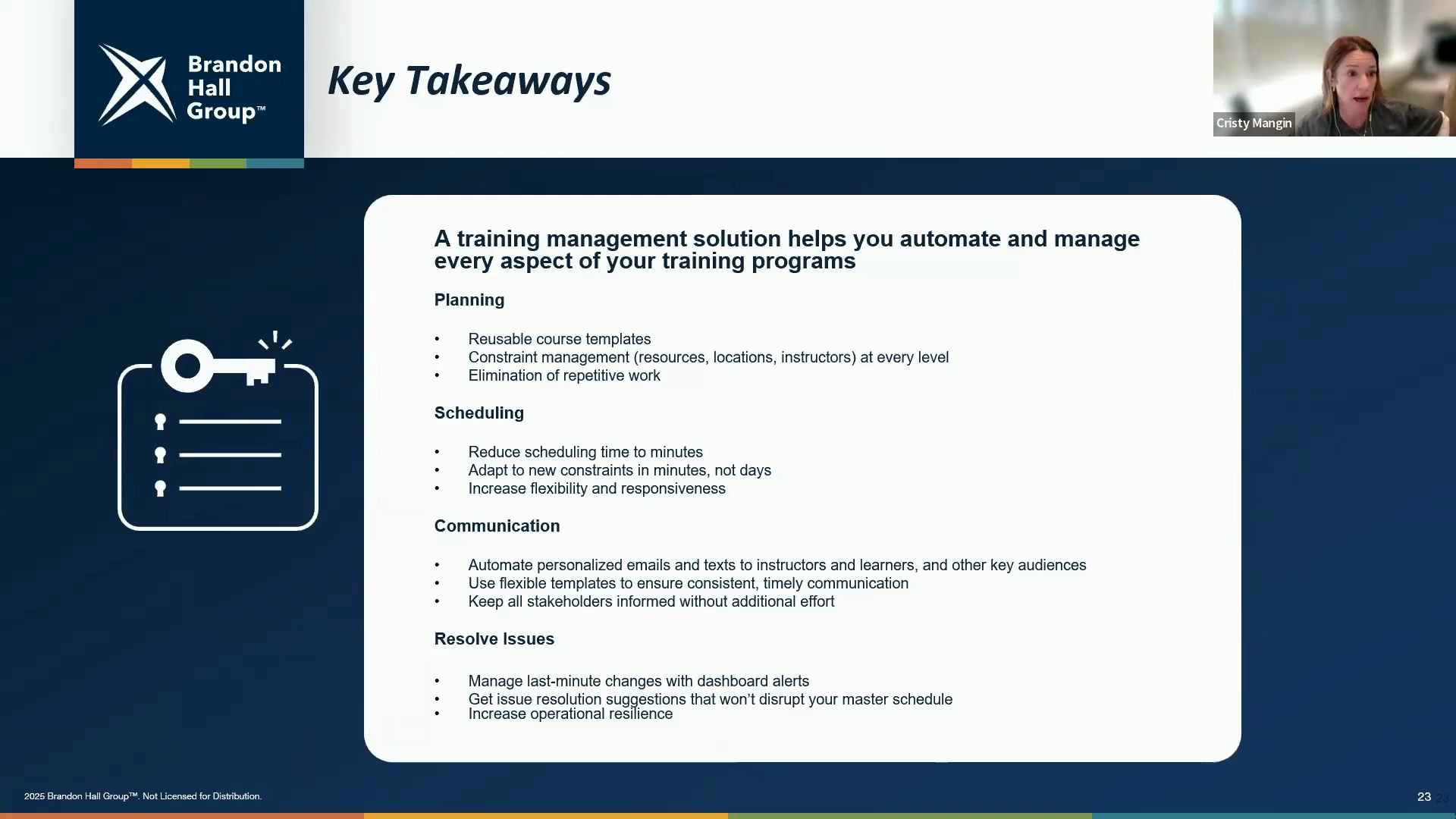
Excellent. Well, as we as we come up on time here, any final thoughts? Any key we've got some key takeaways on the screen, but I'm really any final words from our panel about what you hope people take away about this really important challenge that we're all facing? Michael, let's start with you.
Okay. Cristy, final thoughts, final encouragements? No. I I think it's definitely that relationship with Administrate was was a big key success for us and and continues to be, so keep that in mind. But I think the whole, like, who is doing the work that you need to automate is a big, important part of the puzzle that you need to pay attention to, so that you can go back to the CFOs that you're saying, Hey, I have an instructor that makes this much money that's planning resources, and here's how much that costs on a daily basis. And that was our significant decrease in cost was, like, damn, right away. We have the right people using the tool that they need in order to do what had to be done.
So that would be my kind of final. Okay. And John or Michael? Yeah. I would just echo what what Cristy said, and I I mean, I'll put words in your mouth, Cristy, but my assumption is that based on the just the incredible instructor that led me around on the tour, it is very difficult to hire those, but you can't just snap your fingers and get a molecular PhD, whatever. I don't know what. She just knew everything about everything chemistry wise. And then it's like and then and then get them trained on all this Roche equipment of which they're all these variants and stuff. That is just that is an unsolvable problem in terms of, like, snap.
You you can't spend the money to get five more of those people. So that is just a big a big problem, and and, yeah, having those people do the right jobs is so important. Yeah. And we we definitely you know, that person in particular was also one that was getting ready to retire, and so that we all literally were like, oh, geez. Now what are we gonna do? Because Althea knows this, and she knows this, and she knows this, but Althea should be focusing on that, not, you know, who's in room twenty two zero nine. So that was, yeah, just a big, huge key for us. I'll just add quickly. Sorry. I couldn't get myself off mute for something. Technology is great when it works. Right? But I'm I'm just gonna focus in on the elimination of repetitive work.
And then we we talked around a lot of the strategic value, but there's so much repetition that takes place that if we can get that away from leveraging biological intelligence and people's time and get that into a system that can do it flawlessly in that scale, there's a lot of money and time and energy to be saved right there. And there's just not a platform that's capable of doing unless you have, like, a dedicated system like an administrator.
Excellent. Well, we thank you guys so much. Thanks, panel, for your insights and your your your sharing your intelligence with us today. And we thank you, the audience, for us hanging out with us and asking your questions. And with that, I'm gonna call my colleague Ivy back in to announce our raffle winner. Thank you, Matt. I'm thrilled to share that Heather O'Neill has won fifty percent off in HCM Excellence conference registration ticket. Congratulations to Heather. We'll be reaching out shortly with more details. And with that, we will, send you into the rest of your day. Be on the lookout for that email that has the link to this recording today as well as the slide deck for your reference.
Thank you guys so much. Have a great afternoon. Thank you.