

Get started
Get in touch to learn more about how a TMS removes risk
Training Management Systems make training easy. Learn what a TMS can solve that an LMS simply can’t.
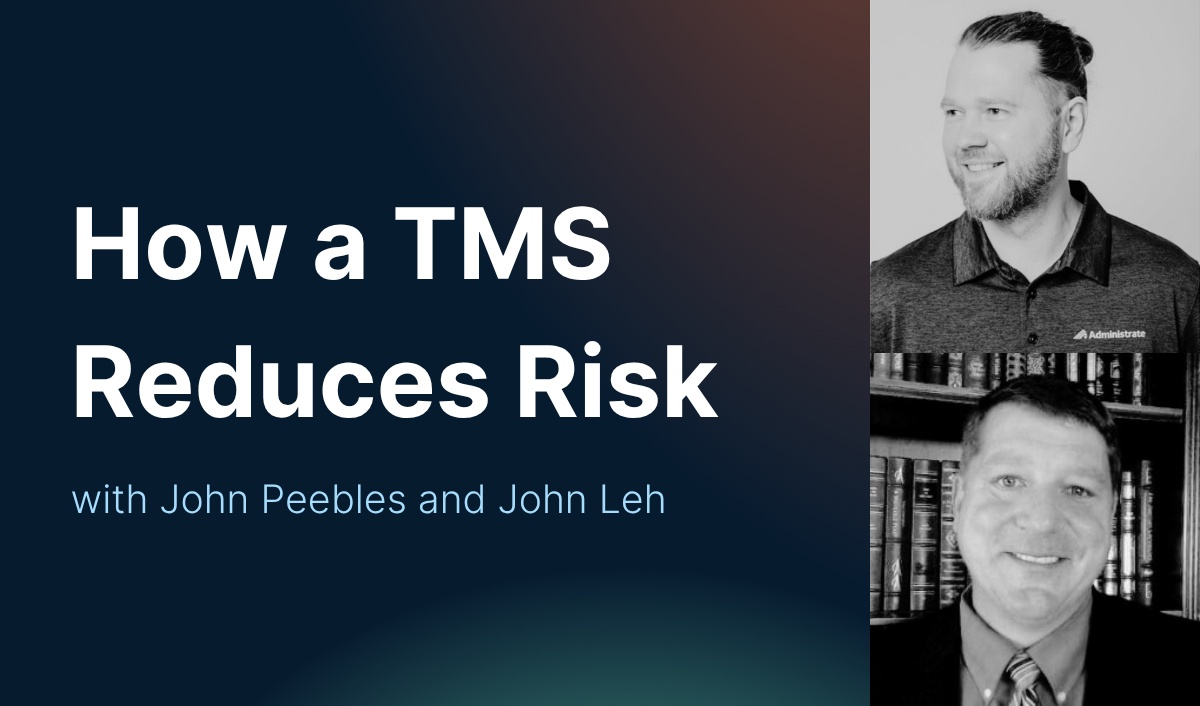
John Peebles and John Leh explore Training Management System risk mitigation and enterprise training scalability.
Live training is usually reserved for the most critical type of training a business performs. But many enterprise organizations continue to manage live training with their LMS, plus complex manual processes and spreadsheets.
In this webinar, John Peebles, Administrate CEO, and analyst John Leh, Talented Learning, discuss how a training management system removes risk in large, enterprise organizations. Learn why scaling training manually increases cost and chaos, how a TMS helps during audits and emergencies, what AI scheduling unlocks for high-stakes, resource-heavy training, how top companies like Roche future-proof their operations with TMS.
35:21 watch · 6,471-word transcript
Auto-generated transcript — may contain errors. Tap a timestamp to jump the video.
Alright. Welcome, everybody. My name is John Peebles. I'm the CEO here at administrate. I'm joined with a good friend and partner also named John, John Lay of Talented Learning. Why don't you introduce yourself a little bit and, tell us why you are so well positioned to talk on matters such as these? Why I could possibly be well positioned. Well, hey. Welcome, everybody. Thanks for tuning in. John, thanks for having me as we continue our discussion. I'm John Lay. I'm the CEO of Talented Learning, and we're a global independent analyst firm that studies the learning systems marketplace. So I spend my days reviewing systems, talking to customers, helping organizations buy learning systems, and have been doing that every day now for, the last eleven years.
And so one of the things that we keep getting into at Talented Learning is the concept of talent management systems or, training management systems rather, TMS, and learning operations and the topic of, training operations, and saving costs, and avoiding risk, and making ROI, and all kinds of stuff. And so can't wait to talk to you about it as we continue our discussion. Yeah. Yeah. Totally. And, John and Talented Learning is a place where we have sent many customers. They're trying to make purchasing decisions and understanding, you know, how to solve problems, the wealth and the breadth of knowledge and information that's there is really, really great, and we highly recommend it. And it's always super fair and super informative, and, you know, it's it's fun too when we could do these things.
So, I think the one of the things around training management systems that we have started to see over the last twelve to eighteen months. And for context, administrate has been around for a long time, but we have been selling to enterprise customers for about the last four or five years. And so a lot of times prospects out in the market will say, we've never heard of you. You're just like an overnight thing, and we're like, well, yes, in your market. Right? And one of the things that we have seen over the last four or five years As you go through these phases when you're entering a new market and there's kind of very early adopters, and these folks are usually visionaries, and they are doing big things, and they're out there leading the pack.
And so to sell to those folks and to convince them that there's a problem to be solved and and so you don't need to do any of that. Right? Because they're coming to you and they're saying, we know we need a training management system and where it's gonna solve all these things, and it's a nice spot to be. And we've actually talked to a number of customers, and made videos with them, that you can see on our website. Kevin Streater is a guy that we've talked with a lot about this early visionary, that we're now lucky enough to to have as chair of our customer advisory board and all this. And I'll and I'll get to a point in just a second, I promise. But the point here is that over the last twelve to twenty four months, as we have as the the TMS market has grown and as the knowledge and mind share of the market and and training leaders has increasingly understood that this is, probably a gap in the organization, There is this topic of risk or this idea of risk that has entered into the zeitgeist.
And what I mean by that is we are now having to articulate why it is so important to have a TMS, how a TMS can actually remove risk, and why making a purchase purchasing decision to bring a TMS into your learning operation is while it feels risky, you're actually removing risk when you do this. And so that's kind of the, I think, the theme that we'd like to to talk about a little bit today. Like, what are the risks of not having a training management system? What are the risks of bringing one in and how to mitigate those and think about those? And what's the payoff at the end, when when you have this working right? Mhmm. Yeah. Absolutely. And, risk side of the equation sometimes feels like the more boring side, but it's actually critical, of course, to the businesses.
And with the TMS, you can really look at the two sides of the coin, either risk avoidance or you can look at generation of return on investment. And, we've talked about the the regeneration of return on investment lots of times. And today, we're gonna get a little more tasky on, on the risk thing. So, hey, we'll start off with with you. You know, what's, what do you think is the number one risk, that gets alleviated with through the implementation of a TMS? That's a good question. I I I can tell you my top three, four, five, narrowing it down to the number one risk is a little tricky. But if I had to say About two. Yeah. If I had to really pick one,
we were we were talking to this, European prospect a few years ago, and they they said something. I said, well, you know, if if I had to put a gun to my head and they just, like, stop they're like, that is so American, right, to say that. You just so don't use that phrase in Europe. But, if I had to put a gun to my head, I would say that the probably the number one risk that a training management system will remove from an enterprise operation is this idea of a ever increasing coefficient of scale. And what I mean by that is as training organizations get bigger, they get more complicated and more throughput is required of them in the form of learners, they get less efficient. And this is well supported in the literature. We've seen it, anecdotally, if you've ever been in a training operation.
But it's this idea that in order to do more training, which which organizations need as they're growing and going through change, they need more and more and more resources and people. And so with a training management system coming in with automation and standardization and all those nice things, you can remove that need to have to bring more people, things, cost, everything to scale your training operation. You you're freed of the shackles of this kind of inefficiency that's gonna be not only there, but increasing as you as you get larger and larger. Yeah. Yeah. No doubt. No doubt. I think the pile on to that is, you know, the end result is that is it is to have a single, record of truth or a single truth record of of all your training data.
Because I think what happens in or what does happen in big organizations is there's a lot of mergers and acquisitions and global expansion through that. And and organizations without even trying collect two, three, ten different learning systems and different ecosystems. And you really have a couple choices at that point. One is, you keep going down that path. Or two, you try to centralize those learning systems. But an easier path a lot of times is to to snap in a TMS that will allow all that to share data and talk and get to that single truth no matter where you're at in the organization and what acquired. And just alleviating that risk right there from a regulatory compliance standpoint or from just an organizational efficiency standpoint is probably one of the bigger, immediate payoff, applications of, avoiding risk with the TMS.
Yeah. Totally. I mean, one of the things that we see all the time is that when things go wrong, and people just don't think about this maybe intuitively, but when things go wrong, usually, the training team is one of the first phone calls that gets made. Right? There's some sort of problem. I've told this story before, but we're on-site with Maersk, our customer, and they got a very urgent phone call, had to interrupt our meeting because one of their ships had run aground. And so when that happens, obviously, you know, law enforcement and emergency services and all this stuff are getting involved, and there's tons of paperwork, but they need they needed to check all the training records and certifications of everybody that was on that ship and everybody that loaded that ship and all that type of thing as within the first hour of this happening.
And so training teams get put under enormous pressure. Imagine if you had to go out and dig out Excel files or, you know, run into some paper filing cabinet somewhere or whatever. For luckily, they had administrate as a TMS already put in place, and it was just a a few minutes, and the data was all up to date, and that was that was that. But that is kind of one of those things where you talk about risk. You know, we have financial services customers, and they might get sued, and they have to figure out who got trained on what products and all kinds of stuff. And and this this is a huge topic that is usually kind of not thought about as, like, a first class reason to buy something. Yeah. Audit readiness usually doesn't hit the top, five of your things you think about every day, but it's really important.
It's not just in, you know, Maersk, you know, from a shipping standpoint, but it's really any industry that has, you know, some danger to it. Yeah. And so, you know, just look at the news here in the last, you know, month with aviation travel. You know, every one of those immediately after every one of those accidents that's happened, you know, they're doing exactly what you said. They're going back to the pilots. They're going back to the maintenance. They're going back to the records to be able to have to pull this for that immediate audit. In that time, you know, it's for an emergency. But the the the conversely to that, then there's the regular audits that go inside, you know, these regulated industries all the time. So having that single source and being able to eliminate, the hands on, because that's where errors, always. The minute that you have to start transposing data from one spreadsheet to another or getting humans involved at all is, you know, especially with a consolidation of data like this, that's where all the errors come in and and where the risk starts increasing, for sure.
Yeah. The other the other area of risk that that we see a lot, that again, I don't know if people it's one of those areas where maybe this is the way it's always been done, and so we don't we don't interrogate it very heavily. But the the idea of, like, time to competency, right, is a metric that a lot of our customers want to track for their own employees, but also for their customers. Right? So if you imagine you're you're trying to go to market, you got a growing business or, you know, some new new market or product that you're gonna launch or just you're just growing. Right? You wanna make sure that the people that you hire can be competent and out there doing the jobs they need to be doing the shortest amount of time.
And you want that for a couple reasons. One, you want them to be productive and and great and have a have a really good career and doing all the things they need to be doing. But also, if it's not the right fit, you wanna know as early as possible, right, before. And and so the the more we can shorten that window on a employee side, the better. And the second piece around customer training, we have a lot of customers that sell a lot of high value, equipment that is, you know, dangerous to use maybe or at least very complicated or could be dangerous to a patient, like in a medical device setting or or whatnot. And so if a customer is taking forever to get competent on using that product, then that and that could be risky. You might lose the deal. They might ask for a refund or return the equipment, whatever it is.
And so that time to competency is a is a huge risk mitigating factor that training teams can materially move the needle on businesses. And if you wanna do that at scale, then you're gonna need a system to do it. Yeah. I think pile it on on that that concept of, you know, the big equipment. You know, think of, like, flight simulators or really anything from a day of mining operation equipment, you know, things that are are super dangerous. The the the simulation environments, the trading environments are wickedly expensive. And so, you know, losing any time on booking those up or having conflicts and, you know, not slotting the maximum amount of people to, you know, utilize those things is a is a terrible waste, but it's also, you know, it really kills the efficiency of these organizations.
And that's just one piece of equipment. So you look at training organizations, you know, that might have a thousand of these pieces of equipment, and they have to be shipped out to different locations for on-site training, aligned with airline flights and aligned with instructor schedules, and doing that, accounting for days off and days off in Europe that you don't think about. And, you know, you put all these pieces together. You know, that creates, like, a ton of friction in organizations to try to do this manually and and then try to take advantage of, the operational efficiency of of these things. And so, you know, just eliminating all that risk by automating that and making that efficient, you know, saves organizations, especially in organizations that have these this high equipment, huge amount of of effort, time, and save and cost savings.
We got a customer that I love to visit. One, because their their operation is in the city of Indianapolis, and I have family there. And I'm a big Colts fan and root for the Pacers and so forth. So I always try to squeeze in a couple of games. But also, they're just a great team and and really, really on the forefront of of innovating and and trying to do more or less. And they were one of the beta testers for our, scheduler, our AI scheduler feature that we released last year, and it's, it's Roche Diagnostics. Right? And they make all kinds of blood analyzer machines and testing equipment, and and, you know, if you've ever been in a hospital or gone to a lab to get some tests run, odds are a Roche machine was was part of that process.
And, it's like as last fall, I was visiting them, and they were like, why don't you come on the normal customer tour? And I was like, yes. I would love that. And so we we start this tour, and and they've got this huge training facility that is just this cavernous building. It looks a lot like the, the factory floor on Monsters Inc. If you've ever seen that that film, you know, this is just big, big, you know, you know, training facility, and the entire floor, as you walk out onto it is, just filled with all kinds of these machines. And they're not only are they a machine to analyze one part of your blood work, but they have these assembly lines that you can basically have the blood go from machine to machine to machine and do multiple tests and all of this stuff.
And it's, like, the coolest model railroad thing. It's, you know, all these blood vials are whizzing around and all this stuff, and it's and they bring not only their own techs to get trained on how to tear down these machines and repair them, but also customers come in, and it's usually a multi day or maybe a week long training course flying in from whatever part of the country they're in or all over the world. And they sit there, and they get certified. And we had a a PhD who was given us and one of their instructors, was giving us this tour and talking about biological concepts that I had never heard of, you know, it's like it was it was really, really cool. But to your point of if so in order to run a class, right, you've gotta have hotel rooms booked, and you gotta make sure flights have been booked, and all this stuff has to line up, and then you have to have the agendas, and you have to make sure the right instructor there.
And you can't just borrow an instructor from this bit because they won't have a PhD. They won't be certified. They won't you know, these are clinicians and physicians and so forth that are coming in for this training. Meals have to be ordered. And then we get down to the the fake blood has to be procured, and then it has to be loaded into the vials, and then they run through the machine, and then it has to be cleaned afterwards. And so all of this stuff has to be is an opportunity for things to go wrong. And we've paid a million dollars for your machine, and you've paid ten thousand dollars for your, you know, week long training. If all of a sudden something is not right, not only does it tank the perception of the quality of what you're getting, but it could have very real consequences in terms of, hey.
We're not ready or they can't get certified. What are they gonna do? They're gonna spend the weekend in Indianapolis and do it on Monday or Tuesday? And so the challenges that they have on just making sure the right equipment and people are at the right places at the right time are introduced enormous risk for them. They're they were they're growing very rapidly, so they were already building a a a couple more training centers that are in the same area, but they just ran out of space. And, this this there's millions and millions of dollars at stake, and it's critical to their success as an organization. And so the fact that they need a training management system should be a no brainer, but it's it wasn't until a couple years ago that they became a customer, and they've been running, you know, this way for a long time.
And so to see the the the people power that got freed up through that that process was very satisfying on both sides for us. Yeah. Right? I can imagine. I can imagine. I think, well, in a lot of people or professionals might not realize that a TMS would do it in an instant like this at at Roche, as you described is, you know, for each one of those machines, there's a series of things that has that has to happen, you know, starting thirty days before that training, starting six months before that are sequential from getting that fake blood, making sure that's it, having the machine sequential from getting that fake blood, making sure that's it, having the machine serviced and cleaned and recalibrated. And all these things have to happen at a certain interval, you know, leading up to one of these training sessions. And, you know, reinventing the wheel and trying to do that every time is insanity.
And so, you know, one of the things I always think that's cool about a TMS is is that they automate that process, in in a concept of a template, if nothing else, using the the concept of offsets a day so that you can just keep on anytime that you have to do that, you have the whole program already built. And that whole program, that template of all the things that have to happen is not included in a single LMS in the world. And so if you don't have a TMS, then there's only one way to do that, and that's the hard way. You know, I think and that's where a lot of risk comes in and, you know, imagine trying to do that manually with a thousand machines in there. That's crazy. Yeah. And then what was interesting about the Roche example was, so you get those templates, and that's just for one course, you know, and that might only be a few machines.
And those offsets so we started out years ago with the days concept of an offset, and we're just about to release hourly offsets, which is because people are like, now we want it to be more fine grained. So but, you know, it's like Soon as you release that, they're gonna want minute minute Yes. Credible. For sure. And, but, you know, some of this stuff too, it's not just a binary, like, order the meal. It's it Farosh was and, you know, we all intuitively know this if we ever stop to think about it, but but, you know, you don't think about it. And so we're we're going around the floor, and they're like, there's there's a machine over there, and they've all got these crazy, you know, long numbers and letters that I can't understand how they remember this stuff.
But they're like, yeah. That's the assembly one certification or something. And it's basically they're teaching their mechanics to put together the machine and diagnose specific problems. And so once the class is done, another tech has to come in and has to disassemble the machine back to the starting point for that lab or that class. And literally, like, pulling the wires out and maybe putting in the damaged part and all, and then reassembling it back. And then and and it is like this type of thing would have had to all been done manually. They would have had to get in tech emailed on. Now it's all it's all been done automated. And so when you have those templates for one class, then the challenge becomes, yeah, but we're gonna run thirty of these classes a day throughout this ginormous building.
Right? And how do you then get that Tetris puzzle of a schedule into place? That's huge risk because, again, utilization needs to be high in order to be profitable and and do all the things that they need to do to hit growth. And so that's where that AI scheduler feature, which we've done a deep dive video on and, you know, just definitely check it out, came into play, why they were so excited about that feature, and why they got so much ROI off that because it was time saved, but it's also risk avoidance. And, yeah, it's been a it's been a thrilling story for us, and for them. The schedulers, as we move into that topic, your scheduler or the the scheduler in in general also gives you another huge tool to avoid risk.
And that's just contingency planning of running what if scenarios of, you know, you're running thirty of those classes at the same time, and now start adding in, you know, different locations and different countries and different languages, and, you know, it becomes exponential. And so to be able to just run different scenarios, what if we tried this? Or what if we just booked it all here for a thirty? And and see if you could make things happen, you know, without that, well, you can't do that. Because just to come up with your original one, you know, takes a month locked in a room Yeah. You know, to to plan that out. So nobody there's you can't find one person that wants to sign up for an if then game. Totally. Totally. And, one of the one of the interesting things about the scheduling problem, is if you think about this and somebody comes in and plunks down a schedule in front of you, maybe it's just for your family vacation.
Right? So I have a very organized mom. She was a teacher. And, we had a big retirement celebration for my parents, and it was earlier in the year. But that schedule was published about six months in advance. Right? And so but if you imagine, you you have a schedule for something as simple as a five day family vacation with a couple of activities a day. Right? Or it's, you know, not nothing huge. But let's say you get another version of that schedule and something has changed on it. How do you compare them? Right? That's actually kind of an interesting problem to solve that we had to come up with because when you talk about iterating, you know, and figuring out, like, is how is schedule a better than schedule b? And, you know, my my six year old niece might say, well, there's more pool time on schedule b.
And it's like, okay. But, you know, you you have to actually think about this. And so that's one of the things that the scheduler within administrate will do is it will automatically generate a lot of metrics primarily around utilization, but it'll say, you know, here's the utilization, mean, min max and median, where are the outliers, here's how many hours are being used, all of these types of metrics that help you actually quantify whether a schedule is better or worse or more expensive or less expensive. Wow. And, of course, now that we've done that, every customer is like, yeah. But we want our tailored metrics to go in it, so we'll do that too. But that that again is one of those kind of risk management elements that people just tend to struggle with. You know, we're on we're on iteration twenty four.
What is the difference between that and iteration seven? You know, it's it's very hard to do that, unless you've got some assistance from a system. Wow. Wow. Cool stuff. Cool stuff. And if you pile on any, to your example about the, the vacation, you know, that's more serious than it than it sounds because, you know, imagine if you have a thousand trainers. And so one of the cool things I like about TMS is is that they finally solved the problem of integrating in with calendar systems. Now LMSs have their own calendar system, and that's cool, but it's reactive and it's manual. Everybody's gotta put in their own vacation if they even have that capability, you know, put in their own kind of dates manually to do some basic conflict checking. But, you know, if, you know, you can't plan anything in advance, you know, from a a personal standpoint, you know, without the capability of of of changing.
And so by by locking into, like, an Outlook system, for example, that that reduces, like, a ton of risk by the just the need to reschedule things and cancel things. Oh my gosh. There's no way you can miss your wedding again. So we're gonna have to cancel this particular class. You know, that all carries risks, you know, down with your students, you know, their timing, when they're supposed to do that, you know, depending on what your business is. So, you know, just that part alone of being able to automate that and be sure to go with the court calendar system. Seems so simple, but for some reason, well, we struggled with that as an industry for a few decades. Yeah. It's it's in it's really interesting, and we've got another deep dive video about that as well. But the idea that we can read and write from instructor calendars and from resource calendars, so if you've got meeting rooms, for example, that you might be sharing with the rest of the business, which happens all the time, we can also sync with those calendars.
It's almost like we have to usually show it twice because people are so shocked that this is a thing when they see it the first time that they're like, yeah. But, I mean, are you really reading off the instructor calendars and you can then sort to the top the people that are available and even show why the other people are not available? It really blows people's minds, and it it's such a powerful feature, that we're really proud of and be mainly because it just makes decision making so much easier. Imagine not having to cycle through fifteen different calendars to find somebody who's available, but, you know, it's just right there. So, yeah, it's been that's that's, that's probably, like, risk of your own employees, like, you know, leaving because they're so frustrated because they're spending so much time on this stuff.
Yeah. It's great. I need a TMS just for my personal calendar. Totally. Totally. I spend way too much time on that. Hey. You know, something else I was thinking, you know, from a a TMS standpoint, when when I think of it, in addition to all the things that we we talked about today, I think they almost like the centralized brain, you know, that that hooks everything together and it you know, it's got it, it's the octopus that's getting its inputs from everywhere and and putting them out from everywhere. But one of the things that that's a trend bigger than that, in in corporate the the the corporate world is this reduction of SaaS systems, in in general. And that every organization has too many of SaaS applications, parallel SaaS applications, applications that have, you know, a crossover of functionality.
So one of the ways that a TMS adds super value to an organization is it makes them less dependent on any one given technology. Because it since it's all integrated, the ability to snap a piece out and snap another piece in and not muck up anything in your whole process is almost unheard of, when you think of it to a traditional way. So just that factor alone reduces the risk of one being behold to any one vendor or maybe there's mergers and acquisitions and things blow up. And, you know, a TMS, as you know, can connect a ton of different things from scheduling, calendar, and CRMs, and HR, and ten different LMSs, and LRSs, and single sign on ecommerce applications, hotel reservations, you know, all these different pieces.
And so to be able to have that control, to to be able to manage that ecosystem, you know, is something that a TMS brings that I bet you a lot of people don't think about. Yeah. Hundred percent. I'm glad you went there. We now this doesn't happen overnight, but within two to three years, the kind of over under for our enterprise customers is fifteen integrations. Most of them have around fifteen. Some will have more. Some will have less. We've got a video of one of our customers also named, John out there, who I think is up to, like, twenty six or something at this point. Some of these are off the shelf integrations, that, you get when you purchase administrate, but some of them are ones that, him and various tech teams and so forth have built, and and some of them are our partner network has built alongside.
So there's a bunch of different ways to solve this problem. But that idea of not being locked in has been really interesting to witness. ForgeRock, is an example of that within our customer base. They, came on board when they were a series a startup, something like twenty five people, open source software company. Training was really, really important for them and for their growth story. And over the next ten years, they went all the way through to going public, and then they got acquired by private equity firm and taken private again, and then they got merged with one of their biggest competitors, Ping Identity. And so that's a lot of change. And they went from using, you know, SurveyMonkey in the days of twenty five, thirty five people to using Qualtrics, and then, of course, having to swap these systems out and then going through a merger, even more systems had to be changed.
But through the whole thing, administrate and the training management system was there, and they changed almost all of their various vendors, including their LMS a couple of times and so forth as they grew and their needs became more and more complicated. So they were future proofing themselves from, a whole bunch of heartache, and and they went from being a drag on the business, a potential drag on the business as as, you know, training was so important to them to being really a supercharger for that organization. And it's a really great story. We've got a lot of, videos with with Kevin as well talking about that that journey. So I'm really glad to Well, there's some irony in that story, listeners. In that, you know, when you think TMS, you think, yeah, it has to be the complicated.
Even I fall under that trap a lot that, you know, I'm looking for the most complicated scenarios because that's where the TMS has the most value. And that's true. But the problem is if they you will wait till it it's all complicated, you know, then you gotta unravel that mess piece by piece Yeah. You know, when it's all, you know, all grown up and un and and tangly. But if you think about these things early, especially high growth organizations, you know, in the software space, for example, thinking about these things when you are in that twenty to fifty, employee range and just standardizing on it right away for customer education and growth and scalability, you're doing yourself a a big favor. Yeah. And, you know, it it doesn't have to be one way or the other. We've got a bunch of stories.
Siemens is one of them. Siemens Healthineers, where they had a twenty year investment in custom homegrown, really purpose built systems. And we came in and we linked up with those, and, you know, they there are other couple of things that we help them untangle and so forth, but it it you know, you can come out up from a bunch of different directions, so don't lose heart if you're not, you know, series a startup with a lot of funding and, you know, plenty of, money to throw at the problem and no legacy because we've we've done the other way as well. But, I think maybe bringing the the whole thing to a close, you know, to summarize, really, there's a lot of risk in not getting a training management system in place.
You've got your own team is at risk. Your business could be at risk. You could be at risk of becoming that dragnet and, on growth, or or kind of a a hand break on the organization and what you're trying to accomplish. And if you think in terms of buckets, there's removal of risk around planning, scheduling, delivering training, but also around reporting, and getting all that data lined up that that you need, and then also the the technical risk around integrations. All of those things should be on your checklist to when you're evaluating a training management system to see how they stack up because all those things will will be important over time. For sure. For sure.
And if you get any pushback internally, I think the, you know, the one argument is, you know, name another business function where this hasn't already been done. And, you know, you can't. Training is really the last one. And so this is the last low hanging fruit to to really avoid risk and automate and really put your position put your organization in a position to scale. Yeah. And, you know, there have already been explorers that have gone before you before you, you know, into the, the last, unknown. So don't, don't worry about that. We love to share stories like we've done a little bit today of various case studies and and ways that we've helped these organizations. Those early adopters have blazed a pretty clear path, and, you know, it's probably time if you're if you're listening to this to to and you haven't implemented a TMS and you're a multinational enterprise or, you know, quick fast growing company out there, you really need to get this problem solved.
You won't believe the difference it makes. Our promise is we will remove ninety percent of the manual effort required to deliver classroom training, in ninety days because that's our standard implementation time frame. So ninety percent in ninety days, that's what we that's what we will tell you if you wanna have a conversation with us and check out all the various resources and things that we have on the website. And, you know, give us some feedback. Let us know. Really appreciate it. Awesome. Awesome. What's your website again? W w w dot get administrate dot com. The company name is administrate, not get administrate. We're we're wanting we're wanting you to do something. We want you to get administrate dot com. Call to action. That's the marketing. That's the marketing. You can see, our stuff at, independent research and analysis on training management systems and learning systems in general at Talented Learning dot com.
And you can also book a complimentary, consultation with me if you wanna talk about your situation, and I can help you think through it, with the TMS. And I'm sure John can too. That's right. I I am very biased. Right? So this John is very biased. The other John is not. Very very independent and gets a great view to all the various systems out there. So feel free to book me first, and then I'll point you in the right direction.