
Get started
Administrate Automator: Deep Dive


Demo: See how Administrate Automator brings powerful automations to training, no IT resources or coding needed.
Are you selling training? Maybe you should. In this video John explains common business models you should consider and ones you shouldn’t.
John Peebles, CEO, makes the case that for a product company, a quality customer training program is the highest-leverage investment available in customer success — and that Administrate’s own biggest mistake was waiting six or seven years to build one.
The evidence: customers with one or two certified users halve their support ticket volume, feature adoption gets faster and broader, classrooms become a structured product feedback channel, and ForgeRock used training engagement as an early warning of churn. Learn why you should charge for training rather than give it away — neither your customers nor your own organization will prioritize what carries no revenue.
The core obstacle: a class is a specific person in a specific place at a specific time, and nobody knows any of that at the point of sale, so sales teams won’t sell classes. See how tokens (your own currency, sold in blocks and drawn down as anyone books) and subscriptions solve this, and the targets to aim for: break even on the training operation within 12 to 18 months, and roughly 5-10% of new product sales in attached training revenue.
46:37 watch · 8,015-word transcript
Auto-generated transcript — may contain errors. Tap a timestamp to jump the video.
Wow. What a perfect break. The song ended right on time. That never happens. So, very, very happy to be hanging out with you all again today on LinkedIn. We're doing this about every week now, and, it's good to be back in Scotland, our intergalactic headquarters, and we've got a lot to cover today. So I'm gonna just dive right into it. This is a topic that I think is so important for product companies that, we're gonna devote an entire LinkedIn live to session to this, but we're also gonna bring on some customers to kind of, you know, reinforce what what I'm saying to you because I realized that there's a lot of different viewpoints and, there's a lot of good stuff here that, we'll want to to get other people to weigh in on.
So, let's go over to our agenda today. Selling training. Why does this matter, and what are all the different business models and things that you wanna consider if you're a product company that is gonna be selling training? Now today's focus mostly is going to be on if you are a product company, I e, you're selling a product that is not training, that's your main product, and you want to figure out how to weave training into that. And there's a whole bunch of benefits, and we're gonna talk about that and so forth. But, you know, some of these things that we're talking about today will also apply if you are a training company that where your primary business is the sale of training. So not everything will be one to one, and we'll do another probably deep dive into how a training company should operate and so forth in the future.
But today, we're really kind of focused on product training. And so the agenda for today is to talk about why are we selling training at all, why is this important, the challenges around selling training, and how, you know, the pitfalls and things that people tend to stumble into and so forth and how to solve those. Discuss various different business models that we see being very effective out there, and ultimately talk about some of the outcomes that you can expect. So, you know, we got a lot to cover here. Got my trusty, Lego head mug here or as we say in Scotland, Lego heed.
Still getting over a bit of a cold. So today's, broadcast is also still sponsored by Lemsip, the all time greatest cold medicine that you can find, both in powder and pill form. I'd highly recommend it. I think it's a UK only thing. And, you know, the UK invented things like the world wide web and the steam engine and so forth. I think LMSIP is, the greatest, claim to fame in terms of invention. So why are we talking about this? Why is this so important? What is in it for organizations when they think about training and selling it? Why? Why would you do this? And the simplest answer is this, which is customer success. And I'm gonna make a statement here that may strike you some of you as bold, but I absolutely completely believe it.
And, it's a blind spot for a lot of folks Whether you're an entrepreneur building a company, whether you're an established business, that has been going for many years, you know, a lot of the companies we work with are large multinationals, and they still haven't gotten this right or thought about this in the correct way. And that is a quality training program is the highest leveraged investment that you can make into customer success right now. I don't care what size of company you are. I don't care what stage you're at. I don't care what your product is, whatever. We believe this. I believe this. And, you know, when you think about that, being able to make a blanket statement like that, it's pretty powerful. So we're gonna we're gonna back that up with a whole bunch of, discussion.
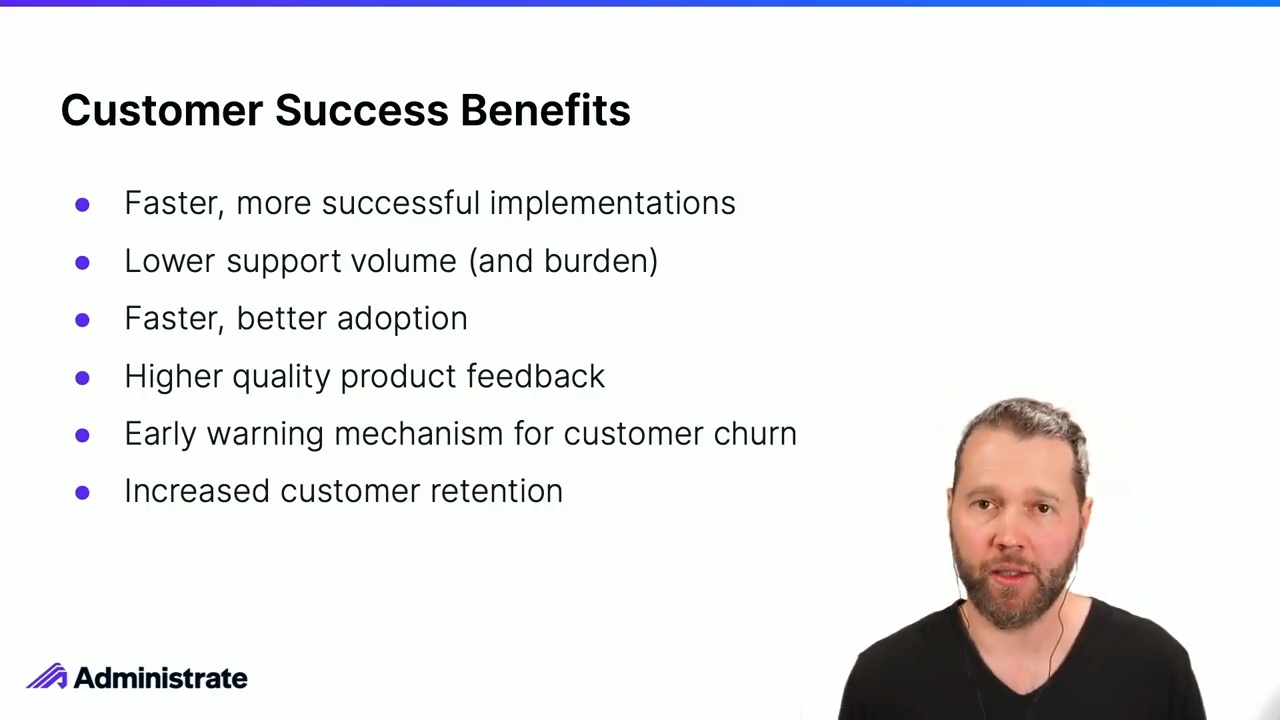
But this is the highest, leveraged thing that you can do right now into customer success is building a quality training program that you are selling the training for, to your own customers. Okay? And the benefits in customer success are far ranging. So these are just a few of them. There will be others that will come out of this, and we'll talk about some of those, a little bit later. And we'll bring some customers on here and talk about this with them. But, basically, here's just a list, that that we have seen, not only with our own customers, but with our own business ourselves. One of the things that I mentioned when I was posting on LinkedIn about this, livestream last week was this is one of the biggest mistakes we made at administrate when we were trying to grow as a company is we waited too long and did not invest into a customer training program that we were selling to our customers.
It hurt our growth. It hurt a lot of our customer success metrics. It's something that I wish I could rewind the clock and probably start that maybe within the first couple years of getting going. I think we waited until kind of year six or seven after talking about it for a few years. So don't be like us. Solve this problem as early as you can. If you're an entrepreneur or startup and if you're in a large established multinational, make sure that you put investment here because it'll pay off big time. So faster, more successful implementations, you know, if you've got a training program that's there that people are working through alongside in tandem with implementation, that is a a fantastic way to make sure that the implementations go smoother and, don't drag out. Lower support volume and burden. So when we launched our customer training program, which we call administrate university, it actually blew my mind.
And and we're in this business. Right? Our our whole platform is designed to support, training and customer training. And, what happened was, you know, we released the the program and, everybody was talking about metrics like, you know, hey. We got, you know, twenty five customers through and, you know, so far and certificates were being issued and people were completing the program or whatever. But the thing that I'll never forget that happened was our customer success, VP came in and said, hey. By the way, did you know that anybody that went through the training program and was certified, for the entire customer, not just the user, their support ticket volume dropped by half. So they're submitting half as many support tickets, and that was just with one or two certified users.
That was not, the entire user base at that customer. And it makes sense. Right? If you've got a question, you're gonna go to your expert that's on your team that's, you know, sitting a few desks over on Zoom or Slack or something like that, and you're not gonna necessarily submit a support ticket. So it was a massive improvement in terms of volume, for us. Better adoption. So we kinda see this on two axes. The first is you will get increased adoption
faster adoption when you have, customers that are have gone through a training program or that is supported by training. And what I mean by that is if you release a new feature or you've got a new new product line or you acquire a company and you're rolling out a new product, the customers that have invested the time to go through your training programs and that see these new training modules come up are gonna be much faster at adopting new features. And you'll you'll find that this is becomes a superpower over time because, you know, it's just, continues to pay off, the the more that you you do this. So it's it's a fantastic way to increase adoption both in speed and also just in terms of breadth. One of the things that we noticed, and I know many of our customers that work at product companies notice, is that you get much faster, much more high quality product feedback when you've got a customer training program.
And if you think about it again, this makes sense, but it's one of those things that we don't necessarily sit down and kind of have an moment around, which is if you have folks that are sitting there in a classroom training environment that are being taught by instructor and they're going through the product and so forth, that instructor, those folks that are in that class will start feeding back on what they like and dislike about the product, and that can become one of the best sources for your product and engineering team, to to gain feedback. And they can gain it in a structured manner. Right? You can actually not only get the unsolicited stuff that's coming back, but you can actually put questions out there for those classes and those students that are coming through the programs and say, hey. You know, for next week's cohort, we wanna see what the feedback is on this, or as you're training this feature, get feedback, along the way.
So it's it's really, really a a great mechanism for that. One of my all time favorite stories and benefits for a training customer training program was actually a case study of ours that happened to a company called ForgeRock. And we're gonna get, Kevin, who's formerly their VP and built that whole training program from the ground up. He's gonna be coming on, not only our podcast that we're launching soon, but a couple other LinkedIn lives. Great guy. Known him for years. And, he'll he might tell this story, but I'm gonna tell it, very quickly for him. And that is, ForgeRock was a software as a service company, large identity management provider. If you're in the UK, for example, and you process a transaction using the open banking network, which is a lot of us, the authentication mechanism for that open banking initiative is provided entirely by FourDrive.
They've now since merged with Ping. So it's a very large, formerly publicly traded company. They started off, very, you know, like like most startups do small and then grew over the next seven or eight years just a rocket ship ride. And for them, subscriptions of their software was really, really important. And one of the things that they noticed was that by monitoring the training uptake, they could predict customer churn. And that, again, it makes sense when you start to think about it, but customers who are not interested in renewing for your product or have a beef with your product or they're just whatever, they're not getting along well, they are gonna stop doing the training. They're gonna stop engaging with the training first long before the decision or the the message has been sent in to the renewals team that they're canceling.
And so Kevin and his team on the training side could start feeding this information to the renewals team and to customer success and account managers and so forth, and they could head off, churn or at least not be surprised by it. So it was a great early warning mechanism. And ultimately, all of this boils down into increased customer retention. I don't care if you're a subscription software company or not. If you're selling products, people are gonna come back over and over and over again and much more so if you have quality training that helps them achieve success in a much faster, better way. Okay? So, and there's a whole bunch of downstream benefits from this as well. Right? We're talking customer success is kind of the one or two word reason why you would want to do this.
But there's a and it'll drive all these metrics, like things like NPS, CSAT, adoption, whatever. But there are a whole bunch of downstream benefits that you will get as well. So customer success, think of that as the kind of the initial carrot. But once you've achieved that and you're driving those metrics and you're working really well, there are other things that will happen. And one of the things that I like the most, in my role and our CFO loves is the the second piece down, right, which is revenue and profit. So by selling your training to your customers, and also we'll talk briefly about you don't have to just sell training to customers. You can also sell training to potential customers or, you know, training that is adjacent to your product that would be of interest to your target customers, the those types of things.
But you can start to drive revenue, and that will then become profit over time. And one of the things that has been kind of astonishing to me, over the last few years kind of witnessing some of these really, really high quality fast growing training programs is just how much revenue can be driven. We're talking millions of dollars for for companies that are at scale, and, and we'll kind of explain why this is, probably one of the easiest ways you can drive additional revenue to your business, if you're not selling your training today, in in just a bit. And there's another thing that I kinda just call the halo of success for lack of a better term, and that is when you've got a high quality training operation that's running within your company, that is training your customers well, what tends to happen is the best practices and things that you're implementing on the customer side will start to bleed over into maybe your internal training of your own employees.
A lot of times, we recommend that customers who are running a customer that are they're running a customer training program also put all of their vendors, partners, employees through big pieces of that program, and so you get a bunch of benefits from that. The other thing is you start to basically build out a culture of learning within your organization and a culture of agility. One of the best tools that you can throw at change and and throw at change management is training. If you're gonna make a big change in the organization, spin up a training program, run everybody through it, it drives alignment, it can be an early warning system in and of itself based on feedback and so forth. And we see that by really nailing this kind of core mechanism of customer training, it starts to pay off all across the business.
And ultimately, we then like to see and we have seen many, many times where training teams become, looked at. They're they're they're moved out of that kind of cost of doing business area or mind space, and they're put into the forefront of business change that helps with careers, that helps with business growth overall, and, it it's something that I think is really important. It's kind of this, like, halo effect of of running a quality customer training program. So, okay, now let's talk about hopefully, I've convinced you that having a a customer training program and, that's alongside your product is, useful and worthwhile.
Let's talk about why it is important to sell this training. Now this is a scene from The Dark Knight, one of my favorite, comic book films. And, it's a scene where basically the joker played by Heath Ledger is, being asked, you know, if he hates the Batman so much and he just wants to get after him, why is he charging these other criminals, for his services? And he says, if you're good at something, never do it for free. Right? And I think that that is, an important lesson not only for criminals trying to overthrow Batman, but also for us when we think about training. Okay? Now I just wanna talk very quickly on this, but, really, the the debate between selling versus free training, I think, is, not one that should, really be a debate.
If you do not sell your your training, then your customer will not prioritize or value it. You only have to look at the stats around MOOCs and other kind of free online courses. The dropout rate is huge. Very few people complete them, and the same thing will translate over if you are giving your training away for free. Now you don't have to sell every single piece of it, but, you know, ninety nine percent of the training that you're delivering should be sold in in our opinion. And and that's that's very, very important. But the second thing is probably even more important than the customer valuing or prioritizing training, and that is your organization will value or prioritize your training if you're selling it, and it will not value or prioritize training if you're not selling it.
And it's a simple thing. There's finite resources. Everybody is vying for budget and so forth in order to do this and do this well, which is point number three. You need money, you need bodies, and you need time. Now you don't need a lot of money, and you don't need a lot of bodies or time because you'll be able to get, your training program profitable very quickly. But you have to value the training from an organizational standpoint and from a customer standpoint. And all those customer success metrics and all those things we were talking about are really nice, but what really, really gets people's attention is revenue. And even more importantly, after that, in many cases is profitability. So, you know, it is very, very rare for a profitable business line to be messed with, cut, you know, downsized, etcetera.
And and that's why this is is super important. And, you know, the customer uptake will anecdotally be ten times if you, if you're selling this versus, giving away for free. Okay? Now if all this is such a slam dunk and everything is so great and, you know, this is so obvious, you know, why do more companies not prioritize this? Why is it such a challenge and so forth? And I think, you know, there's some pretty clear reasons for that. And ultimately, it boils down to, we believe there's a platform problem, and also there is a business model or kind of sales mechanism problem.
So the platform problem, we'd encourage you to check out administrate. It's what we do. It's all we do is help companies, deliver training at scale classroom and instructor led training, whether it's in Zoom or or a a physical classroom. Come to us. Our software is built for this, and we've got a couple of other LinkedIn live episodes we've done in the past as to how we're different from a learning management system and so forth. LMSs will sometimes deal with part of this, but, this is our bread and butter. So talk to us about the platform challenge. We can solve that for you. And the second piece is, this kind of sales mechanism challenge. Alright? And so what I have very badly done here in terms of my graphic design abilities is I have attempted to show what tends to happen within a product company.
Right? Yeah. I you know, if you're selling high value medical equipment, if you're selling some sort of, you know, large equipment, if you're if you're selling software like we do, you're gonna have teams and their job is to sell product. Right? And the product could be physical. It could be digital. It could be software. Whatever it is, you have people that are tasked to sell this product. Right? And that all they think about is getting this product sold and out the door. And the problem is is that with, training, it becomes a distraction or a question mark or a friction point, and the sales teams view it as it is a secondary goal.
It's not their prime reason for existing, and therefore, you've kinda got this dual track. And actually, the the training sales is a complete afterthought, and often it won't even fall into the main sales team's remit. And I wanna talk quickly about, you know, why that is. So I'm gonna jump ahead one slide, and here's the basic question that any sales team within a product organization will ask, which is, how in the world can I sell this? Right? I'm trying to sell my product, and that might be hundreds of thousands of dollars or fifty k or a million, whatever it is. I've been working on this deal for a long time. And then you have the organization or the training team coming alongside and saying, well, you need to sell training in addition to that.
But the problem is training is a specific person going to a specific class on a specific date and at a specific time for a reason, I e, I need to learn something very specific, and it will be at some point in the future. And it could be months into the future. It could be weeks. It could be years in the future. Right? Because if I sell this product, maybe it takes three to six months to get installed. Maybe there's a rollout process, you know, rev one or, you know, milestone one, I do these things, and milestone two, milestone three. And the challenge is nobody actually knows. Like, literally nobody knows who will be going to what class, when, and why at some point in the future.
In many cases, the training team won't even have these classes scheduled yet. Right? They won't be on the calendar. And if you think about enterprise sales, most of the time, the people that are buying, I e, maybe an executive or so forth, they don't know, and the salespeople certainly aren't gonna distract the deal by asking them, you know, who are the fourteen people that need to go through training and so forth. Right? And so what happens is this is basically a nonstarter for most sales motions. You know, companies do not wanna deal with this. They will say, okay. Well, we'll do the sale later on or, you know, we'll bundle a few free hours into implementation or plop them on an e learning class and so forth. There's nothing wrong with e learning or bundling stuff with implementation, but this is the core reason why most companies today struggle with selling their training.
So I wanna talk through a couple of business models and, how how to solve this problem. Okay? I'm gonna go back a slide, and I've kind of put things into two different buckets, right, which is, how things get sold and then what actually gets sold. Okay? Now the direct channel is the one that we're probably all intuitively most familiar with. You know, that's where I go and I see a list of classes or training that I can buy, and I put it into a shopping cart, and I go through a checkout process, and maybe I swipe my credit card, or maybe, you know, the training costs a couple thousand bucks or whatever it is, and I need to get invoiced and so forth, and it goes through a procurement process. Right? Direct is well understood.
You know, it it is a thing. Now the challenges with direct sales are how do you keep that list of training and, products, I e classes, up to date and so forth. And that can be a very difficult thing. Right? Training teams don't wanna be copying and pasting every time they make a change to the schedule and so forth. So getting those course listings out there is a challenge and is a challenge for a lot of folks, but luckily, that's an easy enough problem to solve. You know, at administrate, we have a number of different ways to solve that problem. As simple as, you know, you go to this, website URL that's provisioned for you automatically, then you embed JavaScript code in a website. That's another way to solve it, or you can use our API. And customers have used a whole bunch of different we'll probably do a whole another episode that's just on, you know, how to integrate your website with with administrate in the future.
The second and, you know, so you get your stuff out there and people have a mechanism now to buy. Great. That's great. The second but but that is crucially not where most of your sales are gonna come from, at least not initially. And crucially, that is meeting the customer when they're not at the the ripest point for them to be making a buying decision. Okay? This is a customer's kind of trundling along or maybe they come in through SEO or maybe they hear about this from their account manager at a quarterly business review or whatever it is, and they go out to the website and they book on. Right? Where we really want to do is we wanna meet the customer when they're at their most, vulnerable is not the right word, but they're the they're at the point where they're in the journey where they're the most likely to buy, and that's when they're buying your main product.
Okay? So I'll get that to number three. The second kind of way that we see customers trying to to sell this is that, you know, usually, it'll be some sort of person on the customer success team or maybe in the training team has a dedicated person, in sales and so forth, and they'll kind of call around customers or, you know, move around customers however they're gonna get in touch with them and try to upsell them on a training package or a class and whatnot. And that can work, but, again, it's kind of that, it it can be time consuming. It can be expensive. It's not the most efficient thing. And, again, it's not hitting the customer when they're wanting to buy, when they're literally ready to stroke a check and, and make a purchase.
Okay? So what we really wanna do is those two things are important, and they should be leveraged. And and, you know, that that's that's great. But what we really wanna do is solve this problem of how product companies can sell training alongside their product. Right? Because most of the time, when you're you know, when we serve companies, we serve a lot of companies in medtech. We serve a lot of companies in SaaS. We serve a lot of companies in logistics. And the ticket price of these sales can be mid, you know, low six figures. It could be fifty k and up. And the nice thing about that is from an anchoring perspective, if you are selling a six figure deal, to a customer and you say, well, you know, we we should include a training package along with that fifteen, twenty k.
It makes sense. Right? Or at least ten. And so the anchoring is very advantageous, and it's a it's a great add on. And and we'll talk about how to do that. Okay. So we wanna we wanna focus in a little bit on selling training alongside your product, and then it's kinda like, what are we gonna sell? Right? So back to that slide earlier, you know, the what in many cases, what people think of is classes. Right? And those are the anchoring a person to a specific date, time, and and so forth. Now that is, in our opinion, probably the worst way well, we've already talked about how it's almost a nonstarter. You will not get classes sold alongside your product.
Okay? It's just not gonna happen. You will get classes sold directly and through upsells, but you're not gonna get a sales team to figure out exactly when and where a person's gonna go on a training. Okay? So the other two options that are left are tokens and subscriptions. Alright? And, I've bucketed these two, and the important thing to understand is when I say tokens, I do not mean crypto. Okay? We do not mean Bitcoin. We do not mean any sort of, cryptocurrency or anything like that. What we mean is a thing that is your own currency, and you can, you know, have a gold coin or a silver coin or whatever. And what you do is it's a mechanism for separating the decision making on who, what, when, where, and why that is required to run a classroom training for your customer, from the buying decision.
Okay? So, if you think about this, the way that we support this within administrate is it's a first class feature. You can basically say, I want tokens to be, you know, be put out there, and you can have different tiers like I was saying. Like, you can have as many different issues of tokens that that you would like. We tend to suggest people start small, you know, start simple, and just have one currency that that you're talking, in. And, you know, a lot of customers will make it an analog in terms of, like, hours, for example. So, you know, they'll they'll call it, you know, one token will be roughly equivalent to one hour. Some customers get more or less fancy around this. You can go nuts on this. But, basically, you then are selling a basket or a group of a hundred tokens.
Maybe that's a hundred hours of training. And that means that then those tokens get assigned to the customer when the sale is made. Now how that happens, some customers have integrated with Salesforce and other CRMs and so forth so that when a token sale gets made, that gets kicked over to administrate via an API or an integration, and, it's all automatic. Some customers are like, you know what? We don't mind keying in a few numbers for every sale, and and they've they've worked it out that way. But the the point is you take the tokens and you allocate them against the customer, Okay? Not an individual. This is a really key point because, again, we're providing flexibility and we're providing, basically, ease of use for for your customers or for for the your customers' customers.
And, and what happens is those tokens get loaded up to the account. So let's just say that, you know, Dell computer, buys a hundred tokens of training alongside, some piece of software. You know, maybe they bought from Oracle or whatnot. And those get loaded up. And then what happens is any user within the Dell organization can go through and browse the catalog and see all the offerings of training that you have, and, you know, those schedules will be updated and changing and so forth. And then then if they go and say, I would like to go on this training, what happens is the tokens, the cost of that training, however many maybe it was a five token course, ten token, whatever, is automatically decremented from the balance, and it's a frictionless experience for the end user.
They just go in. They say, yeah. I'd like to take this training. The balance is is, is allocated correctly, and the training team knows, okay. We now have ninety five tokens left in that example. Right? And this is a super powerful way to enable the sales of training alongside the product, and it's also a great way to make sure that the customer is aware that they've got training, that they're valuing it and so forth. And it also helps the training team keep tabs on how people are interacting with their balances and going through things. And it's all all automatic. Right? So tokens is a surefire way to get your sales team motivated to sell training alongside the main product, not distract anybody. We don't have to make all these decisions about things that we can't possibly know at the point of sale, and, and it's it's phenomenal.
In fact, this feature was championed originally by the team at ForgeRock, because they needed a solution to this sales problem at scale. They were growing very rapidly, and they needed to be able sell training. And, this is a solution that, we came up with, and it's been it's been great. Okay. So the next key thing that you can do, to to solve this problem is offer a subscription. Okay? And this is also not crypto just to keep things, you know, consistent. And, basically, a subscription is access to a group of training or, you know, a library or, you know, a catalog of training for a specific time. Okay?
And the way that this works is it's slightly different from tokens and I'll and I'll talk a little bit about where and why you might wanna use this versus versus the other. But instead of being assigned to an account, well, it it does get assigned to a customer, but the actual subscription is then ultimately assigned to a user. Right? So you might buy ten subscriptions, and then they sit there for a while, and then you parcel them out to the to the users as it makes sense. And, basically, you have access. A lot of times, these are annual subscriptions. Sometimes they're, you know, monthly, but in general, we kinda rec we kinda see at least annual. And for that length of time, there is access to this library or or training, and you can offer different tiers of subscription as well.
Right? So you can have maybe a a bronze, silver, and gold. And as you, you know, they they pay more or whatnot, maybe their access is greater and you can have different libraries and so forth that you present. And the reason that this is very popular is because what this does, particularly for companies that are selling, whether it's support or their main product on a subscription basis like a SaaS company, this aligns the training sale to their mainline business model. Because what you don't really wanna have happen is you sell somebody a three year subscription, to software, and then you kinda make them buy things a la carte or, you know, they'll they'll want to buy a hundred tokens or whatnot.
It just the mismatch between business models gets to be annoying, and a little bit hard to articulate and defend. And so customers that like that like to buy a subscription, for products will want to buy a subscription for training. And, one of the challenges that customers run into here, particularly large multinationals, is around things like revenue recognition and so forth for both of these concepts. And so by having an automated platform that can track all this stuff for you, you don't have to worry about that. You can send your reports to finance as to when the training was redeemed and what outstanding balances and all that type of stuff and the revenue recognition become very, very clean and, easy to understand. And, and that's another kind of thing that sometimes holds customers back from exploring this.
Okay? Now one other thing to point out is, just kinda rewinding back to these, these the how bucket, and the what bucket. Now we would tend to recommend that most customers consider offering all of these ways to to to think about selling their training. Right? So, we think direct, upsell, and alongside product, they're all valid, and they all should be explored. And in many cases, you will want to at least have two of these mechanisms in the what category, I e, you wanna off offer probably classes and subscriptions. You can buy a class individually, but you can also buy a subscription, or you can buy a class individually, but you could also buy tokens.
We have seen customers offer all three. And, what tends to happen is the subscription based product companies will want to offer subscriptions. Sometimes if you're just selling a product, you know, like, a machine or something and you sell a couple every year and, you know, customer buys a few from you every year and it's not subscription based, they will be less interested in the subscription option. However, most of high value most high value equipment sales will will include some sort of subscription component, whether it's maintenance or whatever. And so we would recommend offering that as well for for your for selling your training. Okay? Okay. So, you know, the the upshot of this is when you think about, tokens and subscriptions, the reaction that you're going to get when you offer this to your sales teams is I can sell that.
Right? It's a complete contrast from previous, which is I will never be able to sell that because I can't figure out the logistics of who, what, when, why, or where. But when we remove that, we couple the actual decision making of what is the detail behind this training delivery from the sale. Sales teams really love that. And so it has been our experience, in our own, sales organization that, okay, there was a little bit of friction early on in terms of, sales and so forth. But once we implemented the tokens and subscriptions concept, it became a nonissue. And it was one of those things that went from being on zero sales, to tacked on to literally every sale. And there's a whole bunch of things you can do here too that, are powerful, when you've got a revenue generating profitable training business behind it.
Okay? Because one of the things that we do that, is very, very popular is if you maintain a certain ratio of certified users, you will get a reduction in your cert or you'll get an enhanced service level agreement from us. And so and the reason we do that is because we know that when you have enough certified users within the user base, that the questions that you send in are going to be, real questions, high high quality questions, and we won't and and there'll be far fewer of them because you'll know, the system in and out. And so these types of incentives, can really, really help in the sales process. Not only are you delivering a much better customer experience across the board, but you're you're driving revenue.
So it's it's very, very powerful. And and this is what happens when you get this right, which is training and these tokens and subscriptions just becomes another SKU. It's just another thing in the product catalog that you have to sell that, is easy to explain. And it's kind of like I mean, how many of us have bought something that we don't know how to work or it's new to us or or whatnot? And we're like, no. We don't need any training at all. It's a very difficult spot for to be in as a as a as a prospect or a customer and say, no. I don't need any training. People will buy your training. And, you know, with with the the money and resources that you put behind it, they're gonna get great value from that, and, ultimately, you're gonna get a ton of, benefit from it.
So our rule of thumb would be that product companies should target breakeven of the training operation within twelve to eighteen months. Okay? Now, you know, it could be longer. It could be shorter. I think we broke even at something like the eighteen month mark ourselves. Now we invested, a little bit in kind of like an outsized way. We invested maybe more than we would have had to to get started, but it was important for us, you know, when you have we have folks that are that are training teams that are your customers, you need to make sure your own training is high quality. That is the one of the toughest audiences that you can possibly get, when you're building out a training program is people who train others for a living.
So we kind of over invested in that, and that's why it took us a little bit longer. But this is this is all in. Right? So I'm talking, salaries, fully loaded, software, like administrate to help you run this thing, you know, production costs around, you know, videos and materials and so forth. You should be able to bootstrap a training operation to profitability within twelve to eighteen months. And, I mean, worst case, twenty four. And and the reason behind that is you're gonna have not only the customer success arm of the business helping you upsell this stuff and the direct channel or whatever, but with every product that comes through, you will be able to, to, to to sell training to those customers.
And so if you think about it, you know, our our kind of I would say a rule of thumb, now this is like anything, and we should ask Kevin when he comes on, in a couple of weeks' time what what he thinks. But my the rule of thumb I would think that you would wanna target is kind of five to ten percent of new sales would also would would go to training. So if you're selling ten million dollars a year, you know, five to ten percent of that is what you could expect to drive in terms of training revenue, and that that would be a healthy target. And, again, you need to be charging, a decent amount for this so that people will value it and so that you can that your organization will value it. And really, if you're think sitting there thinking about, oh, that's great, but how are you ever going to achieve this?
This is our promise at administrate, right, which is you buy administrate, a platform that is designed to help you manage training at scale, and we will within ninety days get rid of ninety eighty to ninety percent of that manual burden that you have running all these trainings all around the world, chasing after instructors and students and sending out reminders and so forth, that will all become automated. Now you can scale. You don't need to build out a massive training team. Our training team is one person. Okay? And that ForgeRock example of a publicly traded company that went all the way from nothing to publicly traded, I think at the height, their training team was five people. Okay? And so this is this is the point. Right?
You want software to come in and help run this thing. So we will we will get you up and running within ninety days. Within one year, we'll have integrated other systems. We'll work alongside you to identify what these are. Maybe it's your CRMs. You can get those tokens in and out and so forth. But, you know, you're gonna have projects that you're gonna want to to explore, and we'll we'll be there with you and or our partners. And then ultimately for the future, I can move move my head a little bit, is you have a platform now that's built in terms of, and it's flexible, and it's something you can build on, and you can add new tools. A lot of times, we'll have a little plus AI bit at at the bottom here, and that's because, you know, you with all this AI revolution and stuff that's happening, you're going to need data to feed into the AI, and you need to store the outputs that are coming back.
And so administrat is a platform that is designed to do just that. So if this strikes you as interesting, get in touch, connect with us on LinkedIn, hit up our website and so forth. We just updated our homepage to hopefully make this more clear. And, you know, just to recap, why sell training? Well, customer success is a huge, huge reason. It's the reason you will find that your customer success is amplified. The metrics you care about will move in the right directions, and it will be a very, very powerful growth engine for your business. The challenge is most people do not have a platform and do not have systems that will support the very critical piece, which is you must be able to sell your training divorced of the actual who, what, when, where, why.
And so that's where tokens and subscriptions come into play, and then that supports these business models. And, ultimately, if you invest in that platform and the the right mechanisms for for empowering your sales team, you will find that this is a much easier project than you might have thought. You'll find that there's, not only organizational success there at the end of the road, but also personal success and the success of your team. So we've got some more resources here. You can hit this URL. Maybe I'll just
you're gonna have to, figure that out. It's get administrate dot com slash resources slash linkedin hyphen live. So we'll, you know, we'll be posting that stuff, and it'll be on our website. But hit that, URL up. That's where all of our past broadcasts are stored, and and you can see what's coming on, and we're gonna be talking about up in the future. And, ultimately, next week, we do these we're trying to do these about every week. We are gonna be talking about a tremendous product update to administrate that I am personally super excited about. JJ, our product designer, is gonna join me for this one. He is super excited about this. And when the two of us get excited about something, well, you know, who knows what's gonna happen.
But, basically, we're gonna take you through how you can automate away the pain of dealing with instructor availability at scale when running classroom training. And the way that we're gonna do that, and I'm just teasing this a little bit, is showing you how our calendar integration feature works and how our system will identify and alert you to problems and, and help you help you resolve those problems. So we've all been flying somewhere, on Delta, if you're like me, and a flight gets changed or canceled or whatever, and we get an email and it says there's been a problem. You've been swapped to some other flight. We're gonna show you how to do this in administrate at scale with your instructors when life happens.
So I'm I'm really excited about it. We'll see we'll be doing that, a week from today at the same time. So hopefully you enjoyed this. Like always, let us know. Give us feedback. Connect with me on LinkedIn. We'd love to chat. And, you know, if you see some of our team out there, or you wanna, you've got questions or or comments, whatever, get in touch. And, we'd love to to figure out and explore how you could build a high performing, high revenue, profitable training program that will will drive your your business towards success. Alright. That's it for today. Broadcasting from sunny Edinburgh, Scotland. We'll, be in touch next week, and thanks so much for your time.


Get started
