


Get started
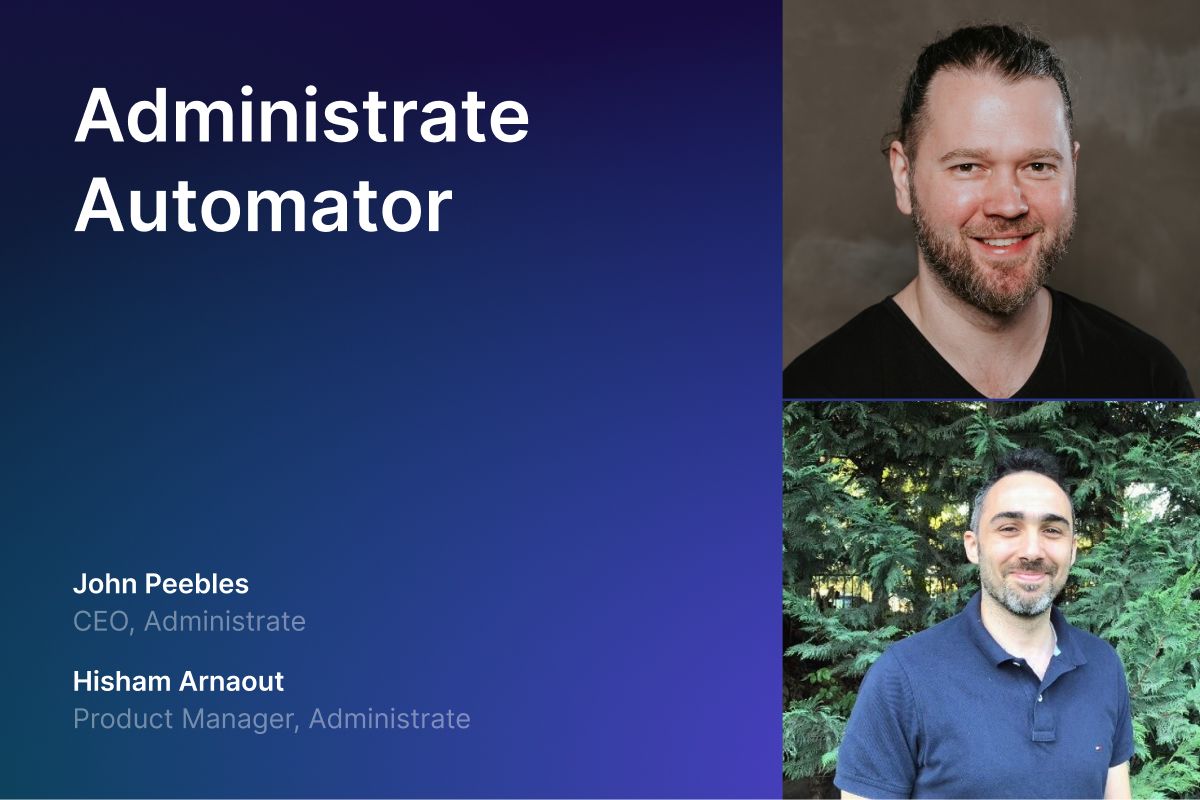
Administrate Automator: Deep Dive


Demo: See how Administrate Automator brings powerful automations to training, no IT resources or coding needed.
Top training teams are using a training management system, but they don’t replace an LMS. In this video we explore why they’re better together.
What is a training management system? A training management system is not a replacement for an LMS, it works with your LMS, to automate the complex, critical training operations you can’t afford to get wrong.
In this video, we join John Leh of Talented Learning to discuss why top enterprise teams are using a training management system as a central pillar of their learning technology.
58:21 watch · 10,671-word transcript
Auto-generated transcript — may contain errors. Tap a timestamp to jump the video.
Alright. Welcome, everybody, to another LinkedIn live presented by administrate. My name is John, and I am delighted to be joining you today from our intergalactic headquarters here in Edinburgh, the beautiful capital of Scotland. And today, we've got a special guest who I'll introduce in just a minute. But the topic is one that we are obviously very passionate about here in administrate, which is the case for a TMS. And what is a TMS? That's a training management system. So today, I'm joined live all the way from his intergalactic headquarters, I guess, in, Pennsylvania. John Lay, and is, is an analyst. He's been following the LMS space in particular for a long time, but it's not just LMS. This is is the broader learning technology landscape.
And I've known him for, I don't know, at least ten years now and, always been impressed by the quality of his writing and analysis and just his tabs on the market in general and all the things that are kind of moving and shaking within within the industry. So, before we get maybe totally into the topic, John, it would just be great if you could introduce yourself, explain a little bit about your background, maybe even before you're an analyst, and kinda what you do today, and and what drives you. Alright. Well, thanks for having me. This is great. One of my favorite topics, training management system, learning systems in general. I'm John Lay. I'm the founder and CEO of Talented Learning. We're now in our eleventh year. My story story started, almost thirty years ago.
I got a master's degree in instructional technology and started out by creating content, and I fell into LMSs. And I spent the next fourteen years as an enterprise sales guy and then VP of marketing sales, for two different major providers. But during all that time, I developed a specialty on the business of learning, less about compliance and training completions and start rates and completion rates and more about moving the business needle of how learning and strategic learning, could actually change a business and make a competitive differentiation in a business by training customers and partners and thinking about learning as a strategic pool. And during those fourteen years, nobody was talking about that, except customers, but none of the the analysts, in the industry were were talking about that.
It was all integrated performance and talent management. And so I thought, why not me? And so eleven years ago, I I created Talented Learning. What we do in the industry is we are an independent neutral voice that studies the different learning solutions, the use cases that are out there. We review, almost a couple hundred, learning systems every single year, and we compile all that data, and we share it freely on Talented Learning dot com to help buyers, to help practitioners, learning system practitioners, and to help sellers all get a view of the market. And the reason we do that is that the market's complex. There's over a thousand different learning solutions in there. Some of them are training management systems. Most of them aren't. And, it's really confusing for buyers, sellers, and practitioners to try to make heads or tails of it, and that's what we try to do at Talented Learning.
Yeah. And I think there's two points that I would add to your intro, John. And the first is, you know, you always seem like a nice guy, and I enjoyed what you wrote. But more importantly, what we found was our customers really listened to you and pointed out and agreed with you that on on the analysis that you put out there. And so it's kind of through that lens, our customers are constantly mentioning you and and, you know, what what you're talking about, what you're writing, and and really trust was was developed very quickly, as you got started. And the second thing around that independence, I think, you know, despite me trying to to get you to write everything that I wanted you to write about us and all this stuff, I think the only thing we ever convinced you to do was to to the first year, Anoint Us as the best learning product out of Scotland, which I think at the time was the only we were the only learning product out of, Scotland and your in your database.
But, yeah. So, fantastic fantastic resource. I read, almost everything that John writes, time permitting. And, it's just a real it's it's a real delight to have you on the the show today. And, it's also really good when everything works out of the bat, which, our team tells us that is that is happening as well. So That's great. It was two thousand fifteen, John, at, ATD in in Washington DC. That's when we met. Yeah. That's That's so weird. Seems like a long time ago, but also not And that's when I award you the best learning system in in Scotland as a result of that meeting. So, you know, he can be bought, but only, you know, very, very slim Yeah. Cases. So we've got a bunch of stuff that, we thought we could talk through today and who knows how long we'll we'll go.
And if you're listening, don't worry because what we do is we take these live broadcast. We lightly edit them and chop them up and put them on our website. And so, you know, if you've got to run out for a meeting or, you know, want another cup of coffee, don't worry. You'll be able to to follow-up on this, after the live broadcast. But maybe we could start before we dive into the topic of training management systems, really just quickly distill down why learning management systems and why they're great at what they do and what, you know, what is it? What is their use case? Because we're gonna probably wanna spend a decent amount of time contrasting what a TMS is from an LMS. And, you know, there's always a little bit of overlap. But in general, what what is what is an LMS great at, John? Mhmm. Yeah. It's, it's somewhat of a confusing topic, and it doesn't need to be.
But the reason that it's confusing is that, learning management systems and training management systems both have something to do with corporate training. You know, both have managed different aspects of training. Both have sometimes overlapping functionalities. Both have analytics. Both focus on integrations. And, you know, those type of overlaps make, LMS providers, practitioners, and TMS providers kinda foggy on, you know, what's the difference be between these these two applications. But there's a huge difference, and we're not splitting hairs. And so a learning management system, the best way to think about it is that's for the learner. So a learning management system is for the learner. It's where they access all the learning that they would need, either assigned to them or voluntarily based on their job, their role, their position, their location, anything.
And that learning is tailored and adaptive, hopefully, and personalized, to them. And so that learning management system then manages all the digital content to get to that learner. And that could be things like online courses or, you know, putting those online courses into a path or a training plan or a curriculum. Or it could be like reading documents or visiting websites or downloading a PowerPoint or listening to an audio, file or watching a video. All those digital assets are maintained inside a learning management system. And a learning management system is smart because what it does is it makes the connections between all of that content and the learners. And what that allows an organization to do is scale, create learning once, and roll it out to lots and lots of people around the world and really drive down the cost of delivery, but more importantly, enable the the skill development of employees, customers, partners, the extended enterprise at a more rapid level.
But generally, not all the time, but generally, it's really focused towards the electronic content. Where some of the confusion comes, John and listeners is during the pandemic, there was a rush for learning management systems to support virtual training and virtual live training. And so lots of learning management systems develop very thin capability to, you know, set up an event or a, you know, a one time class that seems like it's instructor led capability. And it is, but it's really, really thin. Because, generally, the ninety percent lifting is is with electronic content in a learning management system. Right. And it's safe to say that a hundred percent roughly of the organizations and folks that'd be listening in today probably have an LMS of some form already in place.
In fact, many of our customers, if they're large companies, they will have maybe two or three, four, sometimes more than that, learning management systems because we're pretty much at full penetration in market terms of of that toolset. Mhmm. Yeah. That that's right. An LMS doesn't necessarily have to come first, but it usually does inside an organization. That's typically the lower hanging fruit. And then a TMS, as we'll talk about today, is is really for a a subsection of organizations that have very specific need, that we'll talk around live instructor led training and all the complexity and hairiness that goes with that. And, if you have that, you'll recognize yourself as we continue to to describe that situation. Right. And and, you know, ten years ago, that was kind of we were administrate was when we first met.
We're at the beginning stages of trying to solve this gap that we believed existed. And we it wasn't just that we were smart or super attuned to the market or anything like that. It was the software that became administrate had actually become but been been worn within a training company. And a training company that specialized in synchronous live classroom training. Sometimes it was virtual, but often it was in a in a classroom. And they couldn't find software that they needed to to help manage all of that complexity. And so they started building some stuff and cobbling together things, and then that's how the ministry was born. And this has been a, you know, a decade long journey, over a decade long journey because this problem is complicated and and difficult to solve, particularly at scale.
And that problem effectively is how do you get tens of thousands of students through thousands of classes all around the world if you're multinational and do it in a way that is automated and doesn't make people wanna tear their hair out. Right? Well, if you could have picked a more glamorous profession, John, I I wouldn't know what it is. Yeah. Well, you know, my father ran a training company out in Asia, and my mother was a teacher. And, you know, I taught I taught English, to make money out there and, you know, had a had a bit of a front row seat in that. But, actually, my my previous company, before administrate, training fell underneath my remit. And we had a bunch of partners and customers and employees to train, and often it needed to be done in a classroom for a whole bunch of reasons.
And, that mess and that kind of pain that I experienced was was something that I kind of, was was really attuned to. And so, you know, that was the starting point of, hey. We need to to figure out what does a solution look like that could take away that pain, and really, just just help folks get off spreadsheets and whiteboards and dry erase markers and things like that. Mhmm. And it turns out that pain is is all unrealized ROI. And that's where this conversation always comes back to with John and I, is that by automating, by by solving this, you can unlock huge reserves of ROI inside your training organization that a lot of training organizations don't realize.
They're just burning. Just burning that ROI without ever realizing it. And, and so that's why I'm always excited about learning operations, training management systems in general because every other aspect of a business, every aspect, every function has been a hundred percent automated, by twenty twenty four. But for some reason, the complexities of training have remained outside that outside that realm, and it's due. It's time because there's no sense burning ROI or not realizing it because it's not just the money. It's the the nimbleness of your organization, your ability to go to market. Your your strategic competitiveness are all part of that same ROI, factor that we're gonna continue to talk about today. Yeah. So, you know, one of the questions I always get is why does this matter?
Right? And we we sometimes get it from investors. We sometimes get it from skeptical prospects who are trying to help our champion, you know, convince their boss or the CFO or whatever. And, you know, there's a there's a couple of points that we tend to to make, which is the first is there's more classroom training out there than than people realize. And depending on the publication, the survey, and the date, and whatever, anywhere between sixty to eighty percent of training in corporate America is done in in some form of classroom. Now that doesn't necessarily need to be a physical classroom, and it doesn't need to be all of the training is done in a classroom. You can chop it up and, you know, mix any learning and labs and so forth like that. But it's a it's a huge amount of training.
And, you know, there's entire if you think about there's entire industries around, you know, stuff like oil and gas or transport or manufacturing. You know, you need to be trained in a hands on environment that is, you know, the difference between maybe life or death unfortunately and safety is really important or, you know, just just making sure that you know how to, you know, spray paint the the thing in in the right way. So there's there's a lot of training being done in the classroom and of that training, most importantly, is a lot of the high value training is still done in a classroom today. And we see this over and over again which is if you really wanna make sure somebody knows how to do their job or you wanna make sure that they're highly competent, whatever it is that you wanna do, you might start with e learning and make sure that they go through that.
But you're gonna want hands on training that is being looked at or supervised by an instructor in a classroom environment and probably want the advantage of being able to to bounce progress and ideas off peers and so forth. So You know, I mentioned earlier, John, that LMS is because of the pandemic, you know, started tiptoeing or rushing, I guess, into, you know, supporting, the thinner scenarios of, instructor led management, instructor led, training in general generally from a virtual basis. Take us from what that funk what that is to what a TMS solves. Like, how is that thin not sufficient? Like, what is what is complex look like? What's the other side of the equation look like? Yeah. So it's it's a great point because during the pandemic, actually, a lot of people came up to us and said, man, you guys must be, you know, rocking and rolling here because all of a sudden, you know, all this classroom training needs to go online.
It was kinda like, well, sort of. Right? Because the reality was a lot of people just went to Band Aids very quickly. Right? And and I'm not being pejorative. It's just it was the reality. We're all Band Aiding all kinds of things, you know, all over the place. Sure. And, and so I I think the main difference is that we've all, you know, set up a meeting with colleagues or we've all said, hey. Let's jump into this Zoom room and and figure out how to do this together. I'll show you how to to do an aspect of your job and that kind of ad hoc nature. Even if it's scheduled next week, that's fine. The reason why this is thin and I like the use of that term a lot is that the the weird thing about classroom training when you're talking to folks who are used to an elearning context is that elearning is kind of you spend all this time and you design out this great this great content and SCORM and documents or whatever and you bundle it up and you put it out there.
And then once you do that, you're you're effectively more or less done. You might update it every month or quarter or something along those lines but, it's it's a bit of fire and forget. You put it on the shelf and people can take it off the shelf and use it and put it back on the shelf and so forth. Where classroom training is different is because of the very nature of you need to get different people together in probably different places at different times for different reasons, that are then either monitored or instructed by, again, a different group of people. That is kind of like planning your extended family's vacation every week. Right? Over and over again, which is, you you just you need to be able to slot in all these different groups of people and places and things to a framework that just doesn't exist with with this thin kind of ability of, yes, I can smash out a Zoom invite and make sure that everybody knows it's, you know, three PM next week.
But all of the other things and corralling all the people and making sure that we're all there and and so forth is a very, very difficult and time consuming task. And if you can just imagine, forget even your extended family because at least there you probably know who your extended family is. In a training context, that might involve going out to various managers and saying who is ready to take this training or checking calendar after calendar after calendar for both students and instructors and even meeting rooms. And already, I'm getting fatigued just going through. And actually, all of the various things that need to be done, just just spelling them out verbally like this takes four or five minutes. Right? But that that multiply that and it can be a multi hour long, you know, dance to get all this stuff, lined up and ready to go.
And that's just one class. And then once you have taught that class or that class is finished, you you gotta do it all over again for the very next class even if it's the same topic. And and so this that is where the real, pain and and, complexity comes into play. And that's that's the problem that a TMS uniquely is designed to solve. Mhmm. Well, let me pile on. So what if that class then isn't in one class, but it's actually comprised of fourteen different sessions over a six month period? Some of the locations live, some of them virtual. Yeah. We do that. It And then you run that same fourteen part series fifteen times a year. Yeah. And, I mean, even silly little things like, let's say we've got it all nailed and we finally get it and everybody's everybody's registered and we all know what we're doing.
Things like, you know, whoops, there one of those sessions fell on Thanksgiving Day. You know, that that can happen. And it's something you don't think about necessarily as you're going through and and adjusting this. Or, you know, there's a there's some national holiday in some market that you're not intimately familiar with because you're in the United States and you're you're assisting somebody out in the Far East. All of this stuff just that the permutations start to compot you just compound and compound and compound and it becomes very overwhelming. And the the the solution is that folks tend to start throwing more and more bodies at it, more and more spreadsheets at it, and just working really, really hard to get this right. And that's the other kind of the the frustrating and almost sorrowful thing is that when that complex, you know, or that complex system doesn't go right, people are really annoyed because they're showing up at the wrong place or they're getting the wrong meal or, you know, the instructor has been assigned to teach something.
They have no idea what it is. And so these types of human interactions can become very frustrating, almost like, you know, dealing with, maybe an agent at the airport when your flight's been canceled. That that's the type of feeling and emotion that gets evoked when this stuff doesn't go right. And you've got training coordinators and schedulers that are in the firing lines, from all sides. And, it it's just not it's not comfortable. You know? Mhmm. Mhmm. So paint us the the other side of the the the picture, John. What is, what are some what's the the hairiest scenario that you've ever encountered in terms of, you know, instructor led training? Like, what what's it look like when you've really got a problem? Yeah. So we like, just on my desk this morning, we've got a prospect. They're a large financial institution, and they sign up banks.
Actually, they're a they're a financial trainer that has, financial institutions of customers, and they sign up banks that will have a six month training program for a variety of of products. And, you know, there's a few hundred people that need to go through this, and it's something like, you know, it's multiple dozens of e learning pieces of content. It's, you know, classrooms interspersed here and there. And and that's a complicated scenario. Right? But that's more or less, I would say straightforward. Right? Which is we know the pattern. We know who needs to do, you know, what by when. And we can feed all that in the TMS, and then it becomes a template, which we can repeat over and over again. The real complexity starts to come in that we've seen over the years is now take that and translate into a multinational training operation.
A company that might be fortune one hundred, fortune fifty. We've got a customer that's fortune twenty. And they are trying to train, you know, sixty to seventy thousand people every year on basics like compliance and so forth, but also on things like how to do your job, how to sell these products that they have, and they've got hundreds of them, How to ingest and understand new products because they're acquiring companies about every week. And so you take all of these different training activities that need to happen, many of them in the classroom, and then you think about, well, the training team alone is over four hundred people, just to to deal with the the kind of management of all this. And you try to lay out a schedule over the next three to six to nine to twelve months, and that's where it just becomes mind melting.
And so that's where the complexity really starts to pile up because now you've got all the permutations inherent in one specific course, and then you multiply that out all across the calendar, all across the globe. And so that scheduling piece is is something that, we're just beginning to to solve for customers. And we're really excited about some of the the stuff we've had that come up that's come out on that front. But, you know, it gets to these kind of four pillars, which are a TMS really should help help plan, should help folks schedule, actually concrete a plan into, a schedule that can be trusted and and understood, help resolve issues when they come up and and communicate as well. And so those are kind of the four things that that we think about.
And actually, it looks like we're getting some questions in from folks that are tuning in live. So, if I might segue for just a second. We got a great question from Kristen, which is, does the TMS integrate with an LMS and should it? So maybe I'll kick that one to you, John, and, you know, that's right in your wheelhouse. For sure. GMS integrates with everything. That's the whole point. Scheduling systems, HRIS, CRMs, LMS, Everything needs to be sharing data back and forth seamlessly in in a in a true ecosystem for the business of learning. That's right. And a lot of those systems might be unusual when you think about a learning product integrating with stuff. But if you think about it, we've talked a lot about calendars and making sure that folks don't have to scroll through thirty different Outlook calendars.
Just just syncing a calendar with the TMS is such a crucial feature that, you know, saves hundreds of hours of time, you know, very, very quickly. So and, here's another great question from Bruce, which is what is the threshold of complexity at which a training management system is preferable over a learning management system? Wow. Bruce, he took that question right out of my list. And I'll I'll I'll take a quick stab at this. Right? And that is, I don't think these systems are mutually exclusive. Right? And I don't think we should be looking at them as either or. Now in the that that's an evolution of of thinking for sure. If you'd asked me ten ten years ago, I probably would have said, you know, you could probably get by with one or the other and depending on the context.
But we're talking about larger complex training environments, which, most people are in today. I I really think it comes down to let get the right system to play to the right strengths in the areas that you care about. And so, we tend to see, like, all of our customers have learning management system. That's normal. Many of them have multiple. And so, picking picking and choosing the the right tool for the right job, I think is important. And our kind of threshold tends to be if you're if you're running a hundred plus classroom, training events each month, you're probably at the point where somebody in your organization is dying, and and would really appreciate some relief. It could be less than that.
It could be, slightly more than that depending. But, yeah, that that's my quick answer to that, John. I don't know what your thoughts are. I think just from a matter of of ROI perspective, if you think about full time bodies or full time professionals that are helping with administration. So if you've got three, four, or five, twenty of them, you need a TMS. I mean, you should have none. One, two, you know, you know, a small handful, even for a huge training organization. So if you're plugging holes, right now with with people designed to copy and paste and schedule and and work with the spreadsheets, then you already have the ROI business case to to to buy the training management system and automate all that. Yeah. I mean, about a year or so ago, I think I came up with this idea and I was like, marketing folks.
I was like, we need to talk about how a training management system can arrest the coefficient of scale. And everybody's like, what does that mean? And I was like, it's super simple. Right? It's back to physics. You have the coefficient of friction, all that stuff, and they're like, no. We're not gonna listen to you. But I'm gonna say it today because, you know, this is our event, and marketing's not here. But what we mean by that is if you need more bodies to deliver more classroom training, that's a problem. And and the literature is really clear on this, which is, larger companies actually do worse at this, than than medium size or smaller companies. And that is the the the fact that they need to add incremental people to deliver incremental training is a huge burden and problem.
And, what what we want to see from our customers is that, you know, fairly typical story, now Ping Identity, a customer of ours for many years. They were able to ten and one hundred x their business. And actually, we had a great interview with Kevin who's the, the gentleman over there. They started off with three or four people on their training team and then hundred x'd their revenue and throughput and so forth, and they had about four or five people ten years later. And that's kinda what you wanna see when when you think about, whether a TMS has been effective for you. And that's the ROI that you're talking about. Sure. Each each person is, what, eighty to a hundred thousand dollars loaded, when you consider everything. And so, you know, that that pays for a lot of automation for sure Yeah.
To be able to do that. Hey. Let's double back. You said the four pillars, were, plan, schedule, you know, communicate, and resolve. Why don't we go through them? Tell me about plan. What what what's that mean? Yeah. So, planning for us really revolves around that idea of okay. We understand. And and the analogy that we use sometimes is, you know, you think back to the periodic table of elements and, like, I was preparing we had our customer conference John's got a scientific flair. Well, you know, I we we had our we had our customer conference here in Edinburgh, back in May, and I was preparing this talk, to little intro remarks. And I was like, you know, this periodic table of elements, that'd be a great metaphor.
And I I looked it up because I wanted a picture of one. Right? And I pull it up, and I was like, man. I was like, this is a lot bigger than I remember from when I was in middle school and high school. And, you know, we've since discovered, like, fifteen or sixteen elements since late nineties. So, you know, it's one of those things where you're like, wow, you're getting old. But, you know, you've if you've got all these elements of what it takes to run a class, and, you know, you we we talk about distilling those elements into a template, and then it becomes a much easier exercise to lay out and the template will guide you and help you through the scheduling, operation. But if you if you've got all of that, then assembling a plan for what you wanna do over the next three, six, nine, twelve months is really, really important.
And it's important for a lot of reasons. It's important for demand planning. It's important for understanding your business objectives and how the training team is gonna help meet them. It's important to make sure that you've got the right resources available, and that you don't have any constraints that are maybe slowing you down. And so getting that plan put in place, unfortunately, today tends to look like some poor team, four, five, six, maybe dozen people lock themselves away in a room. They have a spreadsheet that they put up on a big TV if they're lucky. And if not, they're on small monitors. And they start playing this game of Tetris of, like, fitting all this, you know, these training classes together.
And often, they'll just start from last year or last quarter or last six months, and they'll just copy and paste what they did before, and they'll they'll use that as a starting point. And again, like, we're not being, pejorative and we're not saying that this is stupid or anything. It's it's what people have. Right? It's it's it's what I would do, if I didn't have any any other alternative. And, you know, that that becomes a very laborious and time consuming and painful process because what happens is just getting the Tetris, you know, game to fit together is, you know, maybe goal number one. But then you've gotta go out and say, hey. Okay. John, you're scheduled to teach this. And, Bob, you're scheduled to teach that. And, Tom, you know, whatever. And you you disseminate this draft plan, and you start getting all the comments back.
And people are like, well, you know, I forgot to put in my vacation days and all this stuff. And so it's that that planning operation is is something that we have seen teams can take up to a month, every year, or sometimes even a few weeks per quarter to get that plan put in place. And then it's still not necessarily the most optimized thing, but that, you know, we're just trying to to keep our head above water and get this thing out on time. So how's the TMS plan it then? Yeah. So through that. So, basically, when we think about what a TMS can do is because the TMS can understand, okay, this is what is required to run these classes. And and one of the features that we've talked about in-depth and we just just did a LinkedIn live a couple of weeks ago, and it's out on our website right now is this new feature of ours that we've called the scheduler.
And it's it's a new feature for us in that we're talking about it publicly, but we've been working on this for, like, three or four years. And it's it's been a big lift. But what it effectively does is you can say, look, I wanna run these four or five hundred classes. And, you know, I I have these resources that are in play for this particular plan. And then it runs a several thousand solutions per second, including some AI, to fit the the Tetris pieces all in a way that makes sense and also is optimized to a degree. You know, trying to make sure that, let's say, all the instructor load is fair, for example. And that is something that, you know, a computer can do very well, and then it it comes up with a solution, and then you can start tweaking it around the edges.
And, you know, you're talking within a couple of minutes, getting a solution that may have taken you weeks or months, previously. And it's a real it's one of those moments where, you work really hard at something. Our team has been working really hard about on this, and then they see it in in practice. And it's it's very satisfying. And so I'm really proud of the work that our team has done. And also, it's been fantastic getting input from customers on on how we can we can make that better. But that's just the starting point of where we wanna go. So that's kinda how we think about in terms of planning and how a team has can solve that for folks. Wow. Cool. Cool. And you you mentioned before, but now's a good time to reinforce it. Now you layer on the calendar aspects of that. So not having to ask five hundred instructors what their vacation schedule is, not having to, you know, look in different places, different spreadsheets on what rooms, what buildings, what flight simulators, what tractors Yes.
You know, need to be in the classroom. You know, having all those things just automatically scheduled and, you know, have an AI think about that without having to check all those different places and recheck them. And, you know, even in my daily life right now, I'm trying to schedule back and forth from the email that says these times are open. And then I go back to my calendar and I'm looking to, you know, even doing that is, is complex, you know, with, with just a handful of people. And so just automating all of that you know, and saving, you know, all those months. And if you put those twenty people in a room, John, and, you know, those twenty people are are smart. They're professionals. They've got a you know, they're earning great salaries and doing all that. It's a huge investment every quarter, you know, to to do that unnecessarily. And and it goes right back to that mind and ROI. That's what we're talking about.
That's and and it's not just the time of that team either. It's the it's the business impact of, like, if you are rolling out a new product and service to your global Salesforce and they have to learn about that, That window of validity of competitiveness of that new product and services is finite until the competition catches on or one ups. And so if you can shave that time down from four months to two months or from two months to one month that your team globally is operational and ready to hit the ground running to sell a new product or service, that has a huge impact of, you know, in the revenue of an organization, especially a large organization. Thinking about that side of the equation, that go to market side is is more valuable than the saving of the money side, in my opinion.
Yeah. And if you think about it, what let let's say we've bought a company yesterday, and we wanna get our five hundred salespeople up and running and trained on this new product that we're really excited about, what are the barriers to decreasing that that time to readiness, right, for my Salesforce? Well, it's it's not just finding the the time of day in order to schedule these classes. Although, you know, that that is a starting point. It's it's the constraints that you will have along the way in order to achieve that. So, you know, I can't I can't put all five hundred people. I can't all train them tomorrow because I don't probably I don't probably have a hundred classrooms, and I probably don't have two hundred instructors that can assist with that. And I don't have the fifty lab rooms that I need in order to to set up the environments to train them on.
And and so that's another cool thing is that when you've got a planning canvas that that shows you, here's what it looks like and what this plan and then if you say, well, I wanna I wanna decrease that time to effectiveness, it'll start, you know, really bubbling up. Here's the the the the rough points, the the resources that I'm missing or the the reasons why I can't do that, and then that lets me make a business decision. Right? I can either go out and recruit more instructors or, you know, get some temporary classrooms or rent a hotel over there. And, you know, all of that stuff becomes in play whereas before it'd be very difficult to, visualize that. So one good one really good question that just came in, from Kathleen is, are some LMSs better equipped to work hand in hand with the TMS, or does it matter?
Yeah. For sure. For sure. It would be the the same type of LMSs that would be able to service an organization of that size and scale and global nature. So you would be looking at your better LMS is are more used to and more attuned to working with a TMS and having a TMS augment them. If you go to the other side of the spectrum, small and medium size, where a lot of the learning management providers are playing in the bottom half of the market, in, in, in volume, you'll find that they probably don't know what a TMS is, and it's not important to them. Them. Yeah. And so, you know, today, for example, we've got out of the box integrations with the folks at Thought Industries, with the folks at Docebo. But really, these LMS integrations, even if it's not out of the box, they're they're all pretty standard in terms of the data that's being shifted back and forth.
And so it's, it's usually a a fairly straightforward process. And, you know, we we've we've managed to make it work no matter what. Kind of the Jurassic Park philosophy of life finds a way, administrate will find a way to integrate with your with your LMS. That's kinda one of the things that we we talk about with We get it done. Aspects. Yeah. Get it done. One of the things that, is one of your pillar, but we haven't talked about it yet today, John. It is so now you you go to these complex scenarios we're talking about. Tell us about the communication challenges. Yeah. So communication,
I used to know a guy that would say, communication permits progress. Right? And I think that's pretty true with training as well. Communication is super important within a TMS environment within a classroom context because as we mentioned before, it's not just me deciding when and where to log in. You know, I'm on the bus or I'm at, you know, my place at night or my desk in the morning to log into my learning management system and and the content that's there waiting for me. I need to know where to go, when, and so forth. And I need very clear instructions on how to get there. And it can be even simple things like I, you know, I know I need to fly over to the city or take the train or whatever. But when I get there, where am I staying?
And and where do I park? And how do I, you know, what how do I am I gonna be fed that day? And and all these all these things. And this stuff's really important not only to make sure that things go well and the training is is well received, but it actually, the administrative kind of, surroundings of the training. Studies have shown that actually that is one of the biggest contributors to the perception of quality that students have when they're taking a class. You know, yes, they'll love the teacher and they'll love the content, but if they get the wrong meal or they don't know where they were supposed to go, that that's a it's a huge negative, for for a student. So when we talk about communication, we think in terms of, you know, emails, SMSs or text messages that go out, and even things like calendar invites and so forth, and and all the documents that need to be shared and and so forth.
Sometimes we have customers that are doing things like they need to make sure that folks have visa letters in order to to enter our country to to take a training and so forth. And our philosophy, and I think this is what we strongly advocate for, is that communications should be very personalized, highly automated, and it should be very obvious if there's a problem with that communication. And so that's where you'll see within a TMS is you'll hopefully be able to template a whole bunch of stuff, make it very personalized, make sure that it's it's automated so you should not have to think about what emails do I need to send this week or anything like that. And instead, the TMS should just be guiding you into, hey, you sent out forty two thousand emails this month and but this week, you had three or four that bounced or, you know, there was, some sort of problem delivering that email.
And and, again, if you make a change or, you know, schedule adjustment, which will happen often despite the best laid plans, you want them to know that that calendar update is going out and they're getting a new iCal attachment and so forth, and it's just all very clear. Where, you know, in the past, you know, when when this is, you know we never have bugs today, but in the past when we had a bug or two, you know, and and people might show up at the wrong place at the wrong time, that's a that's a that's not a good thing to happen. And so there's there's real people and real things that need need to be lined up, and that's what the TMS is designed to help you do. Mhmm. Mhmm. You know, listeners, you might be thinking, well, jeez, I've got the same kind of stuff in the LMS.
And this is one of the areas where there's a a crossover. But think about it like this. An LMS has standard automated messages that you can turn on or off. Like, you've been registered, or you registered, or you completed it, or you haven't completed it. Or, you know, these different triggers cause an email to be sent. And it's kinda cross courses or cross content where a TMS really gets special, in my opinion, is you can set it up for the event. So if we go back to my example of a fourteen, you know, session, class over a six month period, you could set up all the the communications all the way in between all of those. All the just offset by a day. Five days after this thing ends, send this email. And to set that whole path up, that path might be a hundred different communications over six months and have it all templated out so that it's all pulling from the fields and it's all personalized and it looks like it's super personalized to the end year learner.
And then when you schedule that class for January and for the six months out and then for February the six months out, all those emails are already there. You never forget one of them. They're all part of that process. And that alone is, you know, as a guy that runs around pulling my hair out with email, I mean, just being able to to guarantee and go to sleep at night knowing that you're not dropping the ball on, you know, on these necessary communications because you're coming back from vacation or you're entering into the, you know, the annual meeting or something like that. You know, just that part alone, I think, gets glossed over on how important that is from an ROI and from a customer satisfaction, learner satisfaction standpoint. Yeah. One hundred percent. I mean, it it can get very complicated in a good way, I e, you know, you're doing a lot more and you're not not worrying about it.
And, it it can be massively powerful. And I think that's probably a good segue into this other pillar, which is what we tend to refer to as resolve, you know, resolution to to problems. You know, we we we talk about this all the time. Right? Which is you you hit the button in your TMS and you get a great schedule and two minutes later and you tweak it for another hour or two, and then you're ready to go. And life's really good. And you go into the Christmas holidays and you're excited about the New Year and January one rolls around and that's a holiday. And then January two rolls around and that's a holiday in Scotland as well. And so then January three, finally the year starts. And, you know, right away, things start to go wrong as they always do.
Right? And, you know, a classroom gets flooded or, you know, an instructor is going on maternity leave or, you know, And it's kinda like, well, how do you deal with that? And how do you deal with that? And how do you deal with that? And how do you deal with that? And it's kinda like, well, how do you deal with that? And how do you, how does that get bubbled up to you in a way that is actionable and that you don't have to go hunt for it and so forth? And so that's where TMS really should be that, kind of traffic cop or that, you know, that surveillance drone, if you will, to get even more, dystopian around what's happening within your training environment, and bubble those things up to you and say, you know, kinda like, if I'm flying, hey.
This flight has been canceled or you're gonna miss your connection and we've rebooked you here and here's a couple other options. That's what we wanna see with the TMS to really assist folks. Because again, just because you got the schedule put out there, life's gonna happen and it's gonna get in the way and you're gonna have to react to things that that come up. And we want to make that really seamless and straightforward. Mhmm. How automated would would something like that be, John? So would, for example, if, I don't know, an instructor, you know, changes their calendar, you know, puts a you know, he goes on maternity leave or something like that. Does that bubble up then? They say, oh, well, John's supposed to teach these eighteen classes, and and that's how it bubbles up? Or you basically identify and say, John's the problem.
Show me all the places John's impacted or both. Yeah. So, great question. When when things are running well and you've got your instructor calendars fed in and you got your, you know, room calendars and so forth, you know, things will happen. John will need to go to an emergency dental appointment, you know, tomorrow. And, what happened or, you know, schedule a holiday on the wrong week because that that happens.
And what's what's awesome about this is when you've got that two way sync between the TMS and your instructor calendars, And there's some privacy settings on the way that we've implemented it where you don't necessarily need to be able to see everything. You just need to see for your busy. But that will bubble up on a dashboard and administrate, and it'll say, hey, you know, John has now got a conflict, whether it's the dentist or a holiday or something else. And it'll say here all the areas where where that is impacted, whether it's a class or, you know, something else. And then, actually, the the system will then suggest a suitable replacement for that instructor. And in one click, you can hit replace or if you wanna, you know, mess around with it yourself, it'll provide you a bunch of other options that that you can you can do to take care of that.
That's just one example. Right? There's there's a bunch of other things that we monitor proactively that, bubble up to to our dashboard. Things like fill rate. You know, if you're getting close to a class that's about to run, you can specify what is the fill rate you're comfortable with and you're targeting. We'll alert you to that. Is is a whole bunch of things and and it's it's just one of those, you know, really important. It sounds simple, but, when you're doing it at scale and and things, the variables are changing all over the place, it saves so much time and it just increases confidence and and helps peace of mind. And the other thing too is that, okay, you may have very specific business things, you know, requirements that that, are unique to you, that that we haven't contemplated yet.
And that's okay too. You can always build out reports to monitor various other metrics or things that might be happening. And, you know, you know, some of our customers, they have strict maintenance intervals in equipment. And they wanna know when this piece of equipment gets over, you know, hundred hours of usage in a in a given month, and they they need to take it offline and do do some, you know, recalibration or whatever. You can build out those reports, and then those reports can bubble those things up to you as well. So there's a bunch of different ways you can kind of think about being proactive and on that resolution of issues. Mhmm. Mhmm. Is the LMS or the TMS the the final system of record? So, yeah, it's a great question. And, you know, the the the answer, like all complicated topics, is it depends.
Right? It depends. However, what we have seen work really well is that most organizations, they've got their e learning stuff more or less taken care of and it's it's dialed in. And maybe it's not, but, you know, the the e learning stuff is it tends to be under control, and customers are, you know, tend to be very happy with with how that's that's functioning. The reality is we don't wanna come in there and uproot everything and do tons and tons of change for the sake of change. And so the the rule of thumb tends to be, as long as you're happy with how the LMS is working and so forth, the LMS is the system of record in the in authoritative for that e learning content and and often other forms of digital content like you mentioned. And then the TMS will be authoritative in the system of record for the classroom training.
Now the the complexity and some of the decision customers are running. And, you know, again, it's kinda one of those things where if there is a classroom component, most LMS is just simply can't deal with classroom component, most LMSs just simply can't deal with the kind of day to day operational aspect of a classroom training, operation. But they will all happily accept, hey, this class has happened at this date and time, this location. And so that's where the TMS can drive an LMS. And even, you know, many, many of our customers, their their students, don't have any idea the administrate even exists. They've never logged into it. They've never heard of it. They don't know what it is. It's just the back office engine that's keeping the classroom stuff going, and the LMS is how that student interacts with the the TMS.
Mhmm. Yeah. You would hope they would never know about you. Yeah. For sure. Alright. Well, that's, that's great. I know what I wanted to ask you. So just for listeners, we we talked about the core use cases. So large scale training companies, global Fortune twenty, Fortune fifty hundred, type organizations. Who else has a TMS problem? I'd say any organization whose primary business is gonna be some sort of classroom training, you know, deliverable. So a training company, if you will. Now a lot of these training companies, they won't necessarily be hundreds of millions of dollars of revenue, but they could still be running lots and lots of classes, lot of complex
hybrid model, which most are, where they've got public classes that anybody can register onto. They've got, private training that they do for high value key clients. Those organizations are usually dying, for all the reasons that we talked about with a large multinational, but they just won't necessarily have the the revenue scale. And that's okay. And, you know, the any any even to find, like, training operations that are for profit within a larger organization. Mhmm. So, you know, we've seen customers where the the main business is some sort of conference business, but they have a a training arm that, that's for profit. So that that can also be of interest to them. And then the last category, and you see this a little bit less, is around universities with a kind of, you know, know, continuing professional education or adult learning or, you know, some sort of non degreed for profit arm, they will often need a TMS.
Now we've seen more and more, you know, those those customers tend to try to make things work with Blackboard and it's it's it can be political and difficult and whatever. So but, yeah, those are kind of the the three pieces. Training companies, a nondegreed for profit arm of some sort of higher education, you know, thing and then a large a large multinational. Awesome. Awesome. Any more, attendee questions? No. But I I thought it would be good just to touch on the ROI real quick, and we can bring this plane into, to to land. So, you know, ROI can be a bit of a, abstract thing. And I think for for years, even for us in our sales conversations, we would talk about time savings, time savings, time savings, and that's a lot of what we've talked about today.
And and all of that is valid. But, you know, when you get to the point where you're gonna take these hundreds or thousands or tens of thousands of hours of time saved and make the business case to your CFO or your, you know, whoever within the organization that needs to approve something, often the the answer could be, well, we've already hired the folks, and I can't spend time. Right? And so the the CFO, which, you know, sometimes can be the CF know, comes back with, well, I can't spend this time savings. Right? So, yeah, it's an ROI, but, you know, we've already sunk this cost, and these people are here and, you you know, why does this matter?
And and for, you know, a long time, this is one of those questions that was like, well, that's that's kinda tough to answer. But we had this hypothesis, which was, those people really should be doing other things. Not the not the highly important, but kind of lower value work of checking calendars and sending emails. And those people often have come through and been hired, like, me like you were originally, which is they were supposed to be instructional designers. They're supposed to be instructors full time. And instead, they have had a a significant portion of their day to day job has been co opted by this administrative burden. And so our our hypothesis was that the time that gets freed up then gets plowed back into making a better training product, doing a better job overall, updating those classes that need to be updated that that we haven't been able to get to for the last six months or embracing full throttle, you know, the new initiative where we bought this company.
We wanna make sure everybody gets trained super fast. And and so actually, growth becomes the second piece of that ROI where we wanna see the growth in training, you know, in terms of bodies being trained, but also the offerings being offered and so forth. And, and that was the hypothesis over the last three or four years. It's been really neat to see just by looking at our our own customers data that most of our customers within the first year at the minimum that they'll they'll, improve is about forty percent additional training classes, classes delivered and and people have gone through. And, and some of them are, like, three, four digits of of, you know, percentage growth. And, and then that holds true almost every year.
They continue to improve and so forth. And so I think, you know, just in terms of that ROI conversation, that can mean additional revenue. If you're selling your training, that can mean, significant business performance improvement. There's a whole bunch of much more hard metrics that you can tie against that that you can spend, that that we've that we now can be very confident in saying that this is the outcome you'll get in terms of ROI. So, you know, I don't know, John, if there's anything that that you have to add to that. But that's kinda how we think in terms of ROI now. Yeah. That's nice. The the two step process. And I think the third step that's out there, that is the holy grail, is then to to tie that to the actual, business improvement. So how much are you selling more?
How much did it impact the, the churn rate? How much did that impact revenue by having a bigger validity window, you know, with this new content that you're rolling out, our new product and service offering? So taking it to that next stage, and that's combining now the CRM and the the business ERP data with, the the training, data to to get to that analysis. That's where it's all going. And once it's a hundred percent there, then the question of whether you can afford a TMS is off the table at at that point. You know, it's it's it's a rounding error. You're absolutely right. Like, I can't tell you how many times we've spoken to people and they're like, we know this training is effective. We we hear it from our students, and they they can do their jobs better.
We hear it from their managers, and we we can see we know that this is moving the needle. But we don't have time to sit down and crunch the numbers and get all this stuff corralled and so forth. And and being able to free up that time to then be able to articulate that message means a whole bunch of great outputs. It means much more investment in a lot of times we'll see training budgets increase after, folks have brought in a TMS because now they can really put that money to good use. And we'll see folks get have career progression and and all kinds of really cool things. So, ROI just doesn't stop with the the time that's being saved that we've been talking about today. So Excellent. Alright, John. Well, we've been going on for almost an hour here. It's been we could probably go for another hour or two, but, we do this all the time.
Yeah. I I really appreciate your time and, really appreciate the folks that have been tuning in and, asking great questions and so forth. And, you know, if you want to dive in a little bit deeper on some of these topics, things like communications, things like scheduling and planning, things like, even just how how to sell your training and so forth. We got a bunch of videos out there, and we do these things most Tuesdays, at this time. And and, so yeah. I really appreciate your time, John. I know you're know you're busy, and, we'll let you get back there to to helping folks make better decisions on their on their learning tech purchases. So Alright. Well, thanks for having me on. It was a great conversation and, always always thrilled to to trade notes with you. Alright. Thanks, everybody.